
Gynecomastia Treatment: Top 3 Proven Solutions for 2025
Understanding Your Treatment Options for Gynecomastia
Gynecomastia treatment options range from observation to medical therapy to surgery, depending on severity, duration, and underlying causes. Here’s a quick overview of your options:
| Treatment Approach | Best For | Expected Results |
|---|---|---|
| Observation/Waiting | Pubertal cases, recent onset (<1 year) | 90% of teen cases resolve within 3 years |
| Medication | Recent onset (<6 months), tender tissue | Up to 80% show improvement with tamoxifen |
| Lifestyle Changes | Pseudogynecomastia (fat-based) | Weight loss may reduce appearance |
| Surgery | Persistent cases (>1 year), fibrous tissue | Permanent solution with highest satisfaction |
Living with enlarged male breast tissue can be both physically uncomfortable and emotionally challenging. Many men struggle silently with gynecomastia, a condition affecting up to 65% of men worldwide at some point in their lives. Whether you’re a teenager experiencing pubertal changes, an adult dealing with medication side effects, or someone who has lived with this condition for years, understanding your treatment options is the first step toward regaining confidence and comfort.
I’m Dr. Mark Anton, and after completing specialized breast fellowship training and performing thousands of successful gynecomastia treatment procedures over my 33-year career, I founded OC Breast Surgery to provide men with expert care and natural-looking results for this often misunderstood condition.
Know your gynecomastia treatment terms:
– gynecomastia treatment without surgery
– how to know if you have gyno
Gynecomastia Explained: Causes, Diagnosis, Differentials

At the heart of gynecomastia treatment lies understanding what’s actually happening in your body. Think of your hormones like a carefully balanced scale – when that balance tips, changes happen. For men experiencing gynecomastia, the scale tilts as estrogen activity increases relative to androgen (male hormone) activity. This hormonal shift can happen at various life stages and for numerous reasons.
What is Gynecomastia?
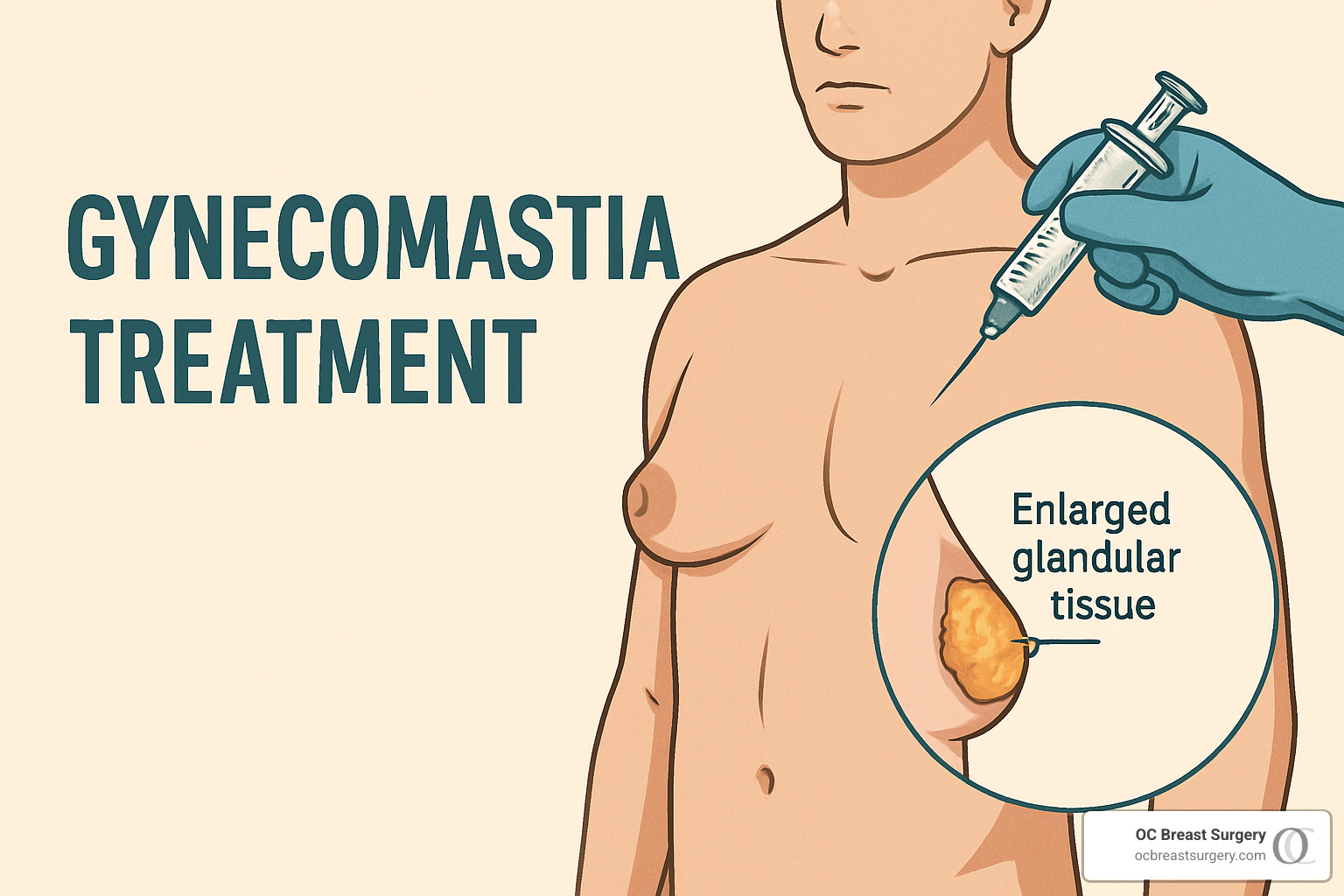
When I explain gynecomastia to my patients at OC Breast Surgery, I emphasize that we’re talking about actual glandular breast tissue – not just fat. True gynecomastia presents as a firm, rubbery disc of tissue directly beneath the nipple area. When you press on it, you’ll feel something distinctly different from the surrounding chest.
“But Dr. Anton, how can I tell if what I have is gynecomastia?” This is one of the most common questions I hear. During examination, I look for that characteristic tissue disc, which may be tender (especially in newer cases) and typically extends outward in a circular pattern from the nipple. The enlargement might affect one or both sides, sometimes unevenly.
We classify gynecomastia into grades based on severity:
– Grade I: Mild enlargement without excess skin
– Grade II: Moderate enlargement, still without excess skin
– Grade III: Moderate enlargement with some excess skin
– Grade IV: Significant enlargement with excess skin and feminization of the breast
Common Causes & Risk Factors
The hormonal seesaw that leads to gynecomastia treatment needs can tip for many reasons. Knowing the “why” often guides our approach to treatment.
Natural life stages frequently trigger gynecomastia. Surprisingly, up to 90% of newborn boys experience temporary breast enlargement due to exposure to mom’s hormones in the womb. During puberty, about 60% of adolescent boys develop some degree of breast tissue, typically peaking around age 14. Later in life, as testosterone naturally declines with age, 24-65% of men between 50-80 develop the condition.
Medications account for about 20% of cases I see. Common culprits include heart medications like spironolactone, hair loss treatments like finasteride, various psychiatric medications, and prostate treatments. Men undergoing prostate cancer therapy with anti-androgens face up to an 80% chance of developing gynecomastia. And yes, those bodybuilding supplements and anabolic steroids that promise muscle growth can ironically lead to breast tissue development too.
Lifestyle factors also play a role. Regular heavy alcohol consumption (especially when it leads to liver damage), marijuana use, and certain recreational drugs like heroin can disrupt your hormonal balance.
Medical conditions that affect hormone production or metabolism frequently cause gynecomastia. These include low testosterone (hypogonadism), thyroid issues, liver or kidney disease, and certain genetic conditions like Klinefelter syndrome. Obesity is another common factor – fat tissue actually converts testosterone into estrogen, creating a snowball effect.
At OC Breast Surgery in Newport Beach, our first step is always identifying these underlying causes, as addressing them often forms the foundation of effective gynecomastia treatment.
Differential Diagnosis: Pseudogynecomastia & Malignancy
Not all male breast enlargement is true gynecomastia, and making the correct distinction guides our treatment approach. We need to differentiate between three main possibilities:
| Feature | Gynecomastia | Pseudogynecomastia | Male Breast Cancer |
|---|---|---|---|
| Texture | Firm, rubbery disc | Soft, fatty tissue | Hard, irregular mass |
| Location | Centered under nipple | Throughout chest | Often eccentric, fixed |
| Tenderness | Often present in recent cases | Usually absent | Usually absent |
| Nipple changes | Rare | None | Possible retraction/discharge |
| Mobility | Mobile tissue | Mobile tissue | May be fixed to skin/chest wall |
| Risk factors | Hormonal, medications | Obesity | Age, family history, BRCA genes |
Pseudogynecomastia (sometimes called lipomastia) is simply fat accumulation in the chest area without actual breast gland development. It feels different – softer and more diffuse – and typically responds well to weight loss efforts, unlike true gynecomastia.
Male breast cancer, while rare (less than 1% of all breast cancers), requires prompt attention. Warning signs include a hard, irregular mass that’s often off-center from the nipple, possible nipple discharge or retraction, and skin changes. Men with family history of breast cancer or known BRCA gene mutations face higher risk.
To ensure accurate diagnosis, we employ several tools at OC Breast Surgery:
The physical exam remains our most important diagnostic tool. I personally examine each patient, feeling for the characteristic tissue differences that distinguish these conditions. For cases that aren’t straightforward, especially for men over 50 or with asymmetric enlargement, we may recommend a mammogram or ultrasound. Blood tests help us check hormone levels and rule out underlying medical conditions. In rare cases where cancer cannot be confidently ruled out, a small tissue biopsy provides definitive answers.
Precise diagnosis ensures you receive the most appropriate gynecomastia treatment for your specific situation, whether that’s addressing an underlying medical condition, considering medication changes, or discussing surgical options for long-standing cases.
Learn more about how to know if you have gyno
Choosing the Right Gynecomastia Treatment: Observation, Medical, Lifestyle

When it comes to addressing gynecomastia, there’s no one-size-fits-all approach. As I tell my patients at OC Breast Surgery, finding the right treatment path depends on your unique situation – your age, how long you’ve had the condition, its severity, what’s causing it, and importantly, how it’s affecting your daily life and confidence.
When Observation Is Enough
Sometimes, the best medicine is patience. For many of my younger patients experiencing pubertal gynecomastia, watchful waiting is often the wisest first step. We typically recommend this approach when:
You’re a teenager going through normal hormonal changes. The good news? About 90% of pubertal gynecomastia resolves on its own within 3 years without any intervention needed. Nature often takes care of things if we give it time.
For mild to moderate cases (Grade I or II) that have been present for less than 1-2 years, especially with minimal discomfort, observation makes good sense. During this period, we’ll schedule check-ups every 3-6 months to monitor any changes and ensure everything’s progressing normally.
Even for adults with recent-onset gynecomastia (less than 6 months), particularly when we’ve identified and addressed a reversible cause, watching and waiting can be the right call. This patient-centered approach avoids unnecessary treatments while keeping a careful eye on your condition.
Lifestyle & Preventive Steps
While lifestyle changes alone might not completely resolve true glandular gynecomastia, they can make a significant difference, especially for pseudogynecomastia (fat-based enlargement).
Weight management can substantially improve chest appearance since excess fat tissue actually converts testosterone to estrogen – creating a cycle that can worsen the condition. Many of my patients see noticeable improvements with healthy weight loss.
Resistance training deserves special attention. Building chest muscle through push-ups, bench presses, and chest flies can transform your upper body contour and create a more masculine chest appearance. Just remember – you can’t spot-reduce fat, but overall fitness helps tremendously.
Your diet matters too. I advise my patients to focus on hormone-friendly foods while limiting alcohol (which can disrupt liver function and hormone metabolism), highly processed foods, and excessive soy products that contain natural plant estrogens.
Don’t forget to review your medications with your primary physician. Many common medications can trigger or worsen gynecomastia, and sometimes simple adjustments can make a big difference. Similarly, recreational drugs like marijuana have strong links to gynecomastia and are best avoided.
First-Line Medical Gynecomastia Treatment
When observation isn’t enough but you’re not ready for surgery, medication can be an excellent middle ground, particularly for:
Recent cases (less than 6-12 months old) where the tissue hasn’t become fibrous
Painful or tender breast tissue that’s causing discomfort
Situations where we’ve identified a specific hormonal imbalance
Patients looking to avoid surgical intervention
The medications we most commonly recommend at OC Breast Surgery include:
Selective Estrogen Receptor Modulators (SERMs) like tamoxifen show impressive results – up to 80% of patients report partial to complete resolution. We typically prescribe 10-20 mg daily for 3-6 months. Alternatives like raloxifene and clomiphene can also be effective, with about half of patients on clomiphene achieving partial reduction and about 20% seeing complete resolution.
Aromatase inhibitors such as anastrozole work by blocking the conversion of testosterone to estrogen. These work particularly well when increased aromatase activity is driving your gynecomastia.
For pain management, simple non-steroidal anti-inflammatory drugs (NSAIDs) can provide welcome relief from tenderness while other treatments address the underlying cause.
I always remind my patients that these medications work best on recent cases. Once gynecomastia has been present for years and the tissue has become fibrous, medical therapy becomes less effective, and surgical options may provide better results.
Monitoring Response & Deciding Next Steps
When we start you on medication, we don’t just send you on your way. At OC Breast Surgery, we create a clear monitoring plan with regular follow-ups, typically at 3 and 6 months. During these visits, we’ll assess changes in breast size, check if tenderness has improved, evaluate any medication side effects, and most importantly, discuss how you’re feeling about your progress.
What happens next depends entirely on your response. If we see significant improvement (more than 50% reduction in size), we’ll likely continue the medication for the full recommended course, usually 3-6 months.
If you’re not seeing the results we hoped for after about 3 months, we’ll have an honest conversation about next steps. We might switch to a different medication, adjust your dosage, add complementary treatments, or begin discussing surgical options if that seems like the right path forward.
For many of my patients, medical therapy serves as a helpful bridge – managing symptoms while they consider their long-term options. While medications can work wonders for recent-onset cases, they rarely completely resolve longstanding gynecomastia.
At OC Breast Surgery, we’re committed to finding the approach that works best for your unique situation, whether that means observation, lifestyle changes, medication, or eventually, a surgical solution to help you feel confident and comfortable in your own skin.
Surgical Gynecomastia Treatment: Techniques, Risks, Outcomes
When you’ve tried non-surgical approaches without success, surgery offers a definitive solution for gynecomastia. At OC Breast Surgery, we understand this decision isn’t made lightly, which is why Dr. Anton specializes in advanced techniques that create natural-looking, permanent results that help men feel confident again.
You might be wondering if surgery is right for you. We typically recommend this path when:
– Your gynecomastia has stuck around for more than 1-2 years
– You experience physical discomfort or psychological distress from your condition
– Medical therapy hasn’t worked (or isn’t appropriate for your situation)
– Your breast tissue has become firm and fibrotic (resistant to medications)
– You’re looking for immediate and definitive correction
Gynecomastia Treatment Surgery Options
Every chest is unique, which is why we customize our surgical approach to your specific needs. Think of it like tailoring a suit – the best results come from techniques chosen specifically for your body.
For men with mostly fatty tissue (pseudogynecomastia), liposuction often works beautifully. This technique requires only small incisions, typically hidden in natural creases, resulting in minimal scarring and relatively quick recovery. We may use traditional, ultrasound-assisted, or power-assisted liposuction depending on your specific case.
When dealing with true gynecomastia with significant glandular tissue, glandular excision (subcutaneous mastectomy) becomes essential. This technique removes the firm breast tissue directly beneath the nipple through carefully placed incisions, usually around the areola where scars blend naturally.
Most commonly at OC Breast Surgery, we use a combined approach that addresses both fatty and glandular components. This comprehensive technique has the lowest complication rate (11.76%) compared to excision alone (30.64%) according to clinical studies, and provides the most complete contouring of the chest.
For younger patients particularly concerned about scarring, endoscopic techniques offer a minimally invasive approach. The innovative “pull-through” technique allows removal of glandular tissue through tiny incisions, with studies showing good to excellent cosmetic outcomes in over 90% of cases.
In severe cases with significant skin excess (Grade III or IV), skin reduction techniques may be necessary. While these approaches result in more visible scarring, they address the redundant skin that would otherwise create an unnatural appearance after tissue removal.
Risks & Complications to Discuss
Over coffee during your consultation, Dr. Anton will have an honest conversation about potential risks. While gynecomastia treatment surgery is generally safe, understanding the possible complications helps you make an informed decision.
The most common issues include hematoma (collection of blood) which occurs in up to 22.88% of surgical excisions, temporary numbness in the chest area, and minor contour irregularities. Less frequently, patients might experience seroma (fluid collection), infection, or asymmetry between sides.
More serious complications like nipple necrosis are extremely rare but important to understand. The need for revision surgery varies widely in medical literature, ranging from less than 1% to 25% depending on technique and severity.
Interestingly, complication rates differ by age – pediatric patients have a slightly higher 30-day surgical complication rate (3.9%) compared to adults (1.9%). At OC Breast Surgery, our complication rates fall significantly below these averages thanks to Dr. Anton’s three decades of specialized experience and meticulous attention to detail.
Recovery & Expected Results
“When can I get back to normal life?” This is one of the most common questions we hear, and fortunately, recovery follows a predictable timeline.
During your first week post-surgery, you’ll wear a compression garment 24/7 – think of it as a special undershirt that reduces swelling and supports healing. Most men experience mild to moderate discomfort that’s easily managed with prescribed medication. While you’ll need to limit arm movements initially, most patients return to desk work within 3-5 days.
As you move into weeks 1-3, you’ll continue wearing the compression garment (though often with reduced wearing time), and you’ll notice swelling and bruising beginning to fade. This is when you’ll gradually return to normal activities, though we’ll ask you to hold off on heavy lifting and intense workouts a bit longer.
By weeks 4-6, most men can return to full activities including exercise. This is when the final results begin to emerge as swelling completely resolves. Your scars will continue to improve for up to 12 months, becoming less noticeable with time.
The long-term results are what make this journey worthwhile: permanent reduction in breast tissue, a natural masculine chest contour, and the confidence that comes with feeling comfortable in your own body. Studies consistently show exceptionally high satisfaction rates following gynecomastia treatment surgery, with significant improvements in quality of life, body image, and self-confidence.
At OC Breast Surgery in Newport Beach, we’re with you every step of the way, providing comprehensive post-operative care and remaining available to address any concerns during your recovery. Many of our patients tell us they wish they’d done it sooner – the physical change often leads to a remarkable emotional change as well. Scientific research on surgical outcomes confirms what we see in our practice: this procedure can be truly life-changing.
Life After Treatment: Prognosis, Insurance, FAQs

The journey doesn’t end when your gynecomastia treatment concludes. In fact, for many of our patients at OC Breast Surgery, it’s just the beginning of a new chapter marked by improved confidence and quality of life. Let’s talk about what you can expect after treatment and how to maintain your results for years to come.
Quality of Life & Psychosocial Impact
“I finally feel comfortable in my own skin” is something we hear regularly from our patients after successful gynecomastia treatment. The psychological change is often as dramatic as the physical one.
Men who previously avoided swimming pools, beaches, or even intimate relationships because of embarrassment report profound improvements in their daily lives. Research backs this up – a notable 2018 study following 44 adolescents showed significant improvements in self-esteem scores after gynecomastia surgery compared to those who didn’t receive treatment.
Body image concerns don’t just disappear overnight, though. At OC Breast Surgery, we understand that healing happens both physically and emotionally. Many patients describe a gradual but powerful shift in self-perception, with increasing comfort in social situations and physical activities they once avoided.
The ripple effects extend into all areas of life – from renewed confidence in professional settings to improved intimate relationships. One patient recently told us, “I didn’t realize how much mental energy I was spending worrying about my chest until that worry was gone.”
Insurance & Clinical Guidelines
Navigating insurance coverage for gynecomastia treatment can sometimes feel like solving a puzzle. Coverage varies widely between providers, but we’ve helped hundreds of patients successfully work with their insurance companies.
Most insurers look for specific documentation to establish medical necessity. They typically want to see that your condition causes physical discomfort (like pain or skin irritation) or significant psychological distress. They’ll also want confirmation that you have true glandular gynecomastia rather than just excess fat tissue.
At OC Breast Surgery, we’re experts at preparing the proper documentation, including detailed clinical notes, appropriate photographs, and letters establishing medical necessity. Insurance typically requires the condition to be stable for at least 12 months and prefers Grade II or higher gynecomastia for coverage consideration.
For patients without insurance coverage or whose claims are denied, we offer transparent pricing and financing options. We believe everyone deserves to feel comfortable in their body, and we’ll work with you to find a solution that fits your situation.
Frequently Asked Questions about Gynecomastia Treatment
How long does gynecomastia treatment take to show results?
Patience is key, but the timeline varies based on your treatment path. If you’re a teenager under observation for pubertal gynecomastia, natural resolution typically takes 6 months to 3 years. With medication like tamoxifen, you might notice improvement within the first 1-3 months, with maximum benefit usually achieved around the 6-month mark.
Surgical results offer the most immediate satisfaction – you’ll see a dramatic improvement in chest contour right away, though final results emerge as swelling subsides over 3-6 months. As Dr. Anton often tells patients, “You’ll see about 70% of your result immediately, and the final 30% reveals itself as your body heals.”
Can medications completely cure gynecomastia?
Medications work best as an early intervention for recent-onset gynecomastia (less than 6-12 months old). They’re particularly effective when we can identify and address the underlying cause, like stopping a medication that triggered the condition.
Complete resolution occurs in about 20% of patients using clomiphene and up to 80% of those using tamoxifen for recent, tender gynecomastia. However, once the breast tissue becomes fibrotic (usually after a year), medications rarely provide complete resolution. This is why we often recommend surgical intervention for longstanding cases – it offers the most definitive solution with the highest satisfaction rates.
Will gynecomastia come back after surgery?
When performed correctly by an experienced surgeon like Dr. Anton, gynecomastia surgery provides permanent results for the vast majority of patients. The glandular tissue removed doesn’t grow back. However, there are a few situations where changes might occur after surgery.
If you continue using medications or substances that caused gynecomastia initially (like anabolic steroids or certain medications), you could develop new breast tissue. Significant weight gain can also create the appearance of recurrence through fat deposition. Untreated hormonal imbalances may continue to stimulate breast tissue growth if any glandular cells remain.
At OC Breast Surgery, Dr. Anton’s meticulous technique ensures complete removal of glandular tissue, minimizing any recurrence risk. We also provide guidance on maintaining your results through lifestyle management and addressing any underlying causes.
Ready to take the next step in your gynecomastia treatment journey? Learn more about our approach to male breast reduction or schedule a consultation to discuss your options.
Conclusion
Life after gynecomastia treatment marks the beginning of a new chapter for many men – one where confidence replaces self-consciousness and comfort replaces discomfort. The journey may have started with embarrassment or frustration, but it doesn’t have to end there.
At OC Breast Surgery in Newport Beach, we’ve witnessed countless changes that go far beyond the physical changes. Dr. Mark Anton’s 33 years of specialized experience has helped men of all ages reclaim their confidence and enjoy activities many had avoided for years – from swimming at the beach to simply removing their shirt on a warm day.
We believe successful gynecomastia treatment isn’t just about changing how you look – it’s about changing how you feel about yourself. That’s why we take a comprehensive approach that addresses both the physical and emotional aspects of gynecomastia.
Your personalized treatment journey begins with a thorough consultation where we’ll:
- Carefully evaluate your specific condition and identify underlying causes
- Discuss all appropriate treatment options, from observation to medication to surgery
- Create a customized plan that aligns with your goals and timeline
- Answer all your questions and address any concerns with compassion and clarity
You’re not alone in this experience. Gynecomastia affects millions of men, and effective solutions are available. The expertise at OC Breast Surgery ensures you’ll receive care that’s both medically excellent and personally attentive.
Whether you’ve lived with gynecomastia since adolescence or developed it more recently, today can be the first step toward the masculine chest contour and renewed self-confidence you deserve.
Ready to explore your options? Visit our male breast reduction page to learn more about our approach and view our gallery of successful outcomes. Your change journey starts with a single step – scheduling your consultation with our caring team at OC Breast Surgery.