
Mastopexy Scar Revision: Expert Solutions 2025
Why Understanding Your Scar Revision Options Matters
Mastopexy scar revision offers proven solutions for women dissatisfied with visible, wide, or discolored scars after breast lift surgery. While scars are a natural part of healing, they shouldn’t diminish your confidence. If your scars remain more prominent than expected, effective treatment options exist.
Key Scar Revision Options:
- Surgical techniques: Excision, Z-plasty, or W-plasty to minimize tension and improve appearance.
- Non-surgical treatments: Laser therapy, steroid injections, and microneedling to fade and flatten scars.
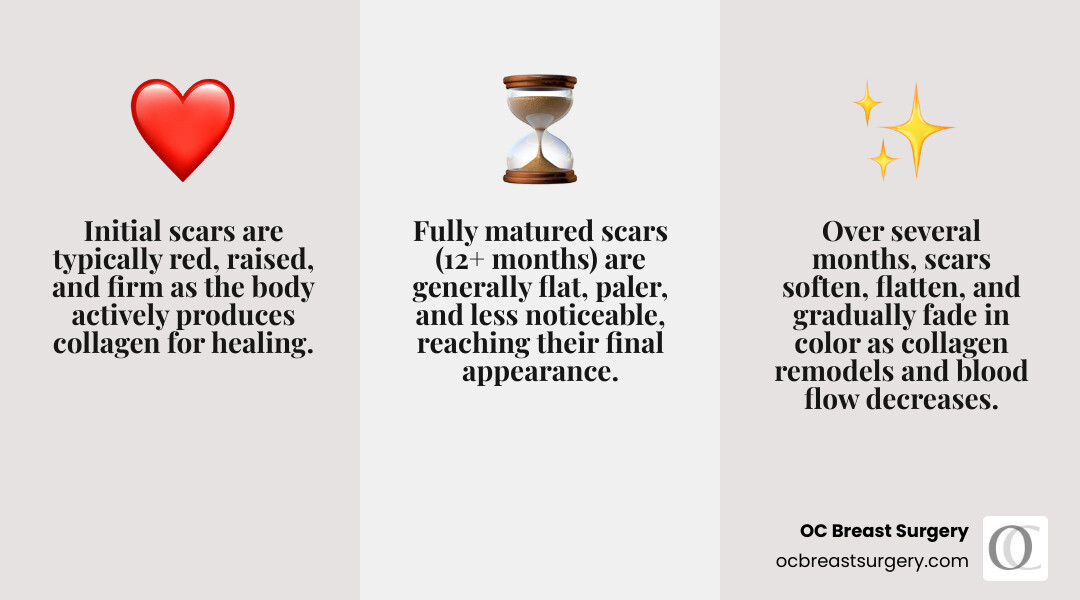
- Timing: Best performed after scars fully mature (typically 12+ months post-surgery).
- Expectations: Revision treatments improve appearance but cannot completely erase scars. Results depend on scar type and your healing ability.
While the initial raised and reddish appearance of incisions will fade, sometimes scars remain prominent. Effective treatments can address scars that are wide, thick, discolored, or cause discomfort.
I’m Dr. Mark Anton, and with 33 years specializing in breast surgery, I’ve helped countless women improve problematic mastopexy scars using both surgical and non-surgical techniques. My training in breast reconstruction and revision surgery at OC Breast Surgery in Newport Beach, CA, allows me to create customized treatment plans for each patient’s unique concerns.
Understanding Mastopexy Scars: Types and Causes
After a breast lift, your body heals by producing new collagen fibers to repair the incisions, which forms scars. The final appearance of these scars is unpredictable and depends on several factors, including your genetics, the amount of skin tension during closure, the surgical technique used, and your post-operative care. Understanding what causes problematic scars is the first step toward improving them through mastopexy scar revision.
Common Types of Breast Lift Scars
Breast lift scars typically follow periareolar (around the nipple), lollipop, or anchor incision patterns. While surgeons place these for minimal visibility, healing can be unpredictable.
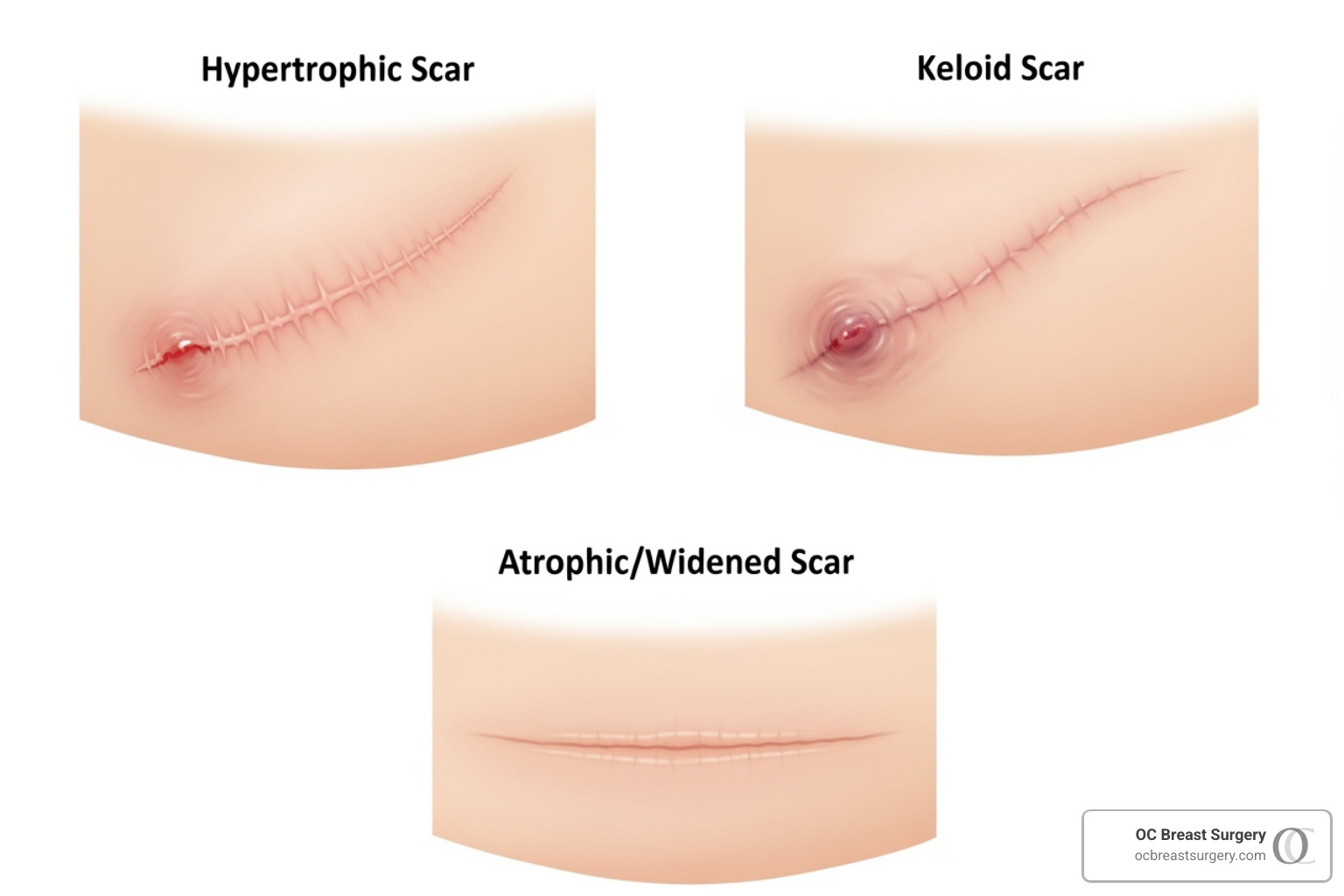
- Hypertrophic scars are thick, raised, and red, staying within the original incision lines. They may be itchy and can improve over time but often remain noticeable.
- Keloid scars are more aggressive, growing beyond the original wound edges into surrounding skin. They are often raised and discolored, rarely fade without treatment, and are more common in women with darker skin tones.
- Atrophic scars appear as depressions or wide, stretched-out areas. They can develop when there is too much tension on the healing incision.
- Discolored scars can be darker (hyperpigmentation) or lighter (hypopigmentation) than the surrounding skin. Sun exposure can worsen discoloration.
For a comprehensive overview, you can explore resources like More on scar types from the American Society of Plastic Surgeons.
Why Did My Breast Lift Scars Heal Poorly?
Several key factors contribute to problematic scarring:
- Excessive tension on the skin closure is the most common cause of wide or raised scars. This happens when skin is pulled too tightly or the underlying breast tissue isn’t properly supported.
- Infection during the post-operative period can disrupt the healing process, leading to thicker, wider scars.
- Poor wound care, such as not keeping incisions clean or picking at scabs, can interfere with optimal healing.
- Smoking severely restricts blood flow and oxygen to healing tissues, making it a strong predictor of poor scarring.
- Sun exposure in the first year can cause permanent hyperpigmentation, making scars darker and more noticeable.
- Genetic predisposition means some individuals are simply programmed to form more prominent scars, like keloids, regardless of surgical technique.
Minimizing Scarring After Your Initial Breast Lift
Prevention is the best strategy for minimizing scars after your breast lift.
- Choose your surgeon carefully. An experienced, board-certified plastic surgeon knows how to minimize tension and place incisions strategically.
- Follow post-operative instructions for wound care, activity restrictions, and wearing your surgical bra.
- Use silicone sheets or gels once incisions are fully closed. They are proven to hydrate scars, flatten tissue, and reduce redness.
- Protect your scars from the sun for at least a year with clothing or high-SPF sunscreen to prevent discoloration.
- Maintain a healthy lifestyle with good nutrition and hydration, and avoid smoking to support your body’s healing capacity.
- Avoid strenuous activities that pull on your incisions during the first few weeks of recovery.
- Manage dark and red scars with patience. Topical treatments can help, but always consult your surgeon before use, as improper timing can cause complications.
For more guidance, refer to resources like Advice on reducing breast surgery scars.
What is Mastopexy Scar Revision and Who is a Candidate?
If you’ve healed from your breast lift but remain unhappy with your scars, mastopexy scar revision can help. The goal isn’t to erase scars completely—which is impossible—but to significantly improve them so they are less noticeable, blend better with your skin, and no longer cause discomfort. We aim for meaningful aesthetic improvement and restored confidence.

Defining Mastopexy Scar Revision vs. a Full Revision Lift
It’s important to understand the difference between these two procedures:
- Mastopexy scar revision focuses only on the scar itself, working to improve its width, texture (raised or depressed), and color.
- A revision breast lift is more comprehensive. It addresses broader concerns about the breast’s shape, asymmetry, recurrent sagging, or nipple position.
In some cases, a combined approach may be the best solution if you are unhappy with both your scars and your breast shape.
Are You a Good Candidate for Scar Revision?
Ideal candidates for mastopexy scar revision meet several criteria:
- Timing is crucial. Your scars must be fully mature, which means waiting at least 12 months, and often 18-24 months, after your initial surgery. This wait is essential because scars continue to soften and fade on their own. Revising too early can lead to disappointing results.
- You should be in good overall health and a non-smoker. Smoking severely impairs healing and can compromise the outcome of a revision.
- You must have realistic expectations. We can achieve remarkable improvements, but complete scar removal is not possible. We will make scars flatter, softer, and less noticeable.
- Your dissatisfaction is genuine. The decision should be driven by your desire to feel more confident and comfortable.
How a Surgeon Chooses the Best Technique
There is no one-size-fits-all approach to scar revision. During your consultation at OC Breast Surgery, I create a personalized treatment plan based on several factors:
- The nature of your scar: A raised hypertrophic scar may respond to injections, while a wide scar typically requires surgical excision.
- Your skin’s characteristics: Your skin’s elasticity, thickness, and healing history (such as a tendency for keloids) guide the choice of technique.
- Location: A scar on the breast crease heals differently than one around the areola due to varying skin tension and movement.
My 33 years of experience allows me to offer a full range of surgical and non-surgical options to give you the best possible outcome.
Surgical Solutions for Mastopexy Scar Revision
When non-surgical treatments aren’t enough for wide, raised, or disruptive scars, surgical mastopexy scar revision often provides the most dramatic improvement. The procedure removes the problematic scar tissue and creates a new, refined closure designed for better healing, giving your body a second chance under more favorable conditions.
Depending on the revision’s extent, we use local anesthesia, intravenous sedation, or general anesthesia to ensure your comfort. We will discuss the best option for you during your consultation at our Newport Beach, CA office.
Common Surgical Techniques for Mastopexy Scar Revision
The surgical approach depends on your scar’s unique characteristics.
- Simple scar excision with layered closure is ideal for linear scars that have widened. We remove the old scar and close the new incision in multiple layers. This technique places tension on deeper tissues, not the skin, which helps the new scar heal as a finer line.
- Z-plasty reorients a scar by using a Z-shaped incision. This can break up the scar line, align it with natural skin creases, and reduce the tension that causes pulling or discomfort.
- W-plasty uses a series of small triangular flaps to create a zigzag pattern. This irregular line is less noticeable to the eye than a straight scar because it mimics the skin’s natural variations.
- Geometric broken line closure is an advanced technique where the scar is excised in an irregular pattern of small geometric shapes. When pieced back together, the line is far less visible than a straight scar.
Learn more about these methods in this overview of surgical scar revision techniques. We can also correct issues like “dog ears” (puckers of skin at incision ends) with specialized techniques for a smooth, tension-free closure.
Potential Risks of Surgical Revision
While mastopexy scar revision is generally safe, all surgery has inherent risks, which we will discuss thoroughly during your consultation.
- Infection and bleeding are rare but possible with any surgical procedure.
- Poor healing can occur due to factors beyond anyone’s control, such as genetics. This means there is always a possibility of a new, undesirable scar forming. While the goal is significant improvement, perfection cannot be guaranteed.
- Anesthesia risks are also a consideration, though serious complications are rare with modern techniques.
Non-Surgical Treatments to Improve Breast Lift Scars
Many mastopexy scars can be improved without surgery. At our OC Breast Surgery office in Newport Beach, CA, we use non-surgical treatments—often in combination—to address redness, texture, and discoloration with minimal downtime. This toolkit of options allows us to create a personalized plan for your specific scar.
Here’s an overview of the most effective non-surgical options:
| Treatment | Best For (e.g., redness, texture, thickness) | Average Sessions | General Downtime |
|---|---|---|---|
| Pulsed-Dye Laser (PDL) | Redness, vascularity | 3-5 | Mild redness/swelling |
| Fractional CO2 Laser | Texture, thickness, discoloration | 1-3 | 5-7 days |
| Intense Pulsed Light (IPL) | Pigmentation, redness | 3-6 | Minimal |
| Corticosteroid Injections | Hypertrophic, keloid scars (thickness) | 3-5 | Minimal |
| 5-Fluorouracil (5-FU) | Hypertrophic, keloid scars (thickness) | 3-5 | Minimal |
| Silicone Gel/Sheeting | Flattening, softening, reducing redness | Ongoing | None |
| Dermal Fillers | Depressed (atrophic) scars | 1 | Minimal |
| Microneedling | Texture, collagen induction | 3-6 | 1-3 days |
| Chemical Peels | Surface texture, discoloration | 3-5 | 1-7 days (depending on depth) |
| Dermabrasion | Surface texture, irregularities | 1-2 | 7-14 days |
Laser & Light Therapies
Laser technology allows us to target specific scar issues with precision.
- Pulsed-Dye Laser (PDL): This laser targets the blood vessels in red or pink scars, reducing their color. It is effective for newer scars and can also help soften raised tissue over 3-5 sessions.
- Fractional CO2 Laser: This ablative laser remodels scar tissue from within by stimulating collagen production. It is excellent for improving texture, thickness, and discoloration in just 1-3 sessions, though it requires about a week of downtime. Research on laser scar revision supports its effectiveness.
- Intense Pulsed Light (IPL): This treatment uses broad-spectrum light to target both brown pigmentation and redness in scars. It is a gentle option with minimal downtime, typically requiring 3-6 sessions.
Injections and Topical Treatments
These options work from within the scar or are applied directly to the surface.
- Corticosteroid injections: Injected directly into hypertrophic or keloid scars, these suppress inflammation and collagen production, flattening them over a series of 3-5 injections.
- 5-Fluorouracil (5-FU): Often combined with corticosteroids, this agent helps break down stubborn hypertrophic and keloid scars.
- Silicone gel and sheeting: When used consistently, these products create a moist environment that helps flatten, soften, and reduce redness in scars. They are non-invasive and have no downtime.
- Dermal fillers: Hyaluronic acid fillers can be injected beneath depressed (atrophic) scars to lift them to the level of the surrounding skin, creating a smoother surface.
Skin Resurfacing Techniques
These treatments improve the surface quality and texture of scars.
- Microneedling: This technique uses tiny needles to create controlled micro-injuries, stimulating new collagen to improve scar texture and color. A Clinical update on microneedling for scars confirms its benefits. Most patients need 3-6 sessions with 1-3 days of redness.
- Chemical peels: These use a chemical solution to exfoliate the outer skin layers, revealing smoother, more evenly toned skin. The strength of the peel determines the downtime.
- Dermabrasion: This mechanical exfoliation technique “sands” the top layers of skin to blend scar edges and improve texture. It is more intensive and requires 7-14 days of healing.
The Revision Journey: Recovery, Results, and Expectations
Starting on a mastopexy scar revision journey is a hopeful step. At OC Breast Surgery, we guide you through the entire process, from consultation to full recovery. Understanding what to expect helps ensure the best possible outcome.
Recovery and Timeline
Recovery varies depending on the type of revision.
- For surgical revisions, expect some swelling, bruising, and mild discomfort for 1-2 weeks, which is manageable with pain relievers. Careful incision care is vital. The most important rule is to avoid tension on new incisions, which means no lifting or stretching.
- Non-surgical treatments involve much less downtime, ranging from none at all to about a week of redness, depending on the procedure.
You can typically resume light activities within a few days to two weeks after surgical revision, but you must avoid strenuous exercise for at least six weeks to protect the healing scar. Final results become visible in 6 to 12 months as the scar tissue fully matures, softens, and fades.
What are the Long-Term Expectations?
Mastopexy scar revision will improve your scars significantly, but it cannot erase them. The realistic goal is to make scars flatter, softer, narrower, and less discolored, changing a prominent scar into a subtle line that blends with your skin. For many patients, this improvement restores their confidence.
Your final appearance depends on both the technique used and your body’s unique healing response. Following all post-operative instructions is critical. One of the most important long-term commitments is sun protection. UV exposure can darken a healing scar, so use high-SPF sunscreen or keep the area covered to protect your results for years to come.
How Much Does Mastopexy Scar Revision Cost?
The cost of mastopexy scar revision varies considerably because every treatment plan is customized to the patient’s individual needs. During your consultation at our Newport Beach, CA practice, we will provide a detailed, transparent cost estimate.
Factors that influence the final cost include:
- Dr. Anton’s surgeon’s fee, reflecting his 33 years of specialized expertise.
- Anesthesia and facility fees, which depend on the type of procedure.
- The complexity of the procedure, as a simple injection series costs less than an extensive surgical revision.
Because scar revision is typically considered a cosmetic procedure, it is usually not covered by insurance. We will discuss all financial aspects openly so you can make an informed decision.
Frequently Asked Questions about Breast Lift Scar Revision
Here are answers to some of the most common questions we hear about mastopexy scar revision.
How long do I have to wait after my breast lift to get a scar revision?
We recommend waiting at least 12 months, and often 18-24 months, after your initial breast lift. This essential waiting period allows your scars to fully mature, soften, and fade on their own. Revising a scar before it is stable can lead to unpredictable and disappointing results.
Is mastopexy scar revision painful?
The procedure itself is not painful, as it is performed with appropriate anesthesia or numbing. Post-procedure discomfort is typically mild and easily managed with over-the-counter pain medication. Non-surgical treatments like laser therapy may cause a temporary sensation similar to a mild sunburn.
Can scar revision fix “dog ears” at the end of my incisions?
Yes, absolutely. “Dog ears”—the small puckers of excess skin at the ends of an incision line—are a common issue that can be effectively corrected. The fix is usually a straightforward minor surgical revision to remove the excess tissue and create a smooth contour, often performed under local anesthesia with a quick recovery. For more on revision approaches, see resources from the American Society of Plastic Surgeons and technical overviews like this one on surgical techniques.
Achieve Your Ideal Results in Newport Beach, CA
If you are unhappy with your breast lift scars, you should know that effective solutions exist. Whether through advanced surgical techniques or innovative non-surgical options like laser therapy and microneedling, mastopexy scar revision offers real hope for improvement.
Dr. Mark Anton and our team at OC Breast Surgery specialize in breast revision and reconstruction. With over three decades of focused experience, Dr. Anton has dedicated his career to helping women achieve the results they deserve, particularly in complex revision cases that require a high level of expertise.
Your journey begins with a personalized consultation at our Newport Beach, CA, practice. We will carefully assess your scarring, listen to your concerns, and create a custom mastopexy scar revision plan custom to you. We believe in transparency and realistic expectations to ensure you feel informed and comfortable.
You’ve already taken a brave step by having breast lift surgery. Don’t let unwanted scars keep you from fully enjoying your results. We’re here to help you feel confident in your skin again.
Ready to explore your options? Take the next step toward correcting your breast lift scars and schedule your consultation with us today.