
Everything You Need to Know About Scars from Breast Implant Removal
What to Know About Scars After Breast Implant Removal
Scars after breast implant removal are a normal part of the healing process — and for most women, they fade significantly over time with the right care.
Here’s a quick overview of what to expect:
- Will you have scars? Yes. Any surgery that involves an incision will leave a scar.
- Where are they? Most scars are located along the inframammary fold (under the breast) or around the areola — often in the same place as your original augmentation incisions.
- What do they look like at first? Scars typically start red or pink and slightly raised, then flatten and fade over 6 to 12 months.
- Can they be minimized? Yes — through surgical technique, post-op care, silicone products, and in some cases, medical treatments like laser therapy.
- How long until final results? Scar maturation can take up to one full year.
The good news: with an experienced surgeon and consistent aftercare, scars from explant surgery are often barely noticeable over time.
When you decide to remove your breast implants, scarring is one of the first concerns that comes to mind — and it’s a completely valid one. Understanding what scars form, why they form, and how they evolve can make a big difference in how you approach recovery and set realistic expectations for your results.
I’m Dr. Mark Anton, a board-certified plastic surgeon with over 33 years of experience specializing exclusively in breast surgery, including thousands of explant procedures where managing scars after breast implant removal is a central part of achieving the best possible outcome. In the sections below, I’ll walk you through everything you need to know — from incision placement and capsulectomy techniques to scar care strategies and healing timelines.
Glossary for scars after breast implant removal:

Understanding Scars After Breast Implant Removal
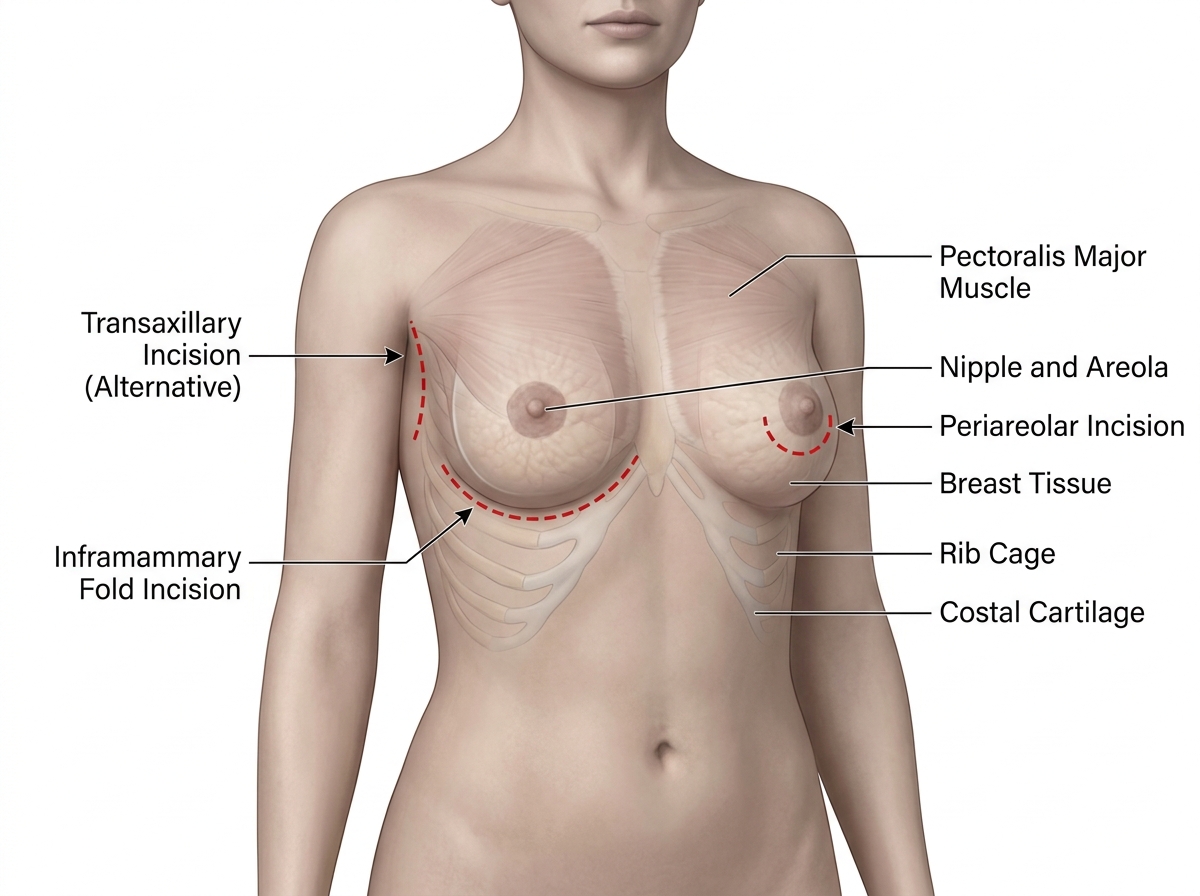
Whenever the skin is incised, the body initiates a complex biological response to knit the tissue back together. This process involves the production of collagen, a structural protein that acts as the “glue” for your skin. While this repair is essential for closing the wound, the resulting tissue is different in texture and appearance than the surrounding skin—this is what we call a scar.
The quality of scars after breast implant removal depends on several factors, including the surgeon’s technique, the degree of tension on the wound, and your body’s unique healing response. Because explant surgery involves removing volume, the skin may have some laxity, which can actually be beneficial for scar healing as there is often less tension on the incision line compared to the original augmentation. You can find more info about breast augmentation scars to see how these initial marks compare to the removal process.
Where are the scars typically located?
In most cases, we aim to place incisions where they are naturally camouflaged. The specific location depends heavily on how your implants were originally placed:
- Inframammary Fold (IMF): This is the most common location, tucked into the crease beneath the breast. It offers excellent visibility for the surgeon and is easily hidden by bras or swimwear.
- Periareolar Incision: This incision follows the border where the dark skin of the areola meets the lighter breast skin.
- Transaxillary: While some implants are placed through the armpit, removal is rarely done through this site because it provides limited access to the scar tissue capsule that often needs to be addressed.
For those in our local area, you can find more info about breast implant removal in Newport Beach to understand how we tailor these locations to your anatomy.
Can original incisions be reused to minimize scars after breast implant removal?
One of the most effective ways we minimize new scarring is by “re-opening” the original incision used during your augmentation. This surgical efficiency allows us to avoid creating a second scar line. During the procedure, we often perform a “scar excision,” where the old, thickened scar tissue from the first surgery is carefully removed, allowing us to create a fresh, clean edge for a much finer and flatter new scar.
By utilizing the existing pathway, we minimize additional trauma to the breast tissue. You can view breast explant before and after photos to see how reusing these sites leads to a clean, singular scar line that fades beautifully over time.
The Impact of Capsulectomy on Scarring Outcomes
A “capsule” is a layer of scar tissue that your immune system naturally forms around any foreign object, including a breast implant. During explant surgery, we must decide how much of this capsule to remove. This decision significantly impacts the surgical technique and the resulting scars after breast implant removal.
In cases of Breast Implant Illness (BII) or concerns regarding BIA-ALCL (a rare lymphoma linked to textured implants), a more extensive removal is often required. The FDA Safety Communication on breast implant complications highlights why thorough capsule management is vital for patient safety. For a deep dive into these procedures, check out the definitive guide to breast implant removal.
Differences between en bloc and total capsulectomy scars
The method of removal can influence the length of your incision:
- En Bloc Capsulectomy: This is the “gold standard” for many patients. It involves removing the implant and the entire capsule as one single, unbroken unit. Because the capsule is larger than the implant alone, a slightly longer incision (often along the breast crease) may be necessary to safely extract the entire mass without rupturing it.
- Total Capsulectomy: Here, the surgeon removes the entire capsule, but it may be taken out in pieces after the implant is removed. This can sometimes allow for a slightly smaller incision than an en bloc approach.
| Feature | En Bloc Capsulectomy | Total Capsulectomy |
|---|---|---|
| Incision Length | Generally longer to accommodate the full capsule | Can be slightly shorter |
| Tissue Integrity | Keeps implant/fluid contained | Capsule removed in sections |
| Recovery | May involve slightly more initial soreness | Similar to standard explant |
| Scar Visibility | Well-hidden in the crease | Well-hidden in the crease |
Scientific research, such as the long-term outcomes study in 99,993 patients, underscores that while the technique may vary, the long-term aesthetic and health outcomes are generally very high when performed by specialists.
The Healing Timeline: What to Expect

Healing is not an overnight event; it is a year-long journey. Scars after breast implant removal go through several distinct phases:
- Inflammatory Phase (Weeks 1-2): The incision is fresh, red, and may be slightly swollen or “bumpy.”
- Proliferative Phase (Weeks 3-6): The body builds new tissue. The scar may look its most “angry” or dark pink during this time.
- Remodeling Phase (Months 3-12): This is the longest phase. Collagen is reorganized, and the scar begins to flatten and lose its redness.
Many patients are surprised to see how much their breasts change in the first few months. If you are concerned about how you will look without the “filler” of the implant, you can see breast implant removal no-lift photos to understand the natural contraction of the skin.
Initial appearance vs. long-term fading
Initially, your scars will be firm to the touch and highly pigmented (red, pink, or purple depending on your skin tone). As the blood vessels that helped heal the wound begin to recede, the color fades to a pale white or a shade that closely matches your natural skin. According to the American Society of Plastic Surgeons, you can find more info about breast implant removal results which confirms that final scar maturation takes about a year.
Factors that influence scars after breast implant removal
Not everyone scars the same way. Several biological and lifestyle factors play a role:
- Genetics: If you are prone to keloids or hypertrophic scars, your removal scars may require extra attention.
- Age: Younger skin often has a more robust (and sometimes overactive) healing response, while older skin may heal more slowly but with finer lines.
- Smoking: This is a major deterrent to healing. Smoking constricts blood vessels, depriving the incision of the oxygen it needs to heal properly.
- Implant Duration: If you have had implants for decades, the tissue may be thinner, requiring a more delicate surgical touch.
If you have existing scars that didn’t heal well the first time, we can discuss breast augmentation scar revision surgery as part of your explant plan.
Effective Strategies to Minimize and Treat Scars
We don’t just “close and hope” at OC Breast Surgery. We provide a comprehensive scar management protocol to ensure your scars after breast implant removal are as discreet as possible.
- Silicone Gel and Sheets: These are the gold standard in scar care. They create a protective barrier that locks in moisture, which signals the body to stop producing excess collagen.
- Scar Massage: Once the incision is fully closed (usually around week 3 or 4), gentle circular massage helps break up internal scar tissue and improves flexibility.
- Fat Transfer: Sometimes, the best way to improve the look of a scar is to improve the tissue underneath it. More info about breast explant with fat transfer shows how adding a little of your own natural fat can smooth out contours and support the skin.
Post-operative wound care essentials
Your job at home is just as important as ours in the OR.
- Keep it Clean: Follow our specific instructions on washing with mild soap.
- Moisturize: Once cleared, keeping the skin hydrated prevents the scar from becoming brittle or itchy.
- Sun Protection: This is non-negotiable. UV rays can permanently darken a healing scar (hyperpigmentation). Keep your incisions covered or use high-SPF sunscreen for at least a year.
- Support: Wearing the right bra reduces tension on the incision line. You can learn more info about breast lift after implant removal to see how a lift can also reposition scars for a better aesthetic.
Medical treatments for persistent scarring
If home care isn’t enough, we offer advanced options in Newport Beach:
- Laser Therapy: Can reduce redness and smooth out the texture of the scar.
- Steroid Injections: Highly effective for flattening raised or “ropey” scars.
- Surgical Revision: If a scar heals wide, we can surgically refine it once the tissue has matured. For more details on local care, see more info about breast implant removal in Orange County.
Recovery Guidelines and Warning Signs
A smooth recovery is the foundation of a good scar. During the first few weeks, your body needs to focus entirely on repair. This means following strict activity restrictions.
What to avoid during scar recovery
To prevent the incision from stretching or opening (dehiscence), you must avoid:
- Heavy Lifting: Anything over 5-10 pounds for the first few weeks.
- Strenuous Exercise: No running or high-impact cardio that causes the breasts to bounce.
- UV Exposure: As mentioned, the sun is the enemy of a fading scar.
- Smoking: You should quit at least 4-6 weeks before and after surgery.
If you are planning for the financial aspect of this journey, you can find more info about explant surgery cost and how it relates to the complexity of the procedure. If you are considering a change rather than a permanent removal, look into more info about breast implant removal and replacement.
When to contact your surgeon
While some redness and swelling are normal, you should call us immediately if you notice:
- Signs of Infection: Pus, foul odor, or spreading redness that feels hot to the touch.
- Fever or Chills: These can indicate a systemic infection.
- Excessive Swelling: Especially if it occurs only on one side (a possible hematoma or seroma).
You can always find a plastic surgeon through the ASPS directory to verify credentials and safety standards.
Frequently Asked Questions about Explant Scars
Will my breasts sag significantly after the implants and scars are addressed?
This is a common fear. When an implant is removed, there is often “excess” skin. While the skin does have some natural ability to “snap back,” significant sagging (ptosis) may remain. In these cases, we often recommend a breast lift (mastopexy) concurrently with the explant. This allows us to remove the extra skin and tighten the remaining tissue, though it does involve additional scarring (usually a “lollipop” or “anchor” shape). You can see more info about before and after explant and lift to weigh the trade-off between more scars and a better shape.
Does health insurance cover the cost of removing symptomatic scar tissue?
In some cases, yes. If you are experiencing severe capsular contracture (Grade III or IV) that causes pain or distortion, insurance may deem the removal medically necessary. Furthermore, The Women’s Health and Cancer Rights Act (WHCRA) of 1998 requires plans that cover mastectomies to also cover certain post-mastectomy complications, which can include implant removal and scar tissue management.
How long should I wait before using over-the-counter scar creams?
You must wait until the incision is 100% closed and any scabs have naturally fallen off. This is typically around the 3 to 4-week mark. Applying creams too early can trap bacteria or soften the wound “glue” prematurely. Always get our “thumbs up” during a follow-up appointment before starting any topical treatments.
Conclusion
At OC Breast Surgery, we understand that the decision to remove your implants is a significant step toward reclaiming your natural body. Our goal is to make that transition as seamless as possible, with a heavy focus on minimizing scars after breast implant removal.
Dr. Mark Anton and our specialized team in Newport Beach, CA, take pride in our ability to correct complications and deliver natural-looking results that our patients love. Whether you are removing implants due to Breast Implant Illness, a lifestyle change, or a desire for a more natural silhouette, we are here to guide you through every step of the surgical and healing process.
Ready to take the next step? Schedule your breast implant removal consultation with us today and let’s discuss your personalized plan for a beautiful, healthy recovery.