
The Innie vs Outie Guide to Inverted Nipple Meaning
Understanding the Inverted Nipple Meaning and Prevalence
Inverted nipple meaning refers to a condition where the nipple points inward or lies flat against the areola, instead of projecting outward. Here’s a quick summary:
| Feature | Details |
|---|---|
| What it is | Nipple retracted inward below the areolar plane |
| How common | Affects 10–20% of the general population |
| Main causes | Congenital (present from birth) or acquired (developed over time) |
| Severity | Graded 1 to 3, from mildly to severely inverted |
| Usually serious? | No — most cases are benign, especially if present since puberty |
| When to worry | Sudden new inversion in adulthood, especially with lumps or discharge |
Most people with inverted nipples were simply born that way. It’s a common anatomical variation — not a defect, and not usually a health risk. That said, it can affect self-confidence and, in some cases, make breastfeeding more challenging.
Whether you’ve had inverted nipples your whole life or noticed a recent change, understanding what’s behind them is the first step toward knowing your options.
I’m Dr. Mark Anton, a breast surgery specialist based in Newport Beach, CA, with over 33 years of experience — including thousands of procedures addressing the full range of conditions related to inverted nipple meaning and correction. In this guide, I’ll walk you through everything you need to know, from causes and grading to treatment options.
Simple inverted nipple meaning word guide:
- How do you fix an inverted nipple
- How much does it cost to fix inverted nipples
- How to fix inverted nipple for breastfeeding
When we talk about an “innie” versus an “outie,” we are usually talking about belly buttons, but the same concept applies to nipples. For most people, the nipple is a small, cylindrical projection that sits in the center of the areola. However, for a significant portion of the population, the nipple is retracted or pulled inward.

Statistics show that Inverted nipple cases are more common than you might think, affecting between 10% and 20% of the general population. This isn’t just a “women’s issue” either; up to 20% of both men and women have some degree of nipple inversion.
In our Newport Beach practice, we often see patients who are surprised to learn that Nipple Inversion is frequently bilateral, meaning it affects both breasts. In fact, about 87% of congenital cases are bilateral. If you have Innie Nips on both sides, it is almost certainly a benign anatomical variation. We also see strong evidence of familial traits; about 50% of people with an Inverted Nipple have a family member with the same condition.
The Inverted Nipple Meaning in Fetal Development
To understand why this happens, we have to look all the way back to the womb. During the second month of gestation, the nipple begins to form as an epidermal pit. Normally, by the third trimester, this “mammary pit” everts, or pushes outward, to create the familiar nipple shape.
According to the Cleveland Clinic, if the tissue underneath the pit doesn’t grow correctly or if the milk ducts don’t lengthen sufficiently, the nipple remains tethered inward. This failure of eversion during fetal development is the primary cause of congenital nipple inversion. In some cases, these “innies” may spontaneously resolve during puberty as the breasts develop, but for many, they remain a permanent part of their anatomy.
Causes and Grading of Nipple Inversion
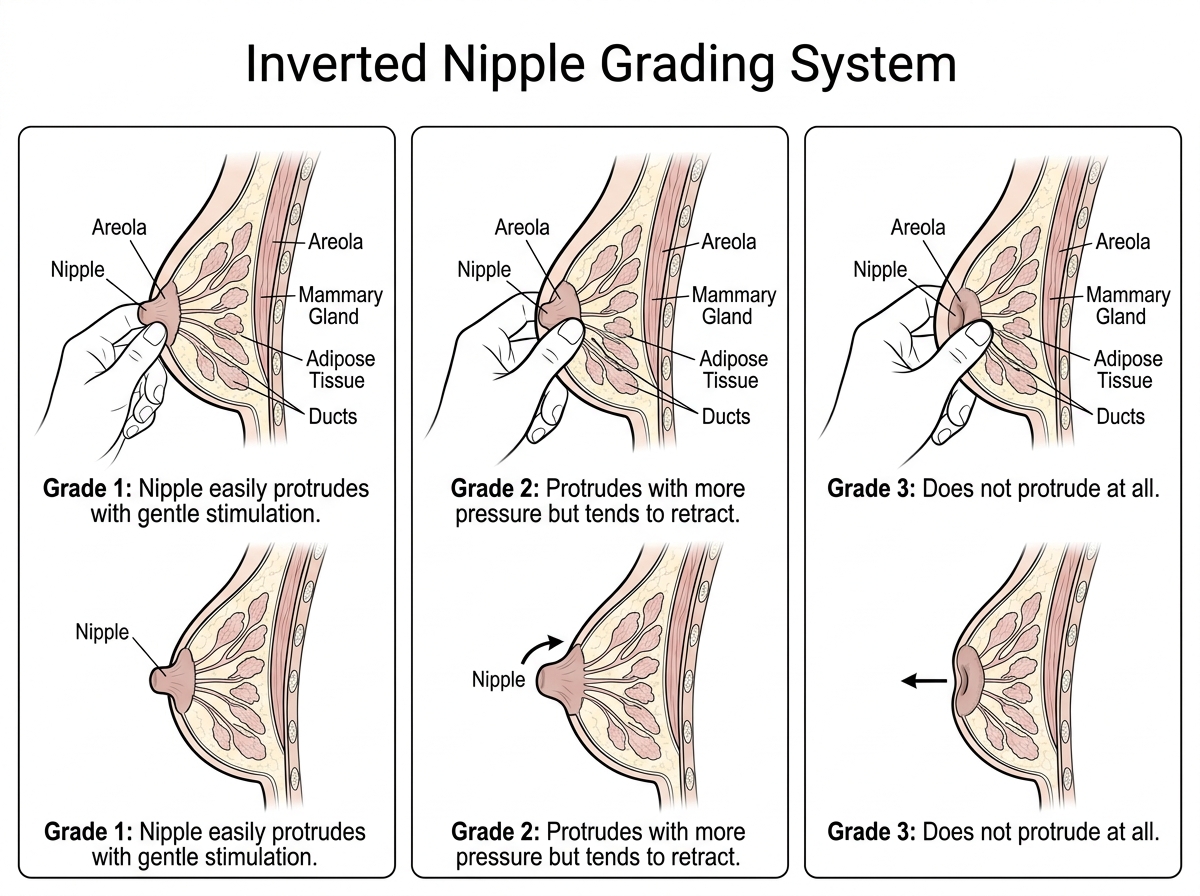
While many cases are present from birth, others are “acquired,” meaning they develop later in life. Understanding the inverted nipple meaning requires looking at the structural differences between these two categories.
| Cause Type | Common Triggers | Description |
|---|---|---|
| Congenital | Genetics, Fetal Development | Present from birth; caused by short milk ducts or tight fibrous bands. |
| Acquired | Aging, Trauma, Infection | Develops later; can be caused by sagging, scarring, or underlying health issues. |
In Female Inverted Nipples, the most common internal culprit is a set of short lactiferous (milk) ducts or tight fibrous bands (stroma) that act like a tether, pulling the nipple tissue back toward the chest wall.
As we age, the milk ducts can naturally shorten, which is why some women notice their nipples turning inward as they approach menopause. Other acquired causes include:
- Trauma: A significant blow to the chest or “seatbelt trauma” from a car accident can cause internal scarring that pulls the nipple in.
- Infection: Conditions like mastitis or a subareolar abscess can lead to inflammation and subsequent retraction.
- Breast Surgery: Occasionally, previous surgeries can result in scarring that affects nipple projection.
When patients visit us for Inverted Nipple Correction, our first step is to determine the severity using a standardized medical grading system. This is crucial for deciding whether non-surgical or surgical intervention is best. The NCBI StatPearls database provides the framework we use to categorize these.
Grading the Severity: Grade 1 to Grade 3
We use the Han and Hong grading system to assess how much the internal “tether” is pulling on the nipple.
- Grade 1 (The “Shy” Nipple): These nipples are mostly flat or slightly inverted but can be easily pulled out with manual manipulation or in response to cold or stimulation. They usually maintain their projection for a while before slowly slipping back in. There is minimal fibrosis (scarring) involved.
- Grade 2: These nipples can be pulled out, but it takes more effort. Once released, they tend to retract almost immediately. There is a moderate amount of fibrosis and slightly shorter milk ducts.
- Grade 3 (Severely Inverted): These nipples are firmly retracted and rarely, if ever, come out with manual manipulation. Histologically, these cases involve severe fibrosis and atrophied milk ducts. For Grade 3, Inverted Nipple Correction almost always requires a surgical approach to release the tension.
When to Worry: Inverted Nipples and Breast Cancer

One of the most common questions we hear in Newport Beach is: “Are my inverted nipples a sign of cancer?”
The short answer is: If you have had them since puberty, they are almost certainly benign. However, if a nipple that used to be an “outie” suddenly becomes an “innie,” it is time to see a doctor immediately.
According to Breastcancer.org, sudden nipple retraction can be a symptom of an underlying tumor. As a tumor grows, it can attach to the milk ducts and pull the nipple inward. This is particularly associated with ductal cancer or a rare form of cancer called Paget’s disease of the breast, which affects the skin of the nipple and areola.
Red flags that require a medical evaluation include:
- Sudden onset of inversion in one breast (unilateral).
- A palpable lump behind or near the nipple.
- Bloody or spontaneous nipple discharge.
- Skin dimpling (an “orange peel” texture) or persistent redness and scaling.
In these cases, we utilize diagnostic imaging such as a mammogram, ultrasound, or even a biopsy to rule out malignancy. Early detection is key, and while most nipple changes are benign (like duct ectasia or aging), we always prioritize safety.
Treatment and Correction Options
If your inverted nipples are causing physical discomfort, hygiene issues (like rashes in the fold), or affecting your self-esteem, there are several ways to address them.
For Grade 1 and some Grade 2 cases, Inverted Nipple Repair Without Surgery may be effective. Common techniques include:
- The Hoffman Technique: This involves placing your thumbs on either side of the nipple and firmly pressing down into the breast tissue while pulling the thumbs apart. This helps break up minor adhesions.
- Suction Devices: Small cups or “nipple extractors” (sometimes fashioned from syringes) can be worn to gradually stretch the milk ducts and fibrous bands.
When conservative methods aren’t enough, Correction of Inverted Nipple Surgery is a highly effective, permanent solution. At OC Breast Surgery, we perform this as an outpatient procedure under local anesthesia.
The Inverted Nipple Surgery Results are typically excellent, providing a natural-looking projection. We focus on “duct-preserving” techniques whenever possible, especially for patients who wish to breastfeed in the future. During the procedure, we release the tight fibrous bands that are pulling the nipple in, allowing it to stand tall.
Regarding Inverted Nipple Surgery Cost, it varies depending on the complexity and whether it is performed on one or both sides. Because it is often considered a cosmetic procedure, insurance may not always cover it, but we provide detailed consultations to help patients plan accordingly.
The Inverted Nipple Meaning for Breastfeeding
Can you breastfeed with inverted nipples? In most cases, the answer is yes.
Breastfeeding is about the baby latching onto the areola, not just the nipple. However, a retracted nipple can make that initial “anchor” point harder for the baby to find. For Grade 1 and 2, the suction from the baby or a breast pump can often draw the nipple out permanently over time.
For those struggling, we recommend:
- Nipple Shields: A silicone cover that provides a firm shape for the baby to latch onto.
- Pumping: Using a breast pump for a few minutes before a feed can help evert the nipple.
- Lactation Consultants: These specialists can teach specific How to Fix Inverted Nipple for Breastfeeding techniques, such as the side-lying position or manual stimulation.
For Grade 3 cases, breastfeeding may be significantly more difficult or impossible due to the severe shortening of the ducts. If breastfeeding is a major goal, we recommend discussing duct-preserving surgery well before pregnancy.
Frequently Asked Questions about Nipple Inversion
Can men have inverted nipples?
Absolutely. The How to Fix Inverted Nipple Male query is quite common. Men have the same basic nipple anatomy as women, and about 10-20% of men are born with inverted nipples. In men, inversion can also be caused by gynecomastia (enlarged male breast tissue) or aging. The surgical correction process for men is very similar to the female procedure, focusing on releasing the tethering bands to create a flatter, more typical male nipple appearance.
Do inverted nipples go away on their own?
Sometimes. It is common for “shy” nipples to resolve during puberty as the breast tissue expands. Some women also find that the hormonal changes and tissue stretching during pregnancy and breastfeeding permanently evert their nipples. However, if the inversion is caused by significant fibrosis (Grade 3), it is unlikely to change without intervention.
Is nipple piercing a safe correction method?
Some people use nipple piercings as a form of mechanical eversion—the jewelry physically prevents the nipple from slipping back into the breast. While this can work for some, it comes with risks. Piercings increase the risk of infection (mastitis) and can cause scarring that may interfere with future breastfeeding. We usually recommend medical-grade suction devices or surgical correction over piercings for long-term results.
Conclusion
Understanding the inverted nipple meaning helps demystify a condition that is often shrouded in self-consciousness. Whether your “innies” are a lifelong trait or a result of life’s changes, they are a common part of human diversity.
At OC Breast Surgery in Newport Beach, CA, Dr. Mark Anton and our team are dedicated to helping you feel confident in your body. We specialize in achieving natural-looking results that respect your anatomy and your future goals, whether that involves breastfeeding or simply feeling more comfortable in your own skin.
If you are curious about How to Fix Inverted Nipples or want to ensure your nipple changes are benign, we invite you to schedule an expert consultation with our breast surgery specialists. We are here to provide the clarity and care you deserve.