
8 Tips for a Smooth Breast Implant Removal Recovery
What the Breast Implant Removal Recovery Timeline Really Looks Like
The breast implant removal recovery timeline follows a fairly predictable path for most patients — here’s a quick overview:
| Recovery Phase | What to Expect |
|---|---|
| Days 1-3 | Rest, peak swelling and bruising, pain managed with medication |
| Days 4-7 | Swelling begins to ease, drains may still be in place |
| Week 1-2 | Most patients return to desk work and light daily activity |
| Weeks 3-4 | Light walking, gradual movement, no heavy lifting |
| Weeks 5-6 | Light exercise like yoga or walking permitted |
| Weeks 6-8 | Full exercise routine cleared by surgeon |
| Months 2-6 | Final breast shape settles, scars continue to fade |
Full recovery typically takes 6 weeks or more, though many women feel significantly better within the first week.
More women than ever are choosing to have their implants removed. Reconstructive explant procedures rose 5% nationally from 2023 to 2024, and globally, removals nearly doubled between 2017 and 2022. Whether you’re removing implants due to a complication, a lifestyle shift, or simply a change in how you want to feel in your body, knowing what to expect during recovery makes the process far less overwhelming.
The good news: most women report that explant recovery is more comfortable than their original augmentation surgery. The timeline is similar, but the experience tends to be gentler.
I’m Dr. Mark Anton, founder of OC Breast Surgery in Newport Beach, CA, and after more than 33 years performing thousands of breast procedures, I’ve guided countless patients through every stage of the breast implant removal recovery timeline. In the tips below, I’ll walk you through exactly what to expect — and how to make your healing as smooth as possible.
Essential breast implant removal recovery timeline terms:
Understanding the Breast Implant Removal Recovery Timeline
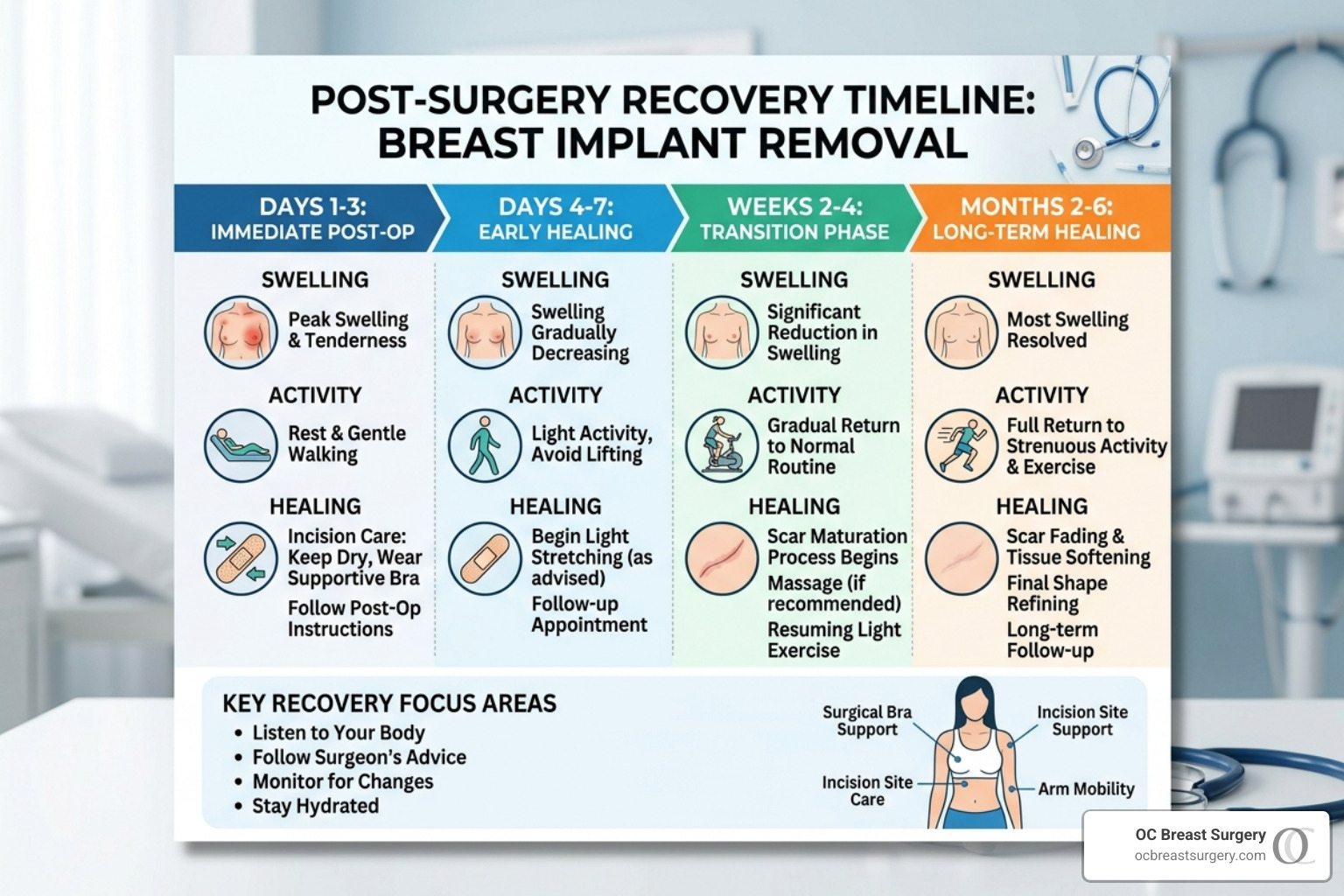
When we discuss the breast implant removal recovery timeline, it is important to recognize that “explant surgery” is not a one-size-fits-all procedure. The complexity of your surgery directly influences how your body heals. While the American Society of Plastic Surgeons notes that most women resume light activity within a week, the specific surgical technique used plays a major role.
In April 2026, we are seeing a massive shift in patient preferences. Statistics show a 653% rise in revisions between 2020 and 2024, with many women opting for total or en bloc removals. The American Society of Plastic Surgeons recommends removing or replacing implants every 10 to 15 years, and as these devices reach their “expiration date,” understanding the nuances of the recovery expectations is vital for a stress-free experience.
Comparing Surgical Techniques
The technique chosen often depends on why you are removing the implants—whether it’s for Breast Implant Illness (BII) concerns, capsular contracture, or simply a desire for a more natural look.
| Technique | Description | Impact on Recovery |
|---|---|---|
| Simple Removal | Only the implant is removed; the scar tissue (capsule) remains. | Shortest recovery; minimal internal trauma. |
| Total Capsulectomy | The implant and the entire scar tissue capsule are removed. | Moderate recovery; involves more internal healing. |
| En Bloc Capsulectomy | The implant and capsule are removed together as one single, unopened unit. | Most complex; requires larger incisions and more downtime. |
Whether you choose a simple removal or a more intensive en bloc procedure, our goal at OC Breast Surgery is to ensure you feel supported throughout your entire healing journey.
What to Expect Early in Your Breast Implant Removal Recovery Timeline
The first few days after surgery are focused on managing fluid and protecting the surgical site. Many patients will have surgical drains—small, flexible tubes that prevent fluid (seroma) from building up in the space where the implant used to be.
We typically ask patients to log their fluid output daily. Once the drainage drops below the 30cc threshold (roughly one ounce) in a 24-hour period, the drains can be safely removed. This usually happens between day 5 and day 10. You will also wear a compression wrap or a specialized surgical bra 24/7 for the first two weeks. This garment is your best friend; it minimizes swelling and provides the “internal support” your tissues need as they begin to contract.
Your first post-op visit in Newport Beach usually occurs within 24 to 48 hours, with suture removal typically happening at the one-week mark. For a more detailed look at healing after implant removal, we always emphasize that patience in these early days pays off in long-term results.
Long-Term Milestones in Your Breast Implant Removal Recovery Timeline
As you move past the first week, you’ll start to feel like yourself again. Most patients can return to non-strenuous desk work within 7 to 10 days, though we suggest taking two weeks off if your job requires significant movement.
Driving is usually permitted after one week, provided you are no longer taking narcotic pain medication and have regained a comfortable range of motion in your arms. However, the “heavy lifting ban” is strict: no lifting anything heavier than a gallon of milk (about 10 lbs) for at least six weeks. According to Breastcancer.org, skipping these restrictions can lead to complications like hematomas or widened scars.
8 Essential Tips for an Optimized Recovery

To ensure your breast implant removal recovery timeline stays on track, we recommend these eight expert-backed strategies:
- Prioritize Nutrition and Hydration: Your body needs fuel to rebuild tissue. Focus on lean proteins (chicken, fish, beans), antioxidants (berries, leafy greens), and healthy fats. Drink at least half your body weight in ounces of water daily to help flush out anesthesia and reduce swelling.
- Strictly Avoid Smoking and Alcohol: Smoking constricts blood vessels and can lead to skin necrosis (tissue death) or failed wound healing. Alcohol can increase swelling and interfere with your medications. We ask patients to abstain for at least three weeks before and after surgery.
- Master the “Sleep Incline”: Sleep on your back with your head and torso elevated at a 45-degree angle. This uses gravity to help fluid drain away from the chest, significantly reducing morning tightness and swelling.
- Manage Your Meds Proactively: If you are prescribed narcotics, take them on a schedule for the first 48 hours rather than waiting for the pain to become severe. To avoid the common side effect of constipation, start a stool softener the night of your surgery.
- Use Cold Compresses Wisely: Apply ice packs or cold compresses to the sides of the breasts (avoiding the nipples) for 20 minutes on and 20 minutes off during the first 72 hours. This is the most effective way to manage the “peak swelling” that occurs on day three.
- Gentle Movement is Key: While you shouldn’t hit the gym, you should walk around your house every two hours while awake. This promotes circulation and prevents dangerous blood clots (DVT).
- Follow the “No Arms Above Shoulders” Rule: For the first 10 days, avoid reaching high into cabinets or washing your own hair if it requires significant reaching. This protects the internal sutures and the “pocket” where the implant was removed.
- Prepare Your “Recovery Nest”: Before surgery, place everything you need at waist level. Have your Explant Surgery Recovery Guide handy, along with button-down shirts that don’t require you to lift your arms over your head.
Managing Side Effects and Recognizing Complications
It is normal to experience a variety of sensations as your nerves “wake up” after surgery. Many patients report nipple hypersensitivity, burning sensations, or sharp “zaps” of pain. This is actually a good sign—it means nerve regeneration is occurring.
However, it is crucial to distinguish between normal healing and potential complications. Swelling typically peaks on day 3 and should gradually subside. If you notice asymmetrical swelling (one side significantly larger than the other), it could indicate a hematoma (blood buildup) or seroma (fluid buildup).
When to call us immediately:
- Fever threshold: A temperature over 100.4 degrees Fahrenheit.
- Infection signs: Redness that is hot to the touch, pus-like drainage, or a foul odor.
- Shortness of breath: This could indicate a rare but serious issue like a collapsed lung (pneumothorax).
- Severe Pain: Pain that is not relieved by your prescribed medication.
In cases where implants are removed due to concerns about BIA-ALCL (a rare lymphoma), we may perform CD30 testing on the capsule tissue to ensure your health and safety.
Long-Term Results: Sagging, Scars, and Combined Procedures
One of the most common questions we hear is, “What will my breasts look like afterward?” It is a reality that after years of carrying implants, the skin and breast tissue have been stretched. This can lead to a “deflated” or hollow appearance once the implants are gone.
Interestingly, 47% of women now choose not to replace their implants, according to recent statistics. To address sagging, many of our Newport Beach patients choose to combine their explant with a mastopexy (breast lift). This procedure removes excess skin and reshapes the remaining natural tissue to a more youthful position.
Another popular option is fat transfer. We can take fat from areas like the abdomen or thighs via liposuction and inject it into the breasts to provide a modest, natural volume boost. This “hybrid” approach is excellent for those who want to be “implant-free” but still want a bit of cleavage and fullness.
Regarding scars, they will appear quite red and pronounced for the first 1 to 3 months. However, with proper care and sun protection, they will begin to flatten and fade to a pale pink or white by the one-year mark. Our Breast Implant Removal Before After Guide provides a realistic look at how these results evolve over time.
Frequently Asked Questions About Explant Surgery
When can I resume strenuous exercise?
We recommend a very gradual increase. You can start light walking immediately. By the 4-week mark, you may be cleared for lower-body exercises (like a stationary bike). However, a full exercise routine—including upper-body weights, running, or high-impact aerobics—usually requires 6 to 8 weeks and specific clearance from your surgeon.
Will my insurance cover breast implant removal?
In many cases, the answer is no if the original surgery was purely cosmetic. However, if there is a “medical necessity,” such as a ruptured silicone implant, severe capsular contracture (Grade III or IV), or chronic infection, some plans may provide coverage. Under the Women’s Health and Cancer Rights Act (WHCRA) of 1998, if your implants were part of a post-mastectomy reconstruction, removal is generally covered. We recommend focusing on “functional issues” like pain or limited range of motion when documenting your case for insurance.
How long do surgical drains stay in place?
Drains are typically in place for 1 to 3 weeks. The timing depends entirely on your body’s fluid management. You will log the output daily; once the drainage is consistently less than 20-30cc per day for two consecutive days, we will remove them during a quick office visit.
Conclusion
Navigating the breast implant removal recovery timeline is a journey toward a more comfortable, natural version of yourself. While the first few weeks require patience and diligent care, the vast majority of our patients find the “explant life” incredibly rewarding, often reporting improved energy and a lighter physical feeling.
At OC Breast Surgery, Dr. Mark Anton and our specialized team in Newport Beach are dedicated to providing the highest level of expertise in breast revision and reconstruction. We pride ourselves on achieving natural-looking results and correcting even the most complex complications from previous surgeries.
If you are ready to take the next step in your healing journey, we invite you to schedule a consultation for Breast Implant Removal with us today. Let’s work together to help you feel confident and healthy in your own skin.