
See the Transformation in Our Gynecomastia Before and After Gallery
What Gynecomastia Surgery Before and After Photos Actually Show
Gynecomastia surgery before and after photos reveal one of the most dramatic chest transformations in male plastic surgery — a visibly flatter, firmer chest with improved nipple position and a more masculine contour.
Here is a quick overview of what most patients can expect to see:
- Chest shape: Rounded or puffy chest becomes flat and defined
- Nipple position: Nipples often sit higher and more naturally after excess tissue is removed
- Scarring: Small scars along the areola edge or underarm area that fade significantly over time
- Timeline: Early results visible within weeks; final results typically clear by six months post-op
- Satisfaction: Studies show 85–95% of patients report high satisfaction after surgery
Gynecomastia is far more common than most people realize. It affects up to 70% of adolescent boys, and in many cases it does not resolve on its own — even with diet, exercise, or lifestyle changes. For men who carry excess breast tissue into adulthood, surgery is often the only effective solution.
Many patients describe avoiding fitted shirts, pools, and social situations for years before seeking help. The decision to pursue surgery is rarely just about appearance — it is about confidence and quality of life.
I’m Dr. Mark Anton, a board-certified breast surgery specialist with over 33 years of experience performing procedures including male breast reduction, and I’ve seen how transformative gynecomastia surgery before and after photos can be for a patient’s self-image. In the sections below, I’ll walk you through everything you need to know to understand your options and set realistic expectations.
Simple gynecomastia surgery before and after photos word guide:
Understanding Gynecomastia vs. Pseudogynecomastia
To set realistic expectations when looking at gynecomastia surgery before and after photos, it is essential to understand exactly what condition is being treated. Many men who believe they have gynecomastia actually have a condition known as pseudogynecomastia, and the distinction between the two dictates the surgical technique we must use.
True gynecomastia is characterized by the proliferation of dense, fibrous glandular tissue behind the nipple-areola complex. This tissue is firm to the touch and cannot be burned off through diet or targeted exercise. It is primarily driven by a hormonal imbalance—specifically, an elevated ratio of estrogen to testosterone. This hormonal shift can occur during puberty, as a side effect of certain medications, or due to aging and natural hormonal declines.
In contrast, pseudogynecomastia consists almost entirely of excess adipose (fatty) tissue without significant glandular enlargement. This is often the result of overall weight gain or genetic fat distribution patterns. While diet and exercise can reduce the volume of pseudogynecomastia, many men still struggle with stubborn fat deposits in the pectoral region that refuse to budge.
When exploring gynecomastia treatment options, a physical examination is the most reliable way to differentiate between the two. During a consultation at our Newport Beach, CA clinic, we palpate the chest tissue; a firm, disc-like mass directly beneath the areola points to true gynecomastia, while soft, uniform tissue indicates pseudogynecomastia.
| Feature | True Gynecomastia | Pseudogynecomastia |
|---|---|---|
| Primary Tissue Type | Dense, fibrous glandular tissue | Adipose (fatty) tissue |
| Texture | Firm, rubbery, disc-like knot under the nipple | Soft, uniform, pliable fat |
| Primary Cause | Hormonal imbalance (Estrogen/Testosterone) | Weight gain, genetics, lifestyle |
| Response to Exercise | Minimal to none (glands do not shrink with diet) | Can decrease with overall fat loss |
| Surgical Approach | Direct surgical excision (often combined with lipo) | Liposuction alone is often sufficient |
Understanding this difference explains why some patients in galleries achieve excellent results with liposuction alone, while others require surgical gland removal to achieve a flat chest contour.
Who is a Good Candidate for Male Breast Reduction?
Not everyone with chest fullness is an immediate candidate for surgery. To achieve the outstanding outcomes you see in the ASPS Gynecomastia Gallery, candidates must meet several safety and lifestyle criteria:
- Stable Weight: Significant weight fluctuations after surgery can compromise your results. Candidates should be at or near their target body weight.
- Good Overall Health: Patients must be free of uncontrolled medical conditions that could impair healing or increase anesthesia risks.
- Realistic Expectations: Surgery aims for improvement and a natural masculine contour, not absolute perfection or a completely hollow chest.
- Adolescent Stability: While gynecomastia affects up to 70% of adolescent boys, we generally recommend waiting until late adolescence or adulthood to ensure hormone levels have stabilized and the tissue will not regress naturally.
- Non-Smokers: Nicotine severely restricts blood flow, which can lead to wound healing complications and wider scars. Patients must commit to quitting smoking well before and after the procedure.
What to Look for in Gynecomastia Surgery Before and After Photos
When reviewing gynecomastia surgery before and after photos, it is easy to focus solely on how flat the chest looks. However, a highly successful outcome involves several subtle aesthetic factors that contribute to a natural, masculine appearance.

When evaluating gynecomastia before and after galleries, keep these critical details in mind:
- Pectoral Definition and Contour: A successful surgery does not simply scoop out all the tissue to leave a completely flat or concave chest. An experienced surgeon sculpts the remaining fat and tissue to highlight the natural margins of the pectoral muscles. The transition from the chest to the underarms and abdomen should be smooth and athletic.
- Nipple-Areola Complex (NAC) Position: In larger cases of gynecomastia, the weight of the excess tissue pulls the nipples downward. Look at the “after” photos to see if the nipples have been lifted to a more youthful, masculine position on the chest wall. They should sit naturally over the lower portion of the pectoral muscle, not droop toward the fold.
- Symmetry: While no human body is perfectly symmetrical, the surgery should correct noticeable differences in size, shape, or projection between the left and right sides of the chest.
- Absence of Deformities: A common complication of inexperienced surgery is the “crater deformity,” where too much tissue is removed directly beneath the nipple, causing it to collapse inward. High-quality results show a smooth, continuous surface.
Analyzing Real Patient Gynecomastia Surgery Before and After Photos
Every patient’s anatomy is unique, which is why we tailor our surgical approach to each individual. When you look at an OC Breast Surgery Case Study, you will see how different techniques translate to real-world visual outcomes.
For instance, in patients with mild to moderate glandular tissue, a direct excision via a small semi-circular incision along the lower border of the areola is highly effective. If you look closely at clinical galleries, you will notice that the incision line is cleverly camouflaged along the natural color transition of the areola border, making it nearly invisible once fully healed.
For patients with moderate fibroglandular tissue, some surgeons utilize specialized techniques like the lateral pull-through. This method allows the surgeon to extract the firm gland through a small, remote incision, minimizing direct scarring on the front of the chest. Other cases demonstrate how minimally invasive approaches under local anesthesia can achieve clean, defined pectoral lines with exceptionally rapid recovery times.
Addressing Puffy Nipples and Areola Stretching
A major concern for many men seeking surgery is the appearance of “puffy nipples.” This occurs when dense glandular tissue directly behind the areola pushes the nipple forward, making it project outward even through thick clothing.
Through targeted gynecomastia puffy nipples correction, we remove this firm glandular disc. This allows the nipple and areola to lay flat against the pectoral muscle. Additionally, when the chest has been stretched out by excess volume for years, the areola itself can become enlarged. During surgery, we can perform an areola reduction, resizing the dark skin to a smaller, more proportional diameter that matches the newly contoured chest.
Surgical Techniques and Expected Scarring
To achieve the refined contours shown in our galleries, we utilize a combination of advanced surgical techniques. The choice of technique directly influences the placement and eventual appearance of your scars.
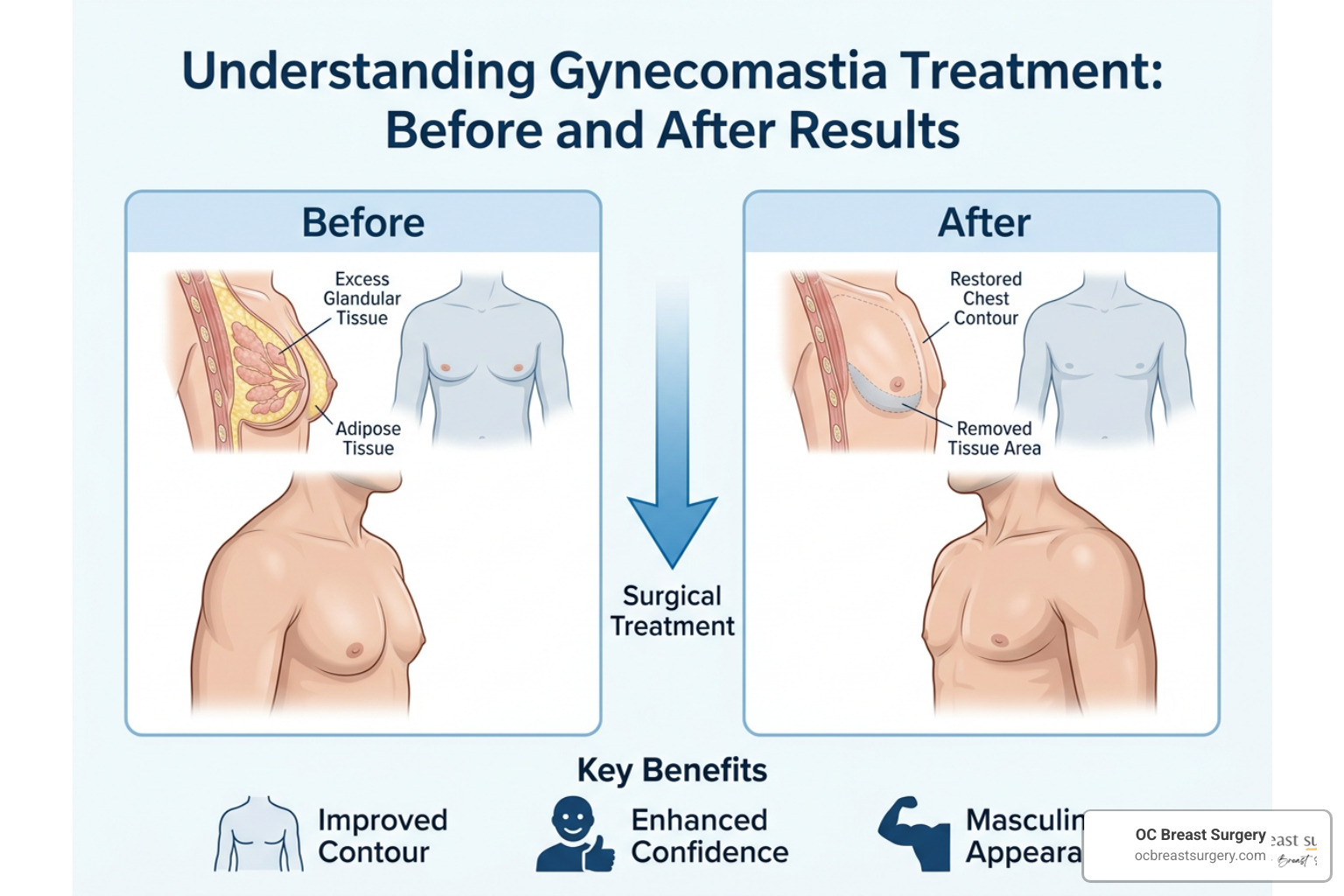
During your consultation, we will map out a customized plan based on your tissue composition and skin elasticity. The three primary approaches outlined in our gynecomastia surgery procedure details include:
- Liposuction: If your chest fullness is primarily composed of fatty tissue (pseudogynecomastia), liposuction alone can deliver outstanding results. We insert a thin tube (cannula) through tiny, well-hidden incisions—often in the armpit or the natural fold under the breast. This gently vacuums out the excess fat, leaving minimal, millimeter-sized scars.
- Direct Excision: When firm glandular tissue is present, liposuction alone cannot remove it. We must physically excise the gland. This is performed through an intra-areolar incision (an arc-shaped cut along the bottom edge of the areola). This placement takes advantage of the natural color boundary to hide the scar.
- Combination Approach: The majority of our patients benefit from a combination of both techniques. We first use liposuction to contour the entire chest and thin out the fat layer, and then perform a direct excision to remove the stubborn gland behind the nipple. This ensures a smooth transition and prevents any unnatural-looking steps or hollows.
How Surgical Techniques Impact Gynecomastia Surgery Before and After Photos
The integration of modern technologies has revolutionized the visual outcomes we can achieve. For example, we frequently utilize Vaser liposuction, which uses ultrasound energy to emulsify fat cells before they are removed. This protects the surrounding connective tissues, leading to smoother skin retraction and less bruising.
For patients presenting with mild to moderate skin laxity—often after moderate weight loss—we can combine tissue removal with J-Plasma (helium plasma energy) or similar radiofrequency devices. This delivers subdermal heating that coaxes the skin to contract tightly over the new chest contour, often sparing the patient from needing more extensive skin-removal incisions.
In cases of massive weight loss, where patients have lost 60 pounds or more, severe skin sagging is common. In these scenarios, achieving a flat chest requires a more extensive surgical lift. This may involve horizontal incisions along the pectoral fold or, in extreme cases, a mastectomy technique with free nipple grafting. While this leaves longer, more visible scars, patients gladly accept this trade-off to achieve a flat, masculine chest contour that allows them to wear fitted clothing comfortably.
Recovery Timeline and Long-Term Results
Understanding the healing journey is crucial when viewing gynecomastia surgery before and after photos. Many of the immediate “after” photos you see online are taken at different intervals, and it is important to know that your chest will go through several distinct healing phases before reaching its final shape.
Immediately after surgery, the chest will be swollen, bruised, and slightly tender. This is a completely normal part of the inflammatory response. To manage this and optimize your results, you will need to wear a medical-grade compression garment continuously for the first 4 to 6 weeks. This garment minimizes fluid buildup, supports the healing tissues, and helps the skin conform to its new, flatter shape.
To help you plan, here is a general breakdown of our gynecomastia surgery results timeline:
- Days 1–3: Swelling and bruising are at their peak. Most patients manage discomfort easily with prescribed medication.
- Week 1: Many patients can return to light desk work and daily walks. The initial post-op follow-up is scheduled to check incision sites.
- Weeks 2–3: Bruising fades significantly. Light cardiovascular exercise (like stationary cycling) can often be resumed, but heavy lifting remains restricted.
- Weeks 4–6: The compression garment is typically transitioned to part-time wear or discontinued. Most swelling has resolved, offering a clear preview of your new contour.
- Months 3–6: Residual deep tissue swelling dissipates. Incisions begin to soften, transition from pink to flesh-colored, and flatten out. Your final, sculpted masculine chest contour is fully realized.
For a raw look at the immediate post-operative stage, some patients document their journey early on, highlighting the immediate flattening of the chest even while swelling is just beginning. In contrast, other resources show beautifully settled, masculine contours just weeks after a dual-approach procedure.
Are Gynecomastia Surgery Results Permanent?
One of the most reassuring aspects of male breast reduction is that the results are generally permanent. Once the excess glandular tissue and fat cells are surgically removed, they cannot grow back. However, maintaining your new masculine chest contour requires a commitment to a healthy lifestyle.
A small percentage of patients (typically under 10% globally) may experience a recurrence of chest fullness due to specific lifestyle or medical factors:
- Significant Weight Gain: While the removed fat cells are gone forever, remaining fat cells in the chest area can expand if you experience substantial weight gain.
- Anabolic Steroids and Supplements: The use of performance-enhancing drugs, testosterone boosters, or certain pre-workout supplements can disrupt your hormone balance, triggering the growth of any residual gland tissue.
- Hormone-Fluctuating Medications: Certain prescription medications for hair loss, depression, or cardiovascular issues can alter estrogen-testosterone ratios.
- Medical Conditions: Underlying liver, kidney, or thyroid disorders can impact hormone metabolism and contribute to tissue regrowth.
By maintaining a stable body weight and avoiding compounds that disrupt your endocrine system, you can enjoy your flat, contoured chest for decades to come.
Frequently Asked Questions About Male Breast Reduction
How much does gynecomastia surgery cost?
Because every chest is unique, the cost of male breast reduction varies based on the complexity of your procedure. Factors that influence the final price include whether you require liposuction alone, direct gland excision, or a combination of both, as well as the type of anesthesia used and the surgical facility fees.
During your personalized consultation in Newport Beach, CA, we provide a detailed, all-inclusive quote. To learn more about pricing structures and payment plans, read our comprehensive guide on how much is gyno surgery.
Will I have highly visible scars after the procedure?
We make every effort to place incisions in the natural shadows and contours of your body. For liposuction, the incisions are tiny (around 4-5mm) and typically hidden in the armpit or the crease under the breast. For gland removal, the semi-circular incision along the lower edge of the areola blends seamlessly with the natural change in skin pigment. Over the course of 12 to 18 months, these scars mature, fade, and soften, becoming highly inconspicuous for the vast majority of patients.
How long after surgery can I return to the gym?
We encourage light walking the very day after surgery to promote healthy blood circulation. However, you must avoid strenuous activity, heavy lifting, and chest-specific exercises (like bench presses or push-ups) for at least 4 to 6 weeks. Elevating your heart rate and blood pressure too early in the recovery process can increase swelling, prolong bruising, or cause bleeding under the skin, which can negatively impact your final contour.
Conclusion
Making the decision to address gynecomastia is a powerful step toward reclaiming your body confidence and comfort. As we have explored, achieving a natural, athletic chest contour requires a highly personalized surgical approach, an artistic eye for masculine anatomy, and advanced surgical techniques.
At OC Breast Surgery in Newport Beach, CA, Dr. Mark Anton and our dedicated team specialize in delivering custom, natural-looking results. Whether you are dealing with true glandular gynecomastia, pseudogynecomastia, or seek to correct a previous, unsatisfactory procedure, we are committed to guiding you safely through every step of your transformation.
Ready to see what is possible for your own body? We invite you to Schedule a Gynecomastia Surgery Consultation with us today. Let us help you achieve the flat, firm, and masculine chest contour you deserve.