
Direct to Implant: Your Guide to Reconstruction Recovery
What Breast Reconstruction Before and After Really Looks Like
Seeing breast reconstruction before after photos for the first time can be both overwhelming and hopeful. Here is a quick overview of what the journey typically involves:
What to expect at a glance:
- Before surgery: Consultation, imaging, and planning based on your cancer stage, body type, and timing of reconstruction
- During surgery: Implant-based or flap-based reconstruction, sometimes combined with nipple-sparing or skin-sparing mastectomy
- After surgery: A phased recovery, followed by finishing steps like nipple reconstruction or 3D tattooing
- Final results: A restored breast shape that improves over months as swelling fades and scars mature
More than 100,000 women undergo breast reconstruction in the United States each year following mastectomy. The results vary widely depending on the technique used, the surgeon’s experience, and each patient’s unique anatomy and medical history.
This guide walks you through every stage — from choosing the right procedure to understanding what realistic results look like — so you can move forward with clarity and confidence.
I’m Dr. Mark Anton, founder of OC Breast Surgery in Newport Beach, CA, with over 33 years of experience in breast reconstruction surgery — including co-developing the Star Flap Nipple Reconstruction technique, still widely used today. I’ve dedicated my career to helping women understand their breast reconstruction before after journey so they can make informed decisions with confidence.
Easy Breast reconstruction before after glossary:

- Autologous breast reconstruction options
- Natural breast lift options
- Natural looking breast augmentation
Understanding Your Breast Reconstruction Surgery Options
When facing a mastectomy, understanding how we can rebuild what cancer takes away is an incredibly empowering step. Breast reconstruction is not a “one-size-fits-all” procedure. It is a highly customized process designed to restore shape, volume, and symmetry to your chest.
To find the right path, we first look at the timing of your surgery. You have two primary options:
- Immediate Reconstruction: This is performed during the same operation as your mastectomy. While you are asleep, the breast surgeon removes the breast tissue, and we immediately step in to begin rebuilding the breast mound.
- Delayed Reconstruction: This option takes place months or even years after your mastectomy and cancer treatments are complete.
Your cancer stage, overall physical health, and the need for post-mastectomy treatments (like chemotherapy or radiation) are the primary factors that dictate this timing. To dive deeper into how these elements interact, explore our comprehensive guide on Breast Cancer Reconstruction Surgery Options and learn more about the physical steps of the procedure in our resource on How Do They Reconstruct Breast After Cancer Surgery.
Immediate vs. Delayed Reconstruction: Key Decision Factors
Choosing between immediate and delayed reconstruction is a collaborative decision made alongside your breast surgeon and oncologist.
Immediate reconstruction is highly favored when oncological safety permits. It often allows us to perform a skin-sparing mastectomy or a nipple-sparing mastectomy, preserving your natural breast skin envelope and, in some cases, your own nipple-areola complex. This typically leads to less noticeable scarring and a more natural-looking transition in your breast reconstruction before after photos.
However, if your oncology team determines that you require intensive post-mastectomy radiation therapy, delayed reconstruction may be recommended. Radiation can damage reconstructed tissue, cause implants to contract, or alter the shape of a newly formed breast. Waiting until radiation is complete ensures that the reconstructed breast remains soft, symmetrical, and healthy. For a closer look at this decision-making process, read our guide on the Post Mastectomy Journey Navigating Breast Reconstruction Options.
How Patient Health and Body Type Influence the Surgical Plan
Your unique physical blueprint plays a massive role in determining which surgical technique will yield the safest and most beautiful results. During your consultation in Newport Beach, CA, we evaluate several key factors:
- Body Mass Index (BMI) and Donor Site Tissue: If you are interested in using your own tissue (autologous reconstruction), we must evaluate whether you have adequate donor tissue on your abdomen, thighs, or buttocks.
- Medical History and Comorbidities: Conditions such as diabetes, auto-immune disorders, or circulatory issues can affect how your incisions heal.
- Smoking History: Nicotine severely restricts blood flow, which is critical for the survival of transferred tissue and skin flaps. We require patients to be completely nicotine-free well in advance of surgery.
- Age and Lifestyle: Your daily activity level, career, and personal recovery goals help us select a technique that matches your lifestyle.
To learn more about how we tailor these operations to your specific body, read our detailed breakdown of Autologous Breast Reconstruction Options.
Comparing Implant-Based and Autologous (Flap) Reconstruction
The two primary methodologies for rebuilding a breast are implant-based reconstruction and autologous (flap) reconstruction.
- Implant-Based Reconstruction: This technique accounts for approximately 80% of all breast reconstructions in the United States. It utilizes silicone gel or saline implants to recreate the breast mound. This is often a staged process, starting with a temporary tissue expander that is gradually filled with saline over several weeks to stretch the skin before the final implant is placed.
- Autologous (Flap) Reconstruction: This method uses your own living tissue harvested from another part of your body. Common donor sites include the lower abdomen (DIEP flap or TRAM flap), the upper thighs (PAP flap), the buttocks (LAP flap), or the back (latissimus dorsi flap). There are also specialized implant-free options like the SWIM flap or a Goldilocks mastectomy, which rearrange local tissue to create a smaller, natural breast mound without foreign materials.
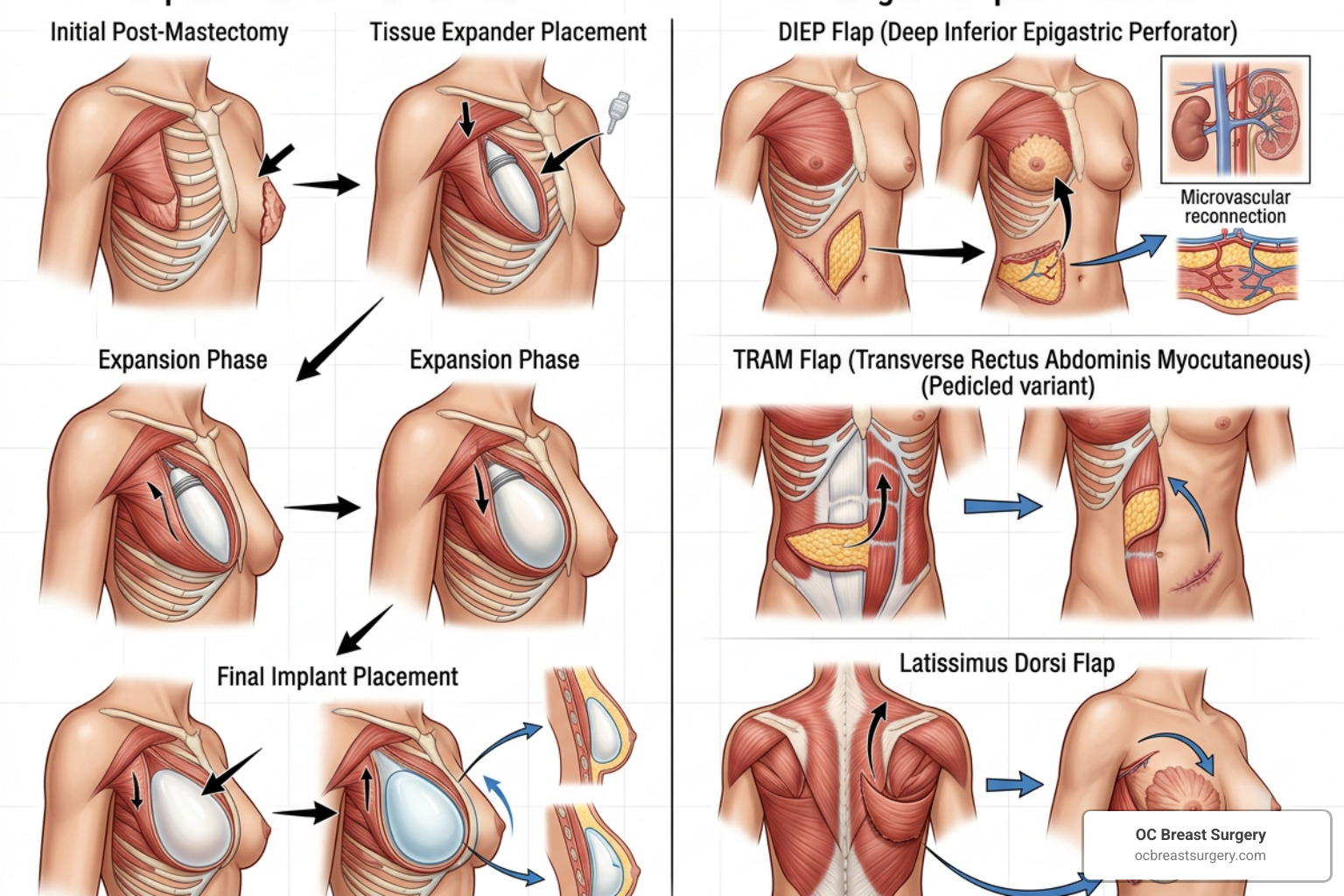
| Feature | Implant-Based Reconstruction | Autologous (Flap) Reconstruction |
|---|---|---|
| Primary Material | Silicone or Saline Implants | Your own living tissue (fat, skin, muscle) |
| Surgery Time | Shorter (usually 1.5 to 3 hours) | Longer (typically 4 to 8+ hours) |
| Recovery Window | 2 to 4 weeks | 6 to 8 weeks (two surgical sites to heal) |
| Long-Term Feel | Firm, may feel cooler to the touch | Soft, warm, and behaves like natural breast tissue |
| Aging Process | Implants do not change size with weight fluctuations | Flaps naturally fluctuate with weight gain or loss |
| Maintenance | May require future implant exchange surgeries | Permanent results that rarely require long-term revision |
Both options have distinct benefits. To explore the surgical details of using your own tissue, read about Flap Reconstructive Breast Surgery. If you are leaning toward implants, discover what to expect in our guide on Breast Implants After Mastectomy.
The Impact of Radiation Therapy on Reconstruction Choices
Radiation therapy is a lifesaver, but it is notoriously tough on skin and tissue. When breast tissue is radiated, it loses some of its elasticity and blood supply, becoming firmer and less pliable.
If you have had radiation and choose implant-based reconstruction, the risk of capsular contracture (where the scar tissue around the implant tightens and hardens) is significantly higher. To mitigate this, we often use an acellular dermal matrix (ADM)—a sterile, tissue-engineered biological sling—to support the implant, provide extra coverage, and encourage healthy tissue integration.
Because radiated tissue stretches slowly, the tissue expansion phase must be managed with extreme patience, sometimes taking up to eight months of gradual fills to safely prepare the skin for the final implant. For many patients with a history of radiation, autologous flap reconstruction is the preferred choice, as it brings fresh, healthy tissue with its own blood supply into the radiated chest area, promoting better healing and a softer, more natural result.
Visualizing Your Journey: Breast Reconstruction Before After Photos
One of the most valuable tools in your pre-operative planning is studying breast reconstruction before after galleries. Looking at these photos is not about picking a breast out of a catalog; it is about aligning your expectations with surgical realities.
When we design your surgical plan, we focus heavily on:
- Symmetry: Ensuring the reconstructed breast matches the natural breast (in unilateral cases) in projection, height, and drape.
- Volume Matching: Selecting implant sizes or tissue flap volumes that complement your natural frame.
- Scar Placement: Placing incisions discreetly along the inframammary fold or around the areola whenever possible.
To begin visualizing what is possible, view our collection of Pictures of Reconstructive Breast Surgery After Mastectomy and browse real outcomes in our gallery of Before and After Breast Reconstructive Surgery.
Setting Realistic Expectations with Breast Reconstruction Before After Galleries
As you review breast reconstruction before after images, it is important to remember that these photos represent a journey over time, not an instant transformation.
- Scar Maturation: Immediately after surgery, scars will appear red, raised, and highly visible. Over the course of 12 to 18 months, these scars fade, soften, and flatten significantly. You can see how these marks evolve by studying our resource on Before and After Double Mastectomy Scars.
- Symmetry Procedures: Achieving perfect balance often requires a “symmetrizing” procedure on the opposite, non-cancerous breast. This can include a contralateral breast lift (mastopexy), a breast reduction, or a small breast augmentation to ensure both sides match beautifully in your clothes and swimwear.
- Multiple Stages: Many of the stunning “after” photos you see are the result of a multi-stage process, which may include secondary fat grafting to smooth out contours or a minor outpatient procedure to build a new nipple.
For additional clinical examples of how these procedures are staged, you can browse the ASPS Breast Reconstruction Before and After Photos.
How to Analyze Breast Reconstruction Before After Results
When evaluating a surgeon’s portfolio, look for patients who share your basic physical characteristics. Ask yourself:
- Does this patient have a similar height, weight, and torso shape to mine?
- Did they start with a similar breast size and skin elasticity?
- Did they undergo the same type of mastectomy (e.g., nipple-sparing vs. total mastectomy)?
A highly experienced, board-certified plastic surgeon will have a diverse gallery showing consistent, natural-looking contours, balanced symmetry, and well-healed scars across a wide range of body types.
The Recovery Timeline and Finishing Aesthetic Touches
Healing from breast reconstruction is a step-by-step process. While everyone heals at their own pace, having a roadmap of the recovery phases can help you plan your life, work, and support system.
- Week 1 to 2 (The Acute Phase): Your primary focus is rest and pain management. You will likely go home with surgical drains in place to collect excess fluid. These drains are usually removed in our Newport Beach, CA office within 7 to 14 days. Light walking is encouraged to promote healthy circulation, but lifting anything heavier than a gallon of milk is strictly off-limits.
- Week 3 to 6 (The Transition Phase): Swelling begins to subside, and your range of motion will improve. Many patients can return to light desk work and driving once they are off all prescription pain medications and their drains are removed.
- Month 2 to 6 (The Settling Phase): The reconstructed breast tissues will begin to “drop and fluff,” softening into a more natural position. You can gradually reintroduce moderate exercise and normal daily activities.
To prepare yourself fully for this transition, read our detailed guide, The Journey of Breast Reconstruction What to Expect Before During and After Surgery.
Nipple Reconstruction and 3D Tattooing: The Final Aesthetic Steps
Once the breast mound has fully healed and settled into its permanent shape (usually 3 to 6 months after your final reconstructive surgery), we can perform the finishing touches that truly restore the visual appearance of a natural breast.
For patients who did not undergo a nipple-sparing mastectomy, we can recreate the nipple-areola complex using local skin flaps—artfully folding the skin on the new breast mound to create a realistic, raised nipple.
The absolute cherry on top of this journey is 3D nipple tattooing (micropigmentation). Using advanced shading and highlighting techniques, a specialized medical tattoo artist can create an incredibly realistic, three-dimensional illusion of an areola and nipple. This non-surgical, outpatient procedure is often the emotional turning point where patients finally feel “whole” again. See how these final touches complete the transformation in our article on the Reconstructed Breast After Mastectomy.
Addressing Complications and Revision Procedures
While our primary goal is to get your reconstruction right the first time, complications can sometimes occur, or you may simply find yourself unhappy with the aesthetic outcome of a previous surgery performed elsewhere.
We specialize in corrective breast surgery and breast revision. Whether you are dealing with asymmetrical breasts, implant ripples, capsular contracture, or tissue loss, there are highly effective solutions available to restore both your comfort and your confidence.
Common Revision and Corrective Procedures:
- Fat Grafting (Lipofilling): Harvesting fat from your abdomen or thighs via gentle liposuction and injecting it around the edges of an implant to soften hard transitions, fill in hollow spots, and create a warmer, more natural feel.
- Implant Exchange: Replacing older implants, changing implant profiles, or switching from saline to highly cohesive silicone gel implants to improve the overall shape and projection.
- Capsulectomy: Surgically removing hardened scar tissue (capsule) around an implant to relieve tightness and restore softness.
- Breast Explant Surgery: For patients who choose to transition from implants to a completely flat chest or an autologous tissue option.
If you are currently dissatisfied with your initial surgical outcome, you are not alone. Read our advice on being Unhappy With Breast Reconstruction After Mastectomy and explore your options for corrective care in our articles on Breast Revision Surgery After Mastectomy and Breast Explant Surgery.
Frequently Asked Questions About Breast Reconstruction
Does health insurance cover breast reconstruction surgery?
Yes, absolutely. Under the federal Women’s Health and Cancer Rights Act (WHCRA) of 1998, group health plans, individual health plans, and insurance companies that offer mastectomy coverage must also cover all stages of breast reconstruction. This federal mandate includes reconstruction of the breast on which the mastectomy was performed, surgery and reconstruction of the other breast to produce a symmetrical appearance, and breast prostheses.
To understand how to navigate these benefits and minimize your out-of-pocket expenses, read our guides on Breast Reconstruction Surgery Insurance Coverage and Does Insurance Cover Breast Reconstruction Surgery.
How much does breast reconstruction surgery cost?
If your reconstruction is performed in conjunction with breast cancer treatment, the vast majority of the costs—including surgeon fees, anesthesia, operating room costs, and implants—are covered by your health insurance provider. However, if you are paying out-of-pocket or seeking specific cosmetic revisions not covered by your plan, the total cost can vary based on the complexity of the surgery.
For a transparent breakdown of potential fees and financial planning, please refer to our resources: How Much Does Breast Reconstruction Surgery Cost and How Much Does Reconstructive Breast Surgery Cost.
What are the newest breast reconstruction techniques available?
The field of reconstructive plastic surgery is constantly evolving. Some of the most exciting advancements available today include:
- Prepectoral Implant Placement: Placing the breast implant on top of the chest muscle rather than underneath it. This eliminates the “animation deformity” (where the implant moves when you flex your chest) and results in a much less painful recovery.
- Sensation-Sparing Techniques: Using microsurgical nerve grafting to reconnect the nerves of the chest skin to the newly transferred flap tissue, helping to restore some physical sensation to the reconstructed breast.
- Direct-to-Implant (One-Stage) Reconstruction: Bypassing the tissue expansion phase entirely and placing the permanent implant immediately after a nipple-sparing mastectomy.
To stay up to date on these medical breakthroughs, read our article on New Breast Reconstruction Techniques.
Conclusion
Breast reconstruction is more than a surgical procedure; it is a profound step toward reclaiming your body, your confidence, and your peace of mind after cancer. Whether you are at the very beginning of your cancer journey or looking to revise a past reconstruction, you deserve compassionate, world-class care tailored specifically to your body and your life.
At OC Breast Surgery in Newport Beach, CA, Dr. Mark Anton and our dedicated medical team specialize in creating natural-looking, beautiful results that help you feel like yourself again. We invite you to take the next step in your healing journey.
Schedule a consultation for breast reconstruction or breast revision with us today.