
You may be here because you've looked in the mirror after breast augmentation and felt that one side seems higher, fuller, tighter, or otherwise different. That reaction is common. It can be unsettling, especially when you expected both breasts to look balanced and move through recovery in the same way.
The first thing to know is that asymmetry doesn't always mean something went wrong. Breasts are rarely identical to begin with, and surgery can reveal differences in chest shape, tissue thickness, or nipple position that were less noticeable before. At the same time, a clear difference in size, shape, or position after surgery is a real concern, and it deserves careful evaluation.
Table of Contents
- Introduction What Is Breast Augmentation Asymmetry
- Common Causes of Uneven Breast Augmentation Results
- Assessing Your Asymmetry When to Be Concerned
- Your Options for Correcting Asymmetry
- Surgical Solutions for Breast Augmentation Asymmetry
- Why Choose a Breast Revision Specialist in Orange County
- Frequently Asked Questions About Asymmetry Correction
Introduction What Is Breast Augmentation Asymmetry
Breast augmentation asymmetry means the breasts don't match as closely as expected after surgery. The difference might be in volume, shape, height, projection, or the way the implants sit on the chest. One side may look rounder, one nipple may sit lower, or one implant may seem to ride high while the other has already settled.
That can happen even though augmentation is also used to improve asymmetry in the first place. In fact, breast augmentation can be used to create more balanced volume and contour when the breasts differ in size, shape, or position. The important distinction is that surgery can improve imbalance, but it can't erase the realities of anatomy or healing.
A simple example helps. A patient may start with one breast naturally smaller and a slightly uneven chest wall. After implants are placed, the size difference improves, but during healing one implant settles faster. Now the patient notices not just the original mismatch, but a new difference in height. That's why asymmetry after augmentation can feel confusing. More than one factor may be involved at the same time.
Perfect symmetry isn't a realistic standard in breast surgery. Meaningful improvement and better balance are.
The key question isn't “Are they identical?” The better question is “Is the difference minor and expected, or is it pronounced enough to suggest a treatable problem?” Once you frame it that way, the situation becomes much easier to understand.
Common Causes of Uneven Breast Augmentation Results
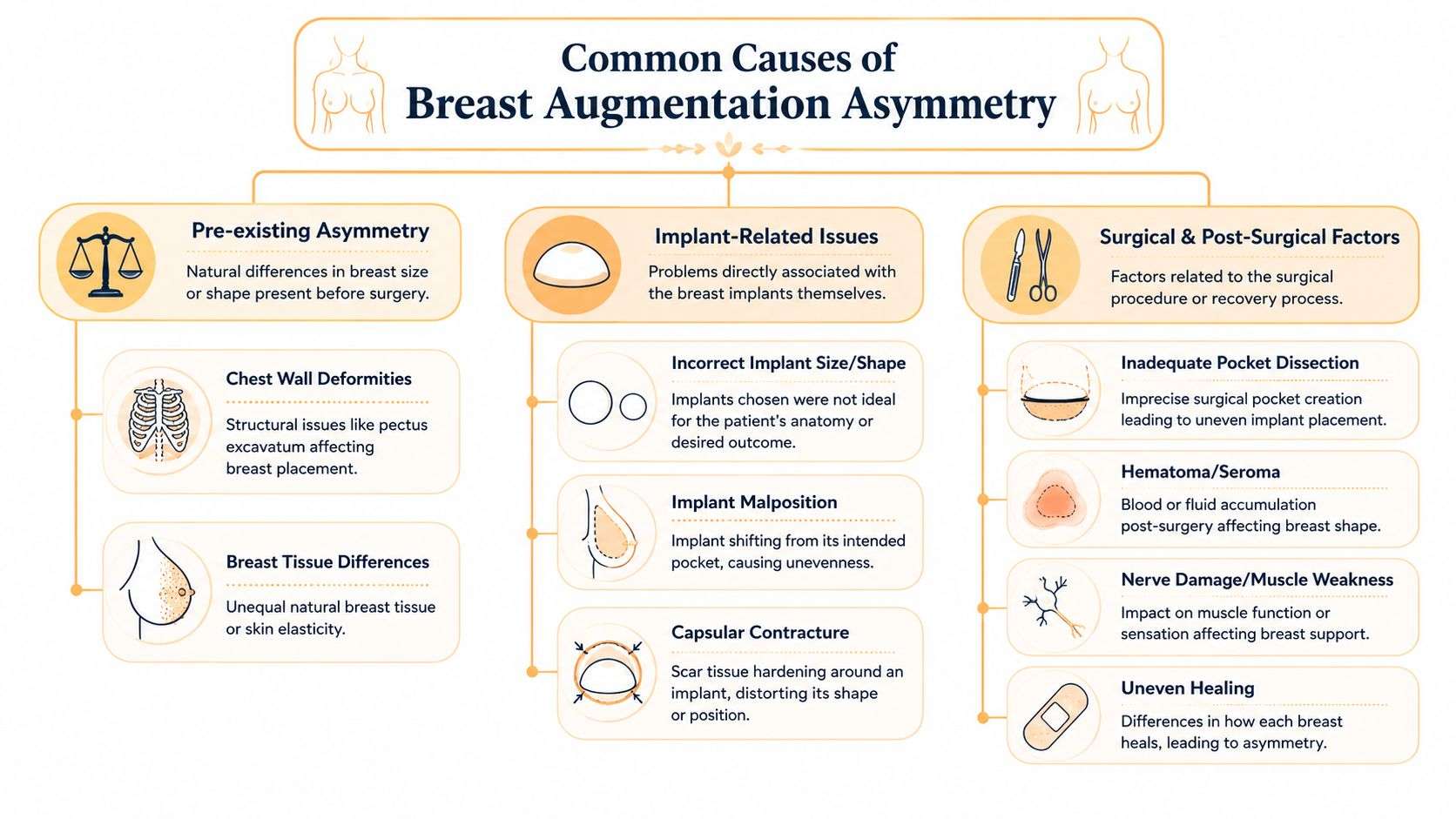
Some uneven results begin before surgery. Others develop after surgery. Many patients have a combination of both.
Pre existing anatomy
A large share of breast asymmetry starts with the body's natural framework. Research published in ASJ Open Forum reports that approximately 10.6% to 36% of women seeking breast augmentation already have chest wall deformities that contribute to asymmetry. That matters because an implant sits on top of a structure that may already be uneven.
Pre-existing differences can include:
- Chest wall shape Some patients have rib cage differences that change how each breast projects forward.
- Breast footprint One breast may start lower, wider, or narrower on the chest.
- Skin and tissue quality One side may have looser skin or less natural tissue support.
If you want a broader patient-friendly overview of natural mismatch before surgery, this guide to lopsided breasts and common causes can help frame what many women notice long before any procedure.
Implant related changes
Sometimes the issue isn't the implant itself, but what happens to it over time. An implant can shift within the pocket. It can sit too high, move too low, or drift to the side. When that happens, one breast may look fuller in the upper part while the other looks heavier in the lower part.
Capsular contracture is another important cause. Scar tissue naturally forms around an implant, but when that tissue tightens too much, it can change the implant's shape, feel, and position. The breast may become firmer and look more distorted than the opposite side.
A breast that looked balanced early on can become uneven later if the implant pocket changes or scar tissue tightens.
Surgical and healing factors
Even with good planning, healing isn't perfectly symmetrical. One side can swell more. One implant can settle faster. Blood or fluid collection can temporarily distort shape. In some cases, pocket creation or support in the lower breast fold may affect how well the implants stay aligned.
These factors don't all carry the same weight. Mild short-term differences are common in recovery. Structural issues, such as malposition or contracture, usually behave differently. They persist, become more noticeable, or create an obvious difference in contour.
A useful way to think about causes is this:
| Category | What it means for appearance | Typical concern |
|---|---|---|
| Anatomical | Breasts start from different foundations | One side never matched perfectly, even before surgery |
| Implant related | Implant position or capsule changes the breast shape | A new difference develops or worsens over time |
| Healing related | Recovery happens unevenly | Early mismatch may improve as tissues settle |
Assessing Your Asymmetry When to Be Concerned
The timing matters as much as the appearance. Breasts rarely heal in perfect sync, so judging the result too early can create unnecessary worry.
What early healing can look like
One breast may be more swollen, tighter, or slower to drop into place. That doesn't automatically mean a revision is needed. In early recovery, small to moderate differences often reflect swelling patterns, muscle tightness, and normal settling.
What matters is the direction of change. If the breasts are gradually becoming more similar, that usually supports continued observation. If they're becoming more uneven, or if one side feels hard, painful, or visibly displaced, that deserves closer attention.
Signs that deserve attention
A few signs tend to raise more concern than simple early swelling:
- Persistent height mismatch One breast remains clearly higher or lower.
- Shape distortion One side looks unusually round, flattened, boxy, or bottom-heavy.
- Firmness or discomfort One breast feels much tighter or harder than the other.
- Visible movement problem The implant appears to have shifted out of its intended position.
Localized implant complications, including asymmetry, occur in at least 1% of breast augmentation patients and the risk can persist or increase over the life of the implant. That doesn't mean every uneven result is serious. It does mean long-term follow-up matters.
If a difference is obvious in clothing, visible in a mirror from across the room, or paired with firmness or discomfort, it's reasonable to ask for an expert assessment.
Bring photos if you have them. A picture from before surgery, one from the first few weeks after surgery, and current images can help show whether the issue is pre-existing, temporary, or progressive. That history often matters as much as the physical exam.
Your Options for Correcting Asymmetry
Not every uneven result needs another operation right away. But not every problem will improve on its own, either. The best correction depends on whether the asymmetry is mild and early, or structural and persistent.
When non surgical measures may help
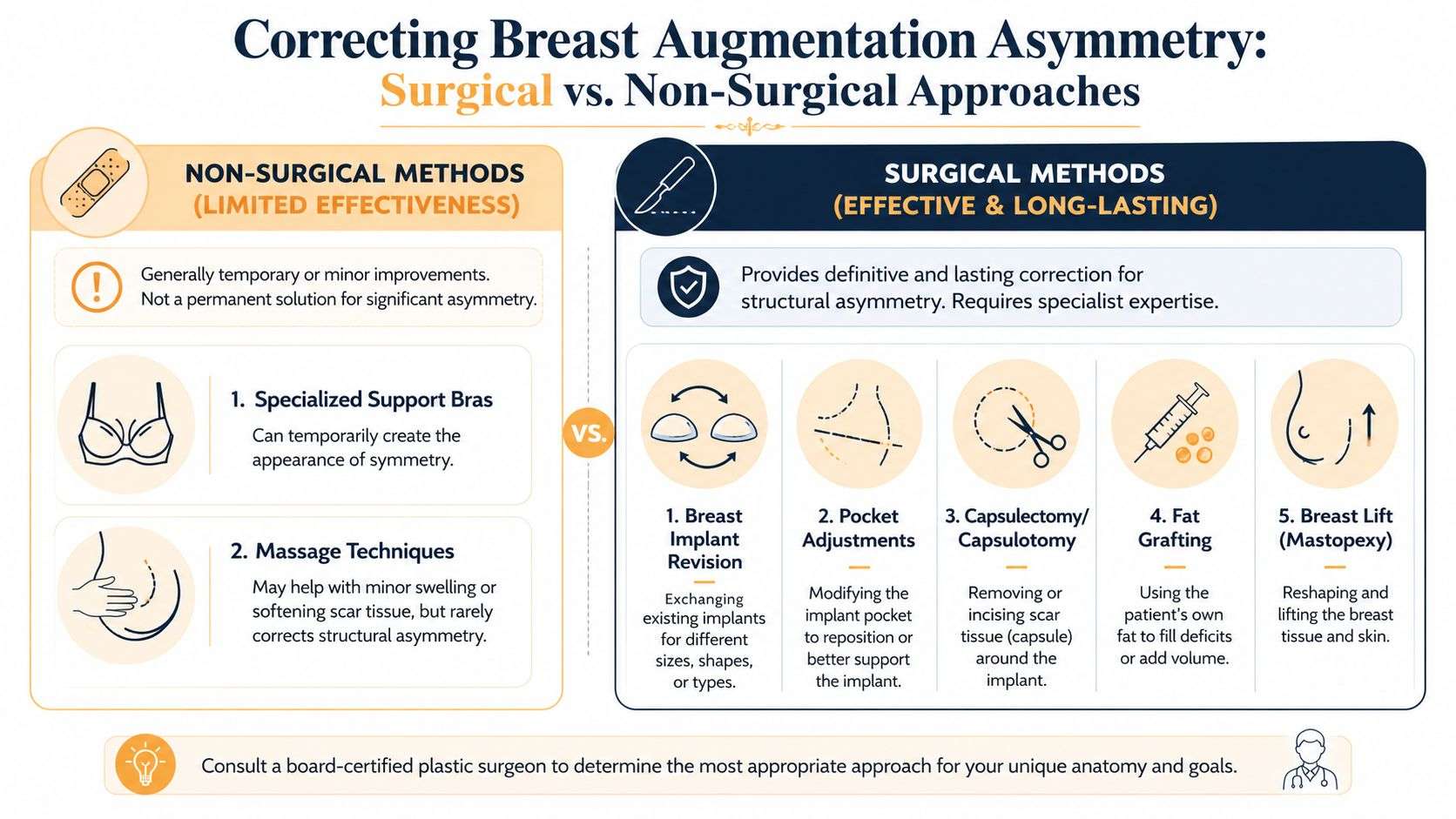
There is a narrow window when supportive measures can be useful. Early postoperative displacement may sometimes improve with non-surgical shoelace support techniques, but that approach is intended for mild, early shifts rather than major asymmetry. In practical terms, this applies to subtle early implant movement before healing has stabilized the pocket.
Other non-surgical strategies may include temporary support garments and close observation. These measures can help guide healing, but they don't correct major pocket problems, significant size differences, or firmness caused by scar tissue.
When surgery becomes the better solution
A lasting correction usually requires surgery when the asymmetry comes from implant position, implant size mismatch, capsule problems, or breast tissue sagging. That's because the issue is structural. Support garments can disguise it, but they can't rebuild support, release scar tissue, or reset pocket boundaries.
Here's the simplest comparison:
- Non-surgical care Best for minor early shifts, temporary swelling differences, and short-term support during healing.
- Surgical correction Better for persistent malposition, implant-related distortion, significant size mismatch, or tissue changes that won't self-correct.
In some cases, correction isn't only about the implant. It may involve the surrounding breast tissue as well. For example, a patient with a hollow area or contour difference may benefit from combining revision principles with volume refinement. For readers exploring that concept, fat transfer breast augmentation is one way surgeons may think about adding softness or filling selected areas, depending on anatomy.
A good consultation should answer two questions clearly. First, what is causing the asymmetry? Second, which part of the breast needs correction: the implant, the pocket, the skin envelope, or all three?
Surgical Solutions for Breast Augmentation Asymmetry
When breast augmentation asymmetry is significant, revision planning has to be specific. The operation should match the problem, not just the appearance.
Breast Implant Revision
Breast Implant Revision is often the central procedure for asymmetry correction. It can involve exchanging implants, changing implant type, adjusting implant profile, or reconstructing the pocket that holds the implant in place.
That matters because asymmetry can stem from more than size alone. One breast may need better internal support. Another may need a different pocket position. Sometimes both sides need coordinated changes to create balance.
A concrete revision example illustrates this principle. In a breast implant revision performed by Dr. Mark Anton, asymmetry was corrected by exchanging 360 cc saline implants for 600 cc moderate profile silicone gel implants to restore symmetry in volume, shape, and projection. The lesson isn't that one implant size is better. It's that revision surgery often works by solving the exact mismatch that's present.
Common revision goals include:
- Implant exchange Changing size, profile, or fill material to improve proportion.
- Pocket revision Tightening, releasing, or reshaping the internal space so the implant sits correctly.
- Capsule treatment Addressing scar tissue when it's distorting shape or pushing the implant out of position.
Some patients also ask about coverage for revision when discomfort, rupture, or reconstructive issues are part of the picture. Coverage varies by carrier and situation, and anyone navigating documentation requirements may find this overview of the prior authorization process helpful before speaking with their insurer and the practice.
Revision surgery works best when the surgeon identifies whether the true problem is volume, position, support, scar tissue, or a combination of all four.
Super Breast Lift
Sometimes the implant isn't the only issue. The breast tissue and nipple position may also be uneven. If one breast sits lower, has more stretched skin, or the nipples don't align, an implant exchange by itself may leave the imbalance only partly corrected.
That's where a Super Breast Lift can play a role. A lift reshapes the skin envelope and repositions breast tissue. For asymmetry, that can be especially important when one breast has dropped more than the other or when the lower fold positions don't match.
This type of correction focuses on breast shape, skin support, and nipple balance. In many patients, that's what brings the result together.
Breast Implant Removal
Not every patient wants new implants. Some decide that the best answer is Breast Implant Removal, especially if they're dealing with long-term implant problems, recurrent asymmetry, or a change in their goals.
Removal can be paired with reshaping techniques to restore a more balanced breast contour after the implants come out. If one side has stretched more than the other, tissue management becomes a major part of creating symmetry.
This is also where expectations have to stay realistic. Surgery can improve balance significantly, but breasts still age, tissue changes over time, and the body continues to evolve. A good plan aims for harmony, not mathematical perfection.
Why Choose a Breast Revision Specialist in Orange County
Primary augmentation and revision surgery are not the same operation. Revision cases are usually more complex because the surgeon is working with scar tissue, altered anatomy, stretched tissue, implant pocket changes, and a patient who often has a very clear sense of what feels wrong.

Why revision surgery is different
Correcting asymmetry requires diagnosis before technique. A revision specialist has to determine whether the visible difference comes from the implant, the capsule, the breast tissue, the chest wall, or some combination of these. If that distinction is missed, the wrong surgery can produce only partial improvement.
This is one reason patients often seek a second opinion after an unsatisfying result. Revision work is less about repeating the first procedure and more about solving a more layered structural problem.
Why experience matters
Dr. Mark Anton, founder of OC Breast Surgery, is a Castle Connolly Top Doctor with over 30 years of practice in Newport Beach, treats thousands of breast patients, and focuses on surgical solutions for ruptured implants, leaking implants, and implant malposition that cause visible asymmetry. That kind of focused breast experience matters when the problem is nuanced rather than routine.
Patients considering revision in this area often want to understand the process in more detail before scheduling. This Orange County breast implant revision guide offers a useful starting point.
Choosing a revision specialist in Orange County isn't about finding someone who can replace implants. It's about finding someone who understands how breasts heal, how implants behave over time, and how to rebuild balance when the original plan no longer fits the anatomy.
The surgeon's judgment is part of the procedure. In revision surgery, that judgment often determines whether the correction is superficial or truly structural.
Frequently Asked Questions About Asymmetry Correction
What is the recovery like for a breast revision surgery
Recovery depends on what's being corrected. A straightforward implant exchange may feel different from a more involved revision that includes pocket repair, scar tissue treatment, or a lift. Most patients should expect swelling, temporary tightness, and a period of restricted upper-body activity while the breasts settle.
Healing also tends to feel less predictable than many patients expect. One side may still recover faster than the other. That's why follow-up and surgeon guidance matter so much after revision.
Will my insurance cover surgery to correct asymmetry
Coverage varies by carrier and situation. Some cases are viewed as cosmetic, while others may involve reconstructive needs or complications such as rupture, capsular problems, or issues related to prior breast surgery. Patients should contact their insurance provider and the practice for guidance rather than assuming coverage or denial.
Are the results of asymmetry correction permanent
It's better to think in terms of long-term improvement rather than a permanent, unchanging result. Revision surgery can correct a structural problem and create much better balance, but the breasts will still respond to aging, weight change, pregnancy, skin quality, and the natural passage of time.
That doesn't make surgery less worthwhile. It means the goal is durable improvement with realistic expectations.
If you're unsure whether your concern is part of normal healing or something more significant, a personalized examination is the safest next step.
Schedule a consultation with OC Breast Surgery in Newport Beach to learn which breast surgery option may be right for your goals.