
You're standing in front of the mirror after pregnancy, major weight loss, or years of watching your body change. Your breasts have less upper fullness, your nipples sit lower, and no bra seems to restore the shape you remember. You may be searching for how to get rid of saggy breasts, but the useful answer isn't a list of creams, exercises, or miracle products. It's a decision about anatomy, skin quality, breast volume, and whether surgery fits your goals.
Table of Contents
- What Sagging Really Means and What This Guide Will Cover
- Why Breasts Sag and Which Factors You Can Change
- What Exercise, Bras, and Creams Can and Cannot Do
- Surgical Options Matched to the Type of Sagging You Have
- Candidacy, Consultation, Recovery, and Realistic Risks
- How to Choose a Breast Surgery Specialist
- Taking the Next Step With a Personalized Consultation
What Sagging Really Means and What This Guide Will Cover
Breast sagging is called breast ptosis, the descent of the breast as skin and internal support structures loosen. Pregnancy, weight change, and aging can alter breast shape in different ways. Some people lose volume, some develop excess skin, and others have both descent and symptoms caused by heavy breast tissue.
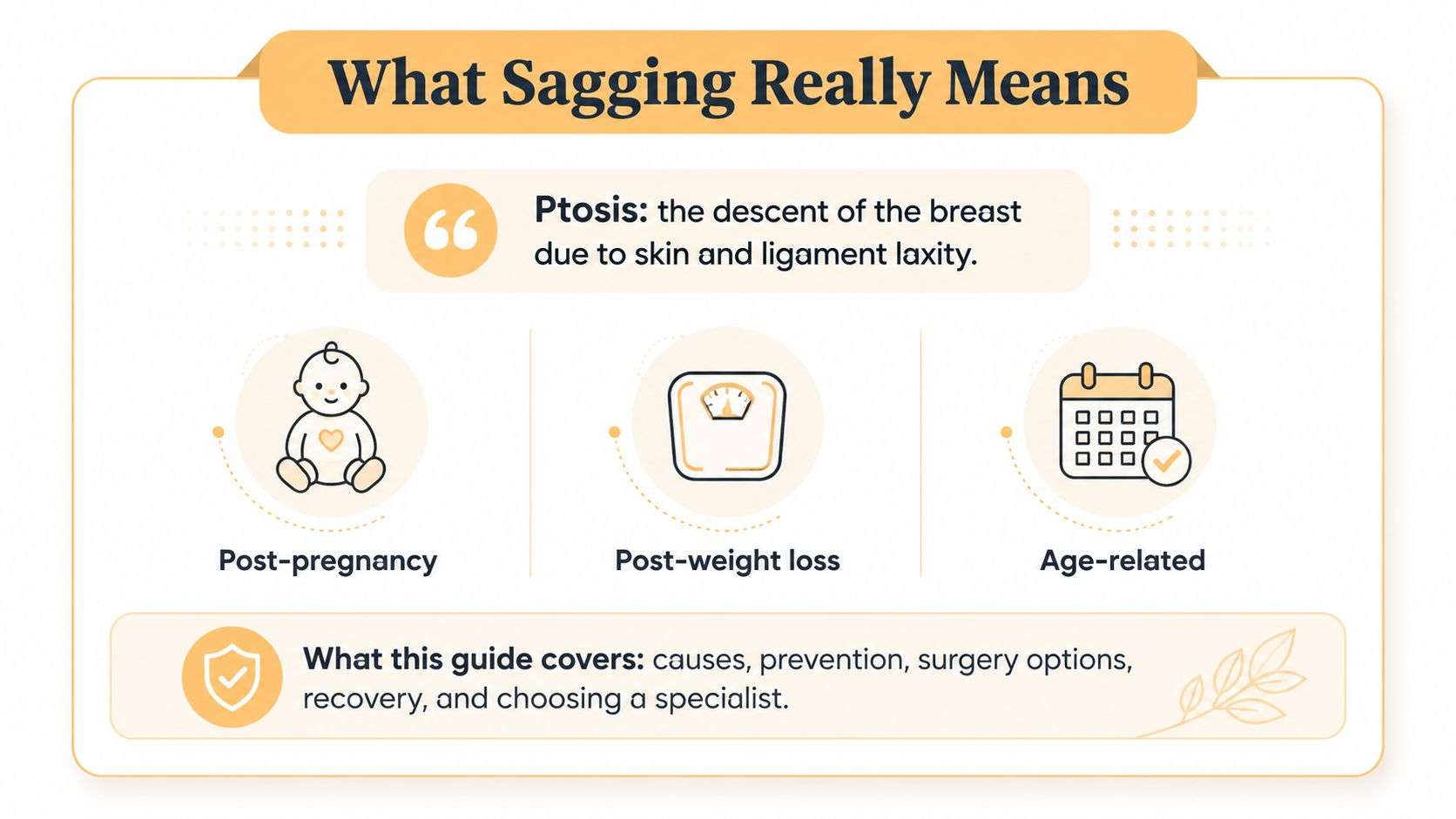
The first promise is honesty about nonsurgical treatment. Exercise can strengthen the chest beneath the breast, supportive bras can improve comfort and temporary appearance, and healthy habits can help protect skin quality. None of these reliably removes stretched skin or moves a descended nipple back to a higher position.
The second is a clear surgical framework. A Super Breast Lift, Breast Reduction, Breast Augmentation, Breast Implant Revision, Breast Implant Removal, or Breast Reconstruction may be appropriate, but each addresses a different problem. A lift repositions tissue. An implant adds volume. A reduction decreases weight while reshaping the breast. Revision and removal address problems involving existing implants.
The third is a practical way to assess a specialist. You need someone who can recognize when a lift alone is enough, when added volume creates more risk, and when a staged plan is safer than combining procedures. That matters especially after previous surgery, because scar tissue, implant position, skin stretch, and asymmetry can make a routine-looking case technically complex.
Practical rule: If the nipple and breast tissue have descended because the skin envelope is stretched, no topical product can substitute for a procedure that removes or reshapes that envelope.
The next sections address the causes you can influence, the limits of exercise and skincare, the surgical choices that match different patterns of ptosis, and the recovery and risks involved. You'll also see how to prepare for a consultation and what to ask when choosing a breast surgery specialist in Newport Beach.
Why Breasts Sag and Which Factors You Can Change
Breast ptosis develops through several overlapping forces. Age, larger breast size, higher body mass index, smoking history, and significant weight loss greater than 50 pounds are strongly associated with sagging in this review of breast ptosis causes and treatment.
Pregnancy requires a more precise explanation. In the same study, 85% of patients who had been pregnant reported adverse changes in breast shape after pregnancy. The breast expands, then involutes, stressing the skin and internal support. The study also reported that 35% experienced smaller breast size and 30% experienced larger breast size after pregnancy. Breastfeeding itself was not identified as a significant risk factor, so lactation alone should not be treated as the cause.
Weight change can produce a similar pattern. Losing more than 50 pounds is associated with ptosis because the breast may lose fat and volume while the skin envelope fails to contract to the same degree. Maintaining a stable weight can limit further stretching. It cannot reliably remove redundant skin that is already present.
Smoking is one of the clearest factors you can change. It damages skin quality and can impair blood flow, affecting both natural aging and surgical healing. Stopping nicotine before a procedure is a safety requirement, not an aesthetic preference.
What your breast size and tissue composition tell you
Other contributors are fixed or largely outside your control:
- Native breast volume: Larger breasts place more downward force on skin and internal support.
- Skin elasticity: Genetics influence collagen quality and how well skin contracts.
- Tissue composition: A breast with less glandular volume and more loose skin behaves differently from a compact, dense breast.
- Age-related change: Skin and breast tissue gradually lose resilience over time.
Your anatomy determines which changes lifestyle can influence and which require surgery. The Regnault system classifies ptosis by the nipple's relationship to the inframammary fold. Grade 1 places the nipple at the fold. Grade 2 places it below the fold but not at the breast's lowest point. Grade 3 places it below the fold and at the most dependent part of the breast (Regnault ptosis classification).
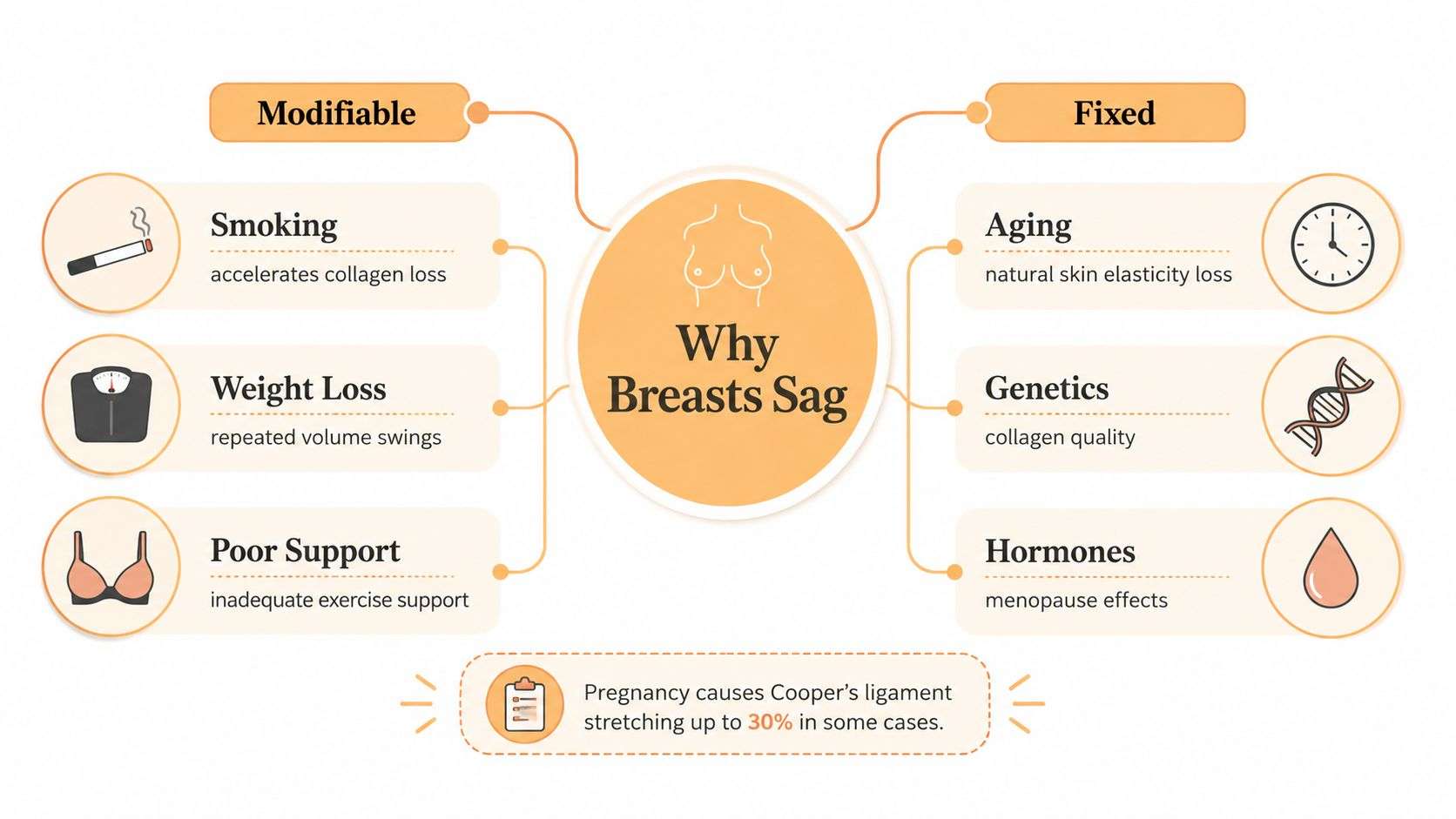
Lifestyle changes can slow further descent, especially by avoiding smoking and repeated major weight fluctuations. They cannot reverse established ptosis after the skin envelope and supporting structures have stretched. If you are also rebuilding strength after childbirth, resources on recovering core after childbirth may support general postpartum conditioning. Core recovery does not reposition breast tissue.
What Exercise, Bras, and Creams Can and Cannot Do
Chest presses, flyes, and push-ups are worthwhile exercises, but they work on the pectoralis muscle behind the breast, not the breast tissue itself. Building that muscle may improve the underlying chest contour and posture. It won't remove excess breast skin, shorten stretched internal support, or move a low nipple to a higher position.
A supportive bra has a different role. It can reduce movement, improve comfort, make clothing fit better, and create a temporarily lifted appearance. It may be particularly useful during physical activity or after breast surgery, when your surgical team recommends a specific garment. A bra supports the breast from the outside. It doesn't permanently change the breast's internal position.
Topical products also have a defined limit. Moisturizers, retinoid-based products, and peptide skincare may improve surface hydration or texture, and readers interested in powerful ingredients for lifted skin can compare general skincare information. These products don't restore ligament length or tighten a stretched breast envelope.
| Option | What It Can Improve | What It Cannot Change |
|---|---|---|
| Chest press, flyes, and push-ups | Pectoral strength, posture, and the muscle contour beneath the breast | Descended breast tissue, excess skin, or nipple position |
| Supportive bra | Comfort, motion control, and temporary shape under clothing | Permanent lifting or skin tightening |
| Moisturizer and topical skincare | Surface hydration and skin texture | Ptosis, breast volume, or stretched internal support |
| Stable weight and smoking cessation | Further tissue stress and overall healing conditions | Established sagging and redundant skin |
| Surgical breast lift | Nipple position, breast shape, and excess skin | A guarantee against future aging, pregnancy-related change, or weight change |
The practical test is simple. If your concern is mainly that the breast looks lower, the nipple points downward, or skin hangs beneath the fold, exercise and creams won't correct the underlying anatomy. A breast lift is the procedure designed to reshape and reposition that tissue. If the concern is lost upper-pole volume, Breast Augmentation may be discussed, but an implant alone may not correct significant descent.
For a deeper discussion of options that don't rely on implants, review this natural breast lift guide. The right choice still depends on an examination, not an online checklist.
Surgical Options Matched to the Type of Sagging You Have
Surgery should match the main anatomical problem. Position, volume, breast weight, skin excess, and existing implant status need separate assessment. A breast that looks deflated requires a different plan from one that is heavy, stretched, or distorted after implant surgery.
| Procedure | Best Ptosis Type | What It Corrects | Key Trade-off |
|---|---|---|---|
| Super Breast Lift | Mild to advanced descent when added implant volume isn't the priority | Excess skin, nipple position, and breast projection through reshaping and internal support | It doesn't create the same added volume as an implant |
| Breast Augmentation | Deflation with limited skin excess and limited descent | Upper-pole fullness and overall size | An implant can't reliably lift a significantly descended breast by itself |
| Breast Reduction | Sagging with excessive breast weight or macromastia | Volume, breast weight, nipple position, and contour | More tissue is removed, and scars and sensation changes must be discussed |
| Breast Implant Revision | Sagging or distortion after implant surgery | Implant position, capsule problems, rippling, rupture, or asymmetry | Revision may require pocket correction, implant exchange, lift, or staged treatment |
| Breast Implant Removal | Implant-related concerns or a preference for a smaller, implant-free breast | Removes the device and addresses implant complications or preference | Removal may reveal or increase visible skin excess, sometimes requiring a lift |
| Breast Reconstruction | Breast shape changes after mastectomy or cancer treatment | Restores breast form and can address asymmetry or ptosis within a reconstruction plan | Timing and technique depend on cancer treatment and reconstructive anatomy |
| Lift with Breast Augmentation | Descent plus meaningful upper-pole volume loss | Repositions the breast and adds volume | Combined surgery has a higher complication and revision burden |
A broad review reported an overall complication rate of 10.4% for nonimplant breast lift, including scar-related issues at 3.0% and nipple-areola problems at 2.9% (review of breast lift complications). A five-year series of simultaneous augmentation and mastopexy reported a 22.9% overall complication rate, with tissue-related complications at 15.1% and implant-related complications at 7.8%.
Those figures do not make combined surgery inappropriate. They show why added volume must justify added complexity. An implant can restore a deflated upper pole, but one that is too large for a stretched skin envelope can contribute to recurrent descent. If you prefer reshaping without an implant, review this breast lift without implants option with a qualified specialist.
When reduction or revision is the more logical answer
Heavy breasts with upper back, shoulder, or neck symptoms often call for Breast Reduction rather than a lift alone. In a large U.S. outcomes analysis, upper back pain was reported by 81.5% of patients undergoing reduction, shoulder pain by 78.6%, and neck pain by 72.3% (breast reduction outcomes analysis).
Existing implants change the decision. Capsular contracture, rupture, leaking, malposition, rippling, or dissatisfaction with size may require Breast Implant Revision or Breast Implant Removal, with or without a lift. Silicone implant rupture can be silent. The FDA identifies MRI as the most effective method for detecting silent rupture, with ultrasound an acceptable alternative for asymptomatic screening (FDA information on breast implant risks).
A Super Breast Lift may fit someone seeking repositioning and projection without added implant volume. Ask how the technique creates internal support, which incision pattern suits your anatomy, and how skin quality affects durability. The consultation should cover the expected shape as well as the factors that could lead to recurrent ptosis or revision.
Candidacy, Consultation, Recovery, and Realistic Risks
Good candidacy begins with timing. Many surgeons prefer a stable weight, completion of childbearing or acceptance that a future pregnancy may change the result, and freedom from nicotine around surgery. Medical history, medications, previous operations, breast imaging when appropriate, and the condition of any existing implant all affect planning.
The consultation should answer four questions:
- Where is the nipple relative to the fold? This helps establish the ptosis pattern.
- How much skin excess is present? Skin quality influences the incision and the likelihood of recurrent descent.
- How much breast volume remains? This determines whether a lift, augmentation, reduction, or combined plan makes sense.
- Is an implant involved? Existing devices may require imaging, removal, exchange, or capsule treatment.
Your surgeon may use standardized photographs, measurements, and imaging to compare your anatomy with realistic examples. Bring goal photographs, records from previous implant surgery, a history of weight changes, pregnancy plans, and a complete medication list. Those details can prevent an attractive but poorly matched procedure choice.
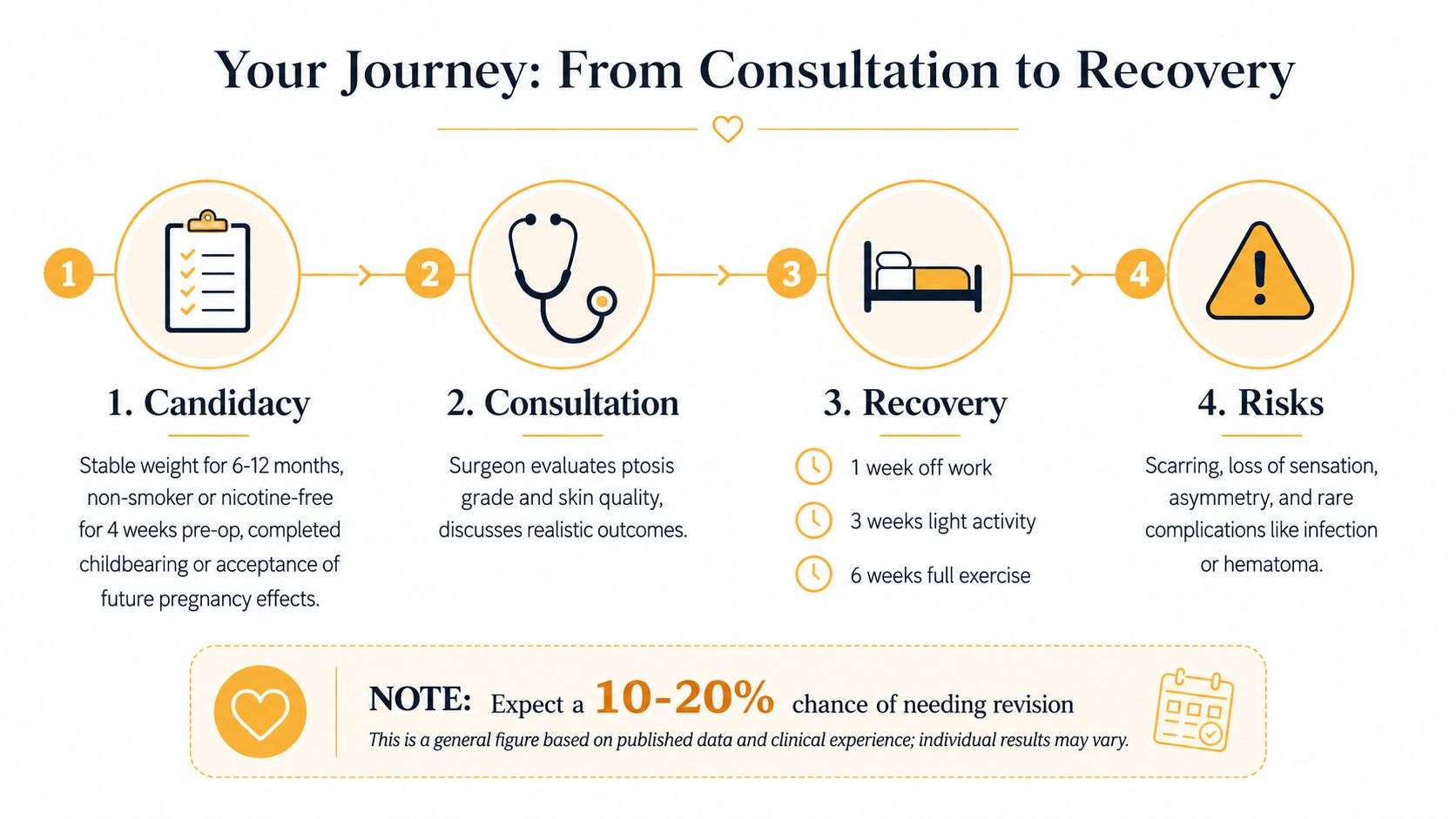
Recovery varies by operation and by the amount of reshaping required. You may need help at home initially, limit lifting, and follow instructions about wound care, compression, sleep position, and returning to activity. Scars fade gradually rather than disappearing, and breast position continues to settle as swelling resolves.
The risks include infection, bleeding, fluid collection, delayed wound healing, asymmetry, changes in nipple sensation, poor scarring, recurrent ptosis, and the possibility of another operation. In one prospective study of 784 breast procedures, mastopexy alone had a 33.3% complication rate, persistent ptosis in 9.5% of cases, and a 24.6% revision rate (prospective study of mastopexy outcomes). Those figures reinforce why procedure selection and honest counseling matter.
How to Choose a Breast Surgery Specialist
Choose the surgeon who evaluates the breast problem accurately, not the person who promises the most dramatic correction. Ptosis surgery requires judgment about skin, tissue quality, nipple blood supply, breast weight, implant pockets, scars, and symmetry. A specialist who regularly performs breast lifts, reductions, augmentation, implant revision, removal, and reconstruction is better positioned to discuss alternatives when the obvious procedure isn't the safest one.
Look for verifiable credentials and relevant experience:
- Board certification: Confirm certification through the American Board of Plastic Surgery.
- Breast-focused training: Ask about fellowship training involving breast surgery and reconstruction.
- Accredited facilities: Confirm where surgery takes place and who provides anesthesia.
- Relevant results: Review before-and-after photographs showing different grades of ptosis and body types.
- Revision experience: Ask how the practice handles recurrent sagging, implant malposition, capsular contracture, rupture, rippling, and asymmetry.
OC Breast Surgery is located in Newport Beach, California, and focuses on breast procedures. Dr. Mark Anton, the medical director and founder of OC Breast Surgery, is a fellowship-trained breast surgery specialist with extensive experience in breast and reconstruction procedures. The practice's Super Breast Lift is presented as an internal-support approach for patients considering lift surgery without implant volume.
Ask directly: “How often do you perform the procedure you're recommending, and what would make you choose a different operation?”
A responsible consultation should include a discussion of scars, sensation, wound healing, recurrent ptosis, implant-specific risks, and the possibility of staged surgery. You should also ask about the practice's revision policy, complication rates for the exact procedure under consideration, anesthesia credentials, and postoperative access.
A specialist shouldn't force every patient toward augmentation or a combined procedure. Sometimes the correct recommendation is a lift alone. Sometimes it's reduction. Sometimes implant removal with a lift makes more sense than replacing the device. And sometimes surgery should wait because weight, pregnancy plans, health conditions, or expectations aren't stable. For questions about evaluating a surgeon, this guide to finding a breast augmentation surgeon in California offers a useful consultation-oriented checklist.
Taking the Next Step With a Personalized Consultation
Start by separating two questions. What can you change? Stable weight, nicotine exposure, general conditioning, and timing may improve your surgical readiness and reduce additional stress on breast skin. What requires anatomical correction? A low nipple, excess skin, significant volume loss, heavy breast tissue, or implant distortion needs an examination and a procedure discussion.
Before your consultation, bring:
- Your goals: Include photographs showing the type of shape or upper fullness you prefer.
- Your timeline: Note pregnancy history, future pregnancy plans, and major weight changes.
- Implant records: Bring operative reports, implant information, and prior imaging if you've had breast surgery.
- Your medication list: Include prescriptions, supplements, and nicotine exposure.
- Your priorities: Decide whether your focus is lift, size, weight reduction, implant removal, reconstruction, or a natural-looking contour.
The examination will focus on nipple position relative to the inframammary fold, skin elasticity, breast volume, breast weight, asymmetry, scars, and the condition of any implant. Those findings determine whether a Super Breast Lift, Breast Reduction, Breast Augmentation, Breast Implant Revision, Breast Implant Removal, or Breast Reconstruction best addresses the underlying issue.
If you're considering surgery after mastectomy or cancer treatment, bring your oncology and reconstruction history. Ptosis can influence reconstructive planning, and staged reshaping may be more appropriate than treating the breast as a straightforward cosmetic lift.
A consultation with a dedicated breast surgery practice gives you a chance to compare the simplest appropriate option with more involved alternatives. It also gives the surgeon an opportunity to recommend waiting, staging procedures, or declining surgery when the anatomy and expectations don't align.
Schedule a consultation with OC Breast Surgery in Newport Beach to learn which breast surgery option may be right for your goals.
OC Breast Surgery offers breast-focused care for sagging, volume loss, implant concerns, reduction needs, and reconstruction planning. Visit OC Breast Surgery to schedule a consultation in Newport Beach and discuss your anatomy, medical history, and goals with Dr. Mark Anton.