
Initial downtime after breast revision surgery is commonly about 1 to 2 weeks, while more strenuous activity is usually cleared closer to 4 to 6 weeks because revision often involves additional repair beyond simple implant exchange. Feeling fully normal can take longer, since swelling, sensation, energy, mobility, and breast shape may continue changing after basic activity resumes.
That difference is the part many short recovery guides miss. “Back to work” and “back to normal” aren't the same milestone. A patient may walk comfortably and handle a desk job while still feeling tightness, fatigue, altered sensation, or limited chest movement. Recovery after breast revision surgery is better understood as a series of overlapping stages, not a single finish line.
Table of Contents
- Rethinking Breast Revision Surgery Recovery
- How Procedure Complexity Changes Recovery After Breast Revision Surgery
- Early Phase Guidance for Breast Implant Revision Aftercare
- Activity Restrictions and Return-to-Work Timelines After Breast Revision
- Managing Pain, Swelling, and Complication Risks After Breast Surgery Revision
- Wound Care, Drain Management, and Follow-Up Milestones
- Optimizing Outcomes with a Breast Surgery Specialist in Newport Beach
- Next Steps for Breast Revision Surgery Recovery Planning
Rethinking Breast Revision Surgery Recovery
Breast revision surgery recovery can follow different paths depending on whether the procedure involves Breast Implant Revision, Breast Implant Removal, Breast Reduction, a Super Breast Lift, Breast Reconstruction, or Breast Augmentation. Even within implant revision, a straightforward exchange may heal differently from surgery that addresses capsular contracture, implant malposition, rippling, rupture, or breast asymmetry.
Primary augmentation often creates a new implant pocket. Revision surgery may require the surgeon to work through existing scar tissue, repair or reshape the pocket, remove an implant, exchange an implant, or combine implant removal with a lift. Those additional steps can create more tissue disruption, so the calendar alone can't predict how you'll feel.
Four layers of healing
Think of recovery like rebuilding a house after correcting a structural problem. Closing the incision is only the first task. The deeper tissue needs time to strengthen, swelling needs to settle, and the final shape needs to stabilize.
- Wound healing covers incision closure and early protection of the surgical site.
- Energy recovery reflects how quickly your body regains stamina after surgery.
- Sensation and mobility may change as swelling decreases and tissues recover.
- Long-term settling includes scar maturation and the gradual stabilization of breast position and shape.
The American Society for Aesthetic Plastic Surgery's recovery guidance describes an initial recovery period of about 1 to 2 weeks, with more strenuous exercise commonly delayed until approximately 4 to 6 weeks. That's a useful framework, not a promise. A multicenter prospective study of breast reconstruction recovery found that recovery wasn't complete at three months for many patients, which reinforces the difference between resuming activities and feeling fully restored (prospective recovery study).
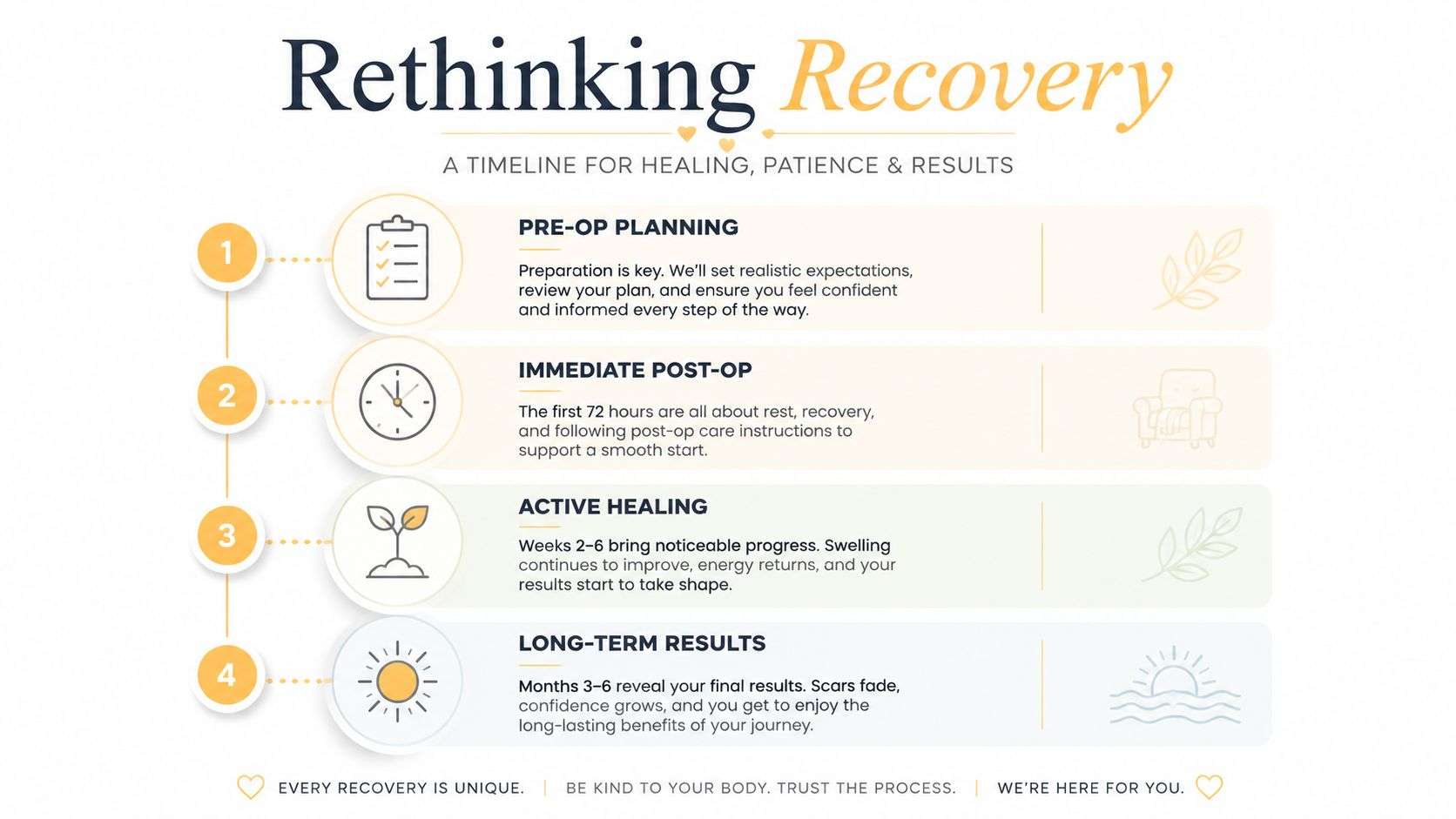
Practical rule: Plan around the slower milestone, not the earliest one. Light activity may return before strength, comfort, and breast shape do.
How Procedure Complexity Changes Recovery After Breast Revision Surgery
The operation's name doesn't tell the whole recovery story. The same “revision” label can describe a limited implant exchange or a more involved correction involving scar tissue, pocket repair, a lift, or reconstruction. The more work required inside the breast, the more important individualized aftercare becomes.
A patient having an implant exchange may mainly monitor swelling, incision healing, and implant settling. Someone with capsular contracture may need treatment directed at the capsule, the surrounding pocket, and the implant strategy. A literature review on capsular contracture concluded that implant exchange is recommended during revision and identified subpectoral smooth silicone gel implants as an option after surgical treatment for Baker III-IV disease (capsular contracture review). The relevance to recovery is practical: recurrence control and pocket management can matter as much as skin healing.
Breast Implant Removal may be relatively limited in one patient and combined with a lift in another. Breast Reduction removes and repositions tissue, while a Super Breast Lift changes breast shape and nipple position without being the same operation as simple implant exchange. Breast Reconstruction can involve a different level of tissue planning, particularly after mastectomy, so its recovery shouldn't be compared directly with a cosmetic implant exchange.
| Procedure Type | Recovery Focus | Typical Downtime Guidance |
|---|---|---|
| Implant exchange | Incision healing, swelling, and implant settling | Initial downtime is commonly about 1 to 2 weeks, with exercise clearance individualized |
| Capsular contracture correction | Capsule treatment, pocket stability, and recurrence monitoring | Healing may be more involved than a simple exchange |
| Implant removal | Incision healing and adjustment to changed breast volume | Downtime depends on whether removal is combined with a lift |
| Lift or Super Breast Lift | Skin and tissue healing, breast position, and sensation changes | Activity restrictions protect the reshaped tissue while it settles |
| Breast Reduction | Incisions, tissue repositioning, and swelling control | Strenuous activity and heavier lifting are commonly restricted during early healing |
| Breast Reconstruction | Tissue healing, reconstruction-specific monitoring, and function | Recovery varies substantially with the reconstructive plan |
Postoperative complications such as seroma, infection, hematoma, persistent postsurgical pain, and wound dehiscence are recognized risks in breast surgery and can prolong recovery. That's why a surgeon's plan should account for your prior procedures, current anatomy, medical history, and the exact correction being performed.
Early Phase Guidance for Breast Implant Revision Aftercare
The first days are usually about protecting the repair, controlling discomfort, and preventing small problems from becoming larger ones. Swelling, tightness, soreness, and limited arm movement can be expected, particularly when the surgeon has adjusted the implant pocket or treated scar tissue.
Rest doesn't mean staying completely still. Gentle movement approved by your surgical team can support comfort, while sudden reaching, pushing, pulling, or lifting can place stress on healing tissues. Keep commonly used items within easy reach, arrange help with household tasks, and follow medication directions exactly as prescribed.
What to prioritize at home
Control discomfort before it builds. Use prescribed or recommended medication according to your postoperative plan. Don't add supplements or pain medicines without checking with your surgical team.
Support your upper body. Resting with your upper body raised may make pressure and swelling easier to manage. Your surgeon will explain the most suitable sleeping position for your procedure.
Protect the incisions. Keep dressings and incision areas managed exactly as directed. Don't apply lotions, oils, or scar products until your surgeon approves them, and don't submerge the incisions until you've been cleared.
Observe rather than guess. Note changes in swelling, drainage, pain, or skin appearance. A concern that seems minor at home may be easier to address when reported early.
For a broader checklist covering assistance, mobility, and household preparation, a post surgery home care guide can help you organize support before the operation. It doesn't replace the instructions from OC Breast Surgery, because your plan depends on the details of your breast surgery.

The first week often feels uneven. You may feel better in the morning and more tired later, or one side may feel different from the other as swelling shifts. Contact your surgical team promptly if pain suddenly escalates, swelling changes quickly, drainage becomes concerning, or you develop symptoms that don't fit the recovery instructions you were given. For procedure-specific information about removal and healing, review breast implant removal recovery.
Activity Restrictions and Return-to-Work Timelines After Breast Revision
Your job and your exercise routine can matter as much as the procedure name when planning time away. Patients with desk jobs may resume work in about 7 to 10 days, while physically demanding work may require 3 to 4 weeks off, according to a breast augmentation recovery guide (work recovery guidance). Revision surgery may call for a different plan if it includes extensive pocket repair, lift work, or reconstruction.
| Activity Level | General Timeline Guidance | Key Restrictions |
|---|---|---|
| Desk-based work | Often around 7 to 10 days, depending on comfort and medication needs | Avoid repeated reaching, carrying, and prolonged unsupported posture |
| Light household activity | Gradual return during the initial recovery window | Stop before fatigue increases soreness or swelling |
| Physically demanding work | May require 3 to 4 weeks away | Avoid pushing, pulling, repetitive arm use, and lifting until cleared |
| Walking and gentle movement | Often introduced early when approved | Keep the pace easy and avoid sudden upper-body strain |
| Exercise and high-impact activity | More strenuous activity is commonly delayed until about 4 to 6 weeks | Clearance depends on incision healing, tissue stability, and the operation performed |
| Chest-focused exercise and swimming | Commonly avoided for 6 weeks | Water exposure and chest loading can stress incisions and healing tissues |
A postoperative exercise guide states that chest-focused exercise, high-impact activity, swimming, and movements that pull on incisions are typically avoided for 6 weeks, along with lifting more than 8 to 10 pounds during that period (breast augmentation exercise guidance). Breast Reduction guidance also commonly restricts strenuous exercise and lifting, pushing, or pulling more than 5 kilograms for 6 weeks (breast reduction recovery guidance).
Returning to work measures function. Returning to exercise tests healing under load. They're related, but they aren't interchangeable.
Before surgery, arrange help with children, shopping, laundry, or tasks that require lifting. Ask your employer whether you can work remotely or reduce physical duties temporarily. For sleep positioning and practical comfort planning, see how to sleep after breast implants, then confirm that the recommendations fit your revision procedure.
Managing Pain, Swelling, and Complication Risks After Breast Surgery Revision
A patient may describe early discomfort as pressure, tightness, burning, pulling, or soreness rather than sharp pain. Those sensations can change as swelling moves and tissues begin to settle. The important question isn't whether every sensation disappears immediately, but whether your symptoms follow the expected pattern provided by your surgical team.
Consider two general recovery patterns. One patient has stable swelling and gradually improving soreness, takes medication as directed, walks gently, and notices that each day brings small functional gains. Another develops a sudden increase in one-sided swelling, worsening pain, or drainage that looks different from earlier fluid. The second pattern deserves prompt clinical evaluation rather than watchful waiting.
Risks that require attention
Clinical literature on breast surgery complications recognizes seroma, infection, hematoma, persistent postsurgical pain, and wound dehiscence as possible postoperative events. A systematic review and meta-analysis in breast cancer surgery found an association between postoperative complications and worse five-year recurrence-free survival, with a hazard ratio of 1.48, a 95% confidence interval of 1.02 to 2.14, and p = 0.04 (systematic review and meta-analysis). This research isn't specific to cosmetic revision, so it shouldn't be used to predict an individual patient's outcome. It does support careful monitoring and follow-up across breast operations.
Contact your surgical team for guidance if you notice:
- Rapid swelling: Especially when one breast changes noticeably over a short period.
- Increasing redness or drainage: Particularly with worsening tenderness or systemic symptoms.
- Pain that changes character: New, severe, or escalating pain deserves assessment.
- Incision separation: Any opening or wound concern should be reported promptly.
- Persistent symptoms: Ongoing discomfort should be discussed rather than normalized without evaluation.
Incision care should remain surgeon-approved. If you're researching general aloe vera scar treatment options, use that information only as background and wait for clearance before applying any product to healing skin.
Wound Care, Drain Management, and Follow-Up Milestones
A healed-looking incision is not the same as fully recovered tissue. Keep the incision clean and dry as directed, avoid soaking until your surgeon clears it, and do not apply scar products, ointments, or other substances without approval. The surface may look closed while deeper layers remain delicate, much like paint that appears dry before the material underneath has set.
Some patients leave surgery with drains, especially after an operation that creates a space where fluid can collect. A breast revision recovery guide covering drain removal timing and care explains that drains may remain for a couple of days up to a week or more. Removal is often based on output falling below a threshold set by the surgeon, sometimes only a few tens of milliliters per side per day. Fluid may change from red toward a pale straw color as healing continues.
A practical drain checklist
- Measure consistently: Record the amount and side as instructed.
- Watch the trend: A steady decline usually matters more than one isolated reading.
- Observe the fluid: Report unexpected changes in color or character.
- Secure the tubing: Avoid pulling, twisting, or compressing the drain.
- Attend removal visits: Never remove a drain yourself, even when output seems low.
Drain care is a short-term task, while deeper recovery continues after the tubes are gone. Follow-up appointments let the surgical team inspect the incision, assess swelling, review symptoms, and adjust restrictions according to your healing. The schedule depends on the procedure and your response, especially when revision includes capsule work, implant exchange, or a lift.
Use each visit to ask when you may shower, drive, work, exercise, and begin scar care. These decisions depend on examination findings, not the calendar alone. For further explanation of the situations that may lead a surgeon to use or omit drains, read whether drain tubes are necessary for breast revision surgery. After the incision is fully healed and scar treatment is approved, you can shop Dermatix Gel Scar Reducer. Do not apply it to an open or incompletely healed incision.
Optimizing Outcomes with a Breast Surgery Specialist in Newport Beach
Recovery planning starts before surgery. A useful consultation identifies what changed after the original operation, whether the concern involves the implant, capsule, pocket, breast tissue, skin, or a combination, and what tradeoffs accompany each possible correction.
OC Breast Surgery is located in Newport Beach, California, and focuses on breast procedures. Dr. Mark Anton, the medical director and founder of OC Breast Surgery, is a fellowship-trained breast surgery specialist. A focused consultation can help patients understand options such as Breast Implant Revision, Breast Implant Removal, Breast Reduction, Super Breast Lift, Breast Reconstruction, and Breast Augmentation without treating every concern as though it requires the same operation.
What to discuss before choosing a plan
Bring your prior surgical history, implant information if available, medication list, and a clear description of what bothers you. Explain whether your concern is firmness, discomfort, rupture, leaking, rippling, malposition, asymmetry, sagging, or a change in aesthetic goals.
Ask how the proposed procedure changes:
- Expected initial downtime
- Work and household planning
- Exercise restrictions
- Drain and incision care
- Follow-up timing
- Possible sensation and shape changes
- The difference between early improvement and final settling
No surgeon can remove every variable from healing. A consultation should instead make those variables understandable, so you can make an informed decision and recognize when your recovery is progressing normally or needs attention.
Insurance coverage varies by carrier and situation. If insurance may be relevant, contact your insurance provider and OC Breast Surgery for guidance rather than assuming that a procedure will be covered or reimbursed.
Next Steps for Breast Revision Surgery Recovery Planning
Recovery planning should separate wound healing from feeling fully recovered. Initial downtime commonly lasts about 1 to 2 weeks, yet swelling, fatigue, altered sensation, and limited movement can continue. Many patients do not feel fully normal by the 4 to 6 week point, especially after procedures that address capsular contracture, exchange an implant, repair the pocket, or combine revision with a lift. Strenuous exercise may still need to wait until approximately 4 to 6 weeks, while the breast shape continues settling afterward.
Use your consultation to prepare for the work ahead:
- Bring prior operative reports, implant cards, imaging, and your medication list when available.
- Ask how implant exchange, capsule treatment, pocket repair, removal, or a lift changes the usual recovery timeline.
- Confirm who will help with driving, meals, childcare, and household tasks during the first days.
- Review work duties with your surgeon, rather than planning by calendar date alone.
- Ask which symptoms require a same-day call and which can wait for routine follow-up.
- Clarify drain care, incision instructions, and the appointments needed to assess healing.
Follow-up lets your surgeon examine changes directly and adjust guidance as recovery progresses. Schedule a consultation with OC Breast Surgery in Newport Beach to discuss your anatomy, prior surgery, goals, and a realistic plan.
OC Breast Surgery offers consultation-based planning for Breast Implant Revision, Breast Implant Removal, Breast Reduction, Super Breast Lift, Breast Reconstruction, and Breast Augmentation. Visit OC Breast Surgery to speak with Dr. Mark Anton about your options.