
Breast Reduction California: Expert #1 Guide to Joy
Why Breast Reduction Can Transform Your Life
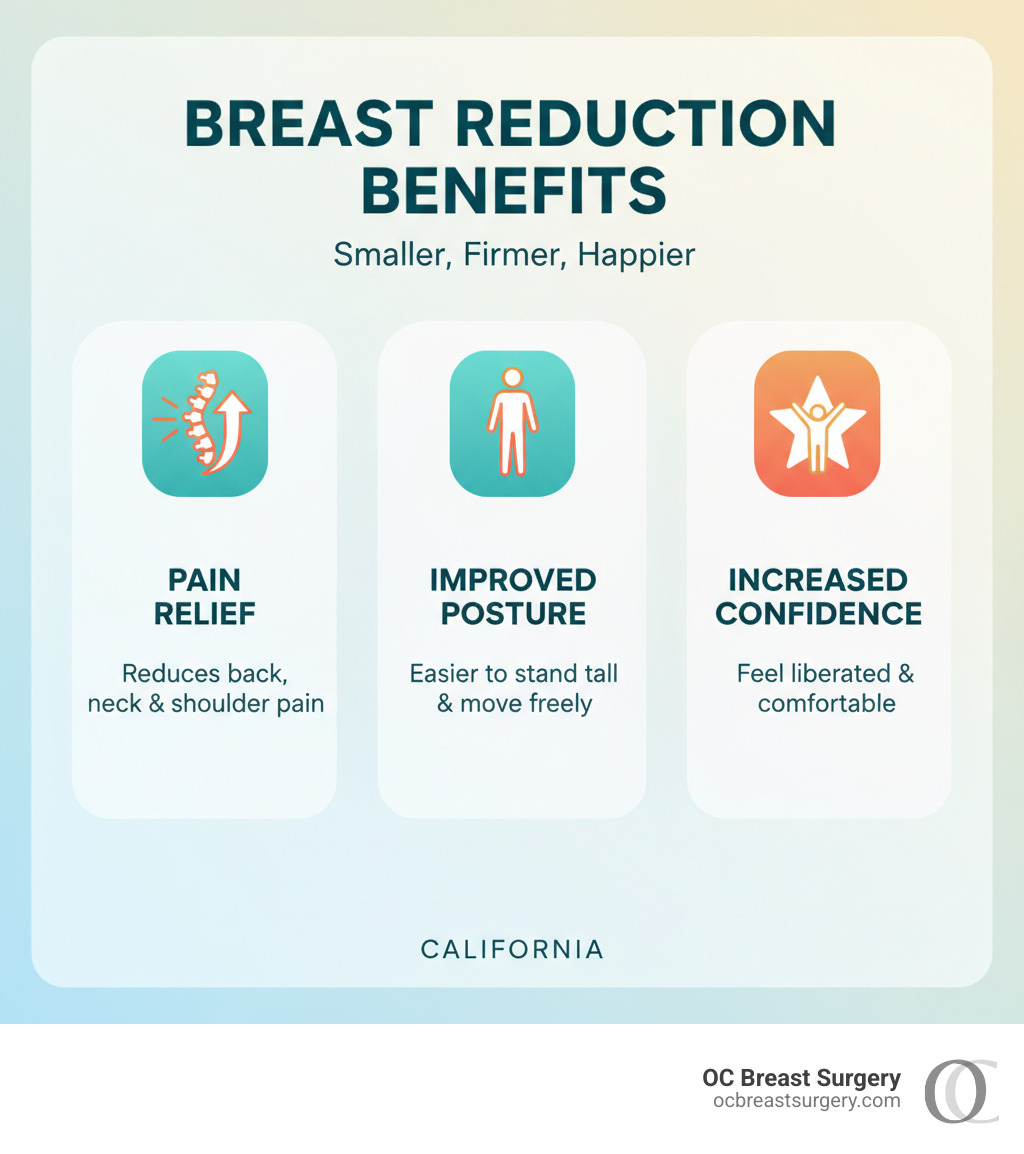
Breast reduction California offers women relief from chronic pain, improved mobility, and renewed confidence. If you suffer from back, neck, or shoulder pain, painful bra strap grooves, or difficulty finding clothes that fit due to overly large breasts, reduction mammoplasty may be the solution.
Quick Guide to Breast Reduction:
- What it treats: Chronic pain, posture problems, skin irritation, and limited activity from large breasts.
- Typical candidates: Women (often DD cup or larger) with physical symptoms, at a stable weight, non-smokers, with fully developed breasts.
- Procedure time: 3-5 hours under general anesthesia.
- Recovery: 1-2 weeks before returning to office work, 3-4 weeks before resuming exercise.
- Insurance coverage: Often covered if medically necessary (e.g., documented pain, removal of 400+ grams per breast).
- Results: Permanent removal of tissue for smaller, firmer, more proportionate breasts.
Breast reduction surgery—also called reduction mammoplasty—removes excess breast tissue, fat, and skin. Beyond physical relief, many women feel liberated, able to enjoy activities they once avoided. The surgery can also correct asymmetry and reposition the nipple and areola. While scars are a tradeoff, most patients find the improvement in their quality of life is well worth it.
I’m Dr. Mark Anton, and with 33 years specializing exclusively in breast surgery, I’ve performed thousands of breast reduction procedures. My fellowship training focused on breast surgery techniques, and I founded OC Breast Surgery to provide expert, personalized care for women seeking transformative results.

Understanding Breast Reduction: Is It Right for You?
Living with overly large breasts can mean daily discomfort that affects everything from exercise to sleep. If you’ve been struggling with chronic pain or feeling self-conscious, breast reduction California might be the solution.
At OC Breast Surgery, we’ve seen how this procedure transforms lives. Our patients report feeling lighter in every sense—emotionally, mentally, and physically. Let’s explore what breast reduction involves and whether it’s right for you.
What is Reduction Mammoplasty?
Reduction mammoplasty is the medical term for breast reduction. During this procedure, a surgeon removes excess breast tissue, fat, and skin to create breasts that are smaller, lighter, and better proportioned to your body. The surgery also reshapes and lifts your breasts, repositioning the nipple and areola to a more youthful position. If you have asymmetry, this can be corrected to create a more balanced body contour.
Signs You Might Need a Breast Reduction
The decision to pursue breast reduction often comes from a combination of physical and emotional concerns. If these sound familiar, it might be time to consider your options.
- Chronic pain: Persistent back, neck, and shoulder pain from carrying the weight of large breasts.
- Painful bra strap grooves: Deep, uncomfortable indentations in your shoulders from bra straps digging in.
- Skin irritation: Rashes, chafing, or persistent irritation in the fold beneath your breasts.
- Posture problems: A rounded back or stooped shoulders from constantly counterbalancing heavy breasts.
- Limited physical activity: Discomfort or pain during exercise like running, or finding high-impact sports impossible.
- Clothing fit issues: An ongoing struggle to find shirts and dresses that fit both your bust and the rest of your body.
- Self-consciousness: Feeling emotionally distressed or lacking confidence due to your breast size.

Who is an Ideal Candidate for Surgery?
To ensure the best results and minimize risks, an ideal candidate should have:
- Good physical health: You should be in good overall health without medical conditions that could interfere with healing.
- A stable weight: We generally recommend a Body Mass Index (BMI) under 30 for optimal results. Some insurance providers also have BMI requirements.
- Be a non-smoker: You must quit smoking and all nicotine products for several weeks before and after surgery to ensure proper healing.
- Realistic expectations: Surgery involves a recovery period and will leave permanent scars.
- Fully developed breasts: We typically recommend waiting until at least age 18, though exceptions can be made for highly symptomatic adolescents.
The Journey to a More Comfortable You: Consultation and Procedure
Taking the first step toward breast reduction is a personal one. At OC Breast Surgery, we guide you through every stage, ensuring you feel informed, comfortable, and excited about the positive changes ahead.
What to Expect During Your Consultation
Your consultation is your opportunity to share your concerns and learn how we can help.
- Medical History and Goals: We’ll review your health background and discuss what you hope to achieve with breast reduction California surgery. Bringing photos of your desired outcome can be helpful. A recent mammogram may be required.
- Physical Examination: We will assess your breast size, shape, skin quality, and any asymmetry to determine the best surgical approach for your body.
- Personalized Surgical Plan: Based on our discussion and examination, we’ll create a surgical plan custom to you, explaining the recommended techniques and incision patterns.
- Review and Questions: You’ll have a chance to see before-and-after photos of previous patients and ask any questions you have about the procedure, recovery, or costs.
Common Breast Reduction Surgical Techniques
Performed under general anesthesia, the surgery typically takes 3 to 5 hours. The specific technique used depends on your anatomy and goals.

- The Anchor Incision (Inverted T): This technique involves an incision around the areola, vertically down to the breast crease, and horizontally along the crease. It allows for significant tissue removal and reshaping, making it ideal for women with very large or pendulous breasts.
- The Lollipop Incision (Vertical): This method uses an incision around the areola and straight down to the breast crease. It is well-suited for moderate reductions and results in less scarring than the anchor approach.
- Liposuction: This may be used alone for patients with good skin elasticity whose breast size is mostly due to fat, or in combination with other techniques to refine the final shape.
During the procedure, the areola is also often reduced in size and repositioned to create a natural proportion with the new breast contour.
Breast Reduction vs. Breast Lift: What’s the Difference?
While related, these procedures address different primary concerns. Breast reduction removes tissue to decrease the size and weight of the breasts, alleviating physical symptoms. A breast lift (mastopexy), on the other hand, removes excess skin to lift and reshape sagging breasts without significantly changing their volume. A reduction surgery inherently includes a lift, providing both benefits in one procedure.
| Feature | Breast Reduction (Reduction Mammoplasty) | Breast Lift (Mastopexy) |
|---|---|---|
| Primary Goal | Reduce breast size and alleviate physical symptoms. | Lift and firm sagging breasts. |
| Tissue Removed | Excess breast tissue, fat, and skin. | Primarily excess skin. |
| Impact on Size | Decreases overall breast volume. | Does not significantly decrease breast size. |
| Candidacy | Women with overly large, heavy breasts causing physical discomfort. | Women with sagging breasts who are happy with their breast volume. |
Navigating Your Breast Reduction Recovery and Results
The recovery period is a vital part of achieving your best results and requires patience and careful adherence to our post-operative instructions.
The Recovery Process: Week by Week
Immediately after surgery in Newport Beach, CA, you’ll experience some swelling, bruising, and discomfort, which we will help you manage.
- First Few Days: You will wear a special surgical bra for support. Pain medication will manage discomfort. Rest is crucial, and you will need assistance at home. Drains may be used for 3-5 days to prevent fluid buildup.
- First Week: You can typically return to office work but must continue to avoid strenuous activities. Swelling and bruising will begin to subside.
- Weeks 2-4: Most initial discomfort should be gone. You can gradually increase light activity, but avoid heavy lifting or intense exercise for at least 3-4 weeks.
- Weeks 4-6 and Beyond: With your surgeon’s approval, you can usually resume most normal activities, including more vigorous exercise. Scars will mature and fade over the coming months, with final results taking several months to appear as swelling fully resolves.
We will provide specific instructions for scar care to help them soften and fade. Protecting scars from direct sunlight for at least a year is also crucial.
Potential Risks and Long-Term Outlook
While breast reduction is a safe procedure, it carries potential risks like any surgery. We will discuss these with you thoroughly.
- Scarring: Scars are permanent but are placed as discreetly as possible and fade significantly over time.
- Sensation Changes: Nipple and breast sensitivity may temporarily or, in rare cases, permanently change.
- Asymmetry: Minor differences between the breasts may persist post-surgery.
- Infection and Bleeding: These are general risks associated with any surgical procedure.
- Breastfeeding Ability: Lactation can be affected. If you plan to breastfeed in the future, you may want to postpone surgery.
Results are considered permanent, as the removed tissue is gone for good. However, significant weight fluctuations, pregnancy, or aging can cause your breasts to change in size or shape. Despite the risks, studies show that patients experience a significant improvement in quality of life and self-esteem after surgery.
How Surgery Affects Breastfeeding and Nipple Sensitivity
These are common and important concerns for women considering breast reduction California.
- Lactation Impact: It is possible to breastfeed after a reduction, but the surgery can interfere with lactation. We generally recommend postponing surgery until after you have completed breastfeeding.
- Nipple and Breast Sensitivity: Changes in sensation are expected after surgery. Nerves are affected, which can lead to numbness or altered sensitivity. For most patients, normal sensation gradually returns within a few months, but in some cases, changes can be permanent.
Practical Considerations for Breast Reduction California
Understanding the practical side of breast reduction—from costs and insurance to finding the right surgeon—is an important part of your journey.
Is Breast Reduction Covered by Insurance?
This is a common question, and the answer is often yes. Unlike purely cosmetic procedures, breast reduction can be covered by insurance when it is deemed medically necessary.
Insurance companies typically look for evidence of medical necessity, including:
- A history of chronic symptoms like back, neck, and shoulder pain, bra strap grooving, or skin rashes.
- Proof of failed conservative treatments, such as physical therapy or specialized bras, documented in your medical records.
- A minimum amount of tissue to be removed, often 400 grams or more per breast.
- BMI requirements, as some insurers require a BMI below a certain threshold (e.g., 35) to reduce surgical risks.
Our team at OC Breast Surgery has extensive experience with the insurance authorization process and can help you determine your eligibility.
What are the Costs of a Breast Reduction in California?
The cost of breast reduction California varies. If your procedure is not covered by insurance, the total investment typically includes:
- Surgeon’s Fee: Reflects the expertise, experience, and time of your plastic surgeon.
- Anesthesia Costs: Covers the anesthesiologist’s services and medications.
- Facility Fees: For the use of the surgical center, operating room, and nursing staff.
- Pre- and Post-Operative Care: Includes your consultation, follow-up appointments, and surgical garments.
Geographic location, such as our practice in Newport Beach, CA, can also influence costs. We will provide a detailed, personalized quote during your consultation.
How to Find a Qualified Surgeon for Your Breast Reduction in California
Choosing your surgeon is the most important decision you will make. Here’s what to look for:
- Board Certification: Your surgeon must be certified by the American Board of Plastic Surgery. This is your assurance that they have met the highest standards for training, safety, and ethics.
- Specialization and Experience: Look for a surgeon who focuses on breast procedures. At OC Breast Surgery, Dr. Mark Anton has dedicated his entire 33-year career to breast surgery alone, giving him an unparalleled level of expertise.
- Proven Results: Read patient reviews and carefully examine the surgeon’s before-and-after gallery to see the quality of their work and ensure their aesthetic style aligns with your goals.
- Consultation Rapport: The right surgeon will listen carefully, answer your questions thoroughly, and make you feel respected and confident. Your comfort and trust are paramount.
Frequently Asked Questions about Breast Reduction
If you’re considering breast reduction California, it’s normal to have questions. Here are answers to some of the most common ones we hear at OC Breast Surgery.
Can Breast Reduction Correct Asymmetry?
Yes, absolutely. Correcting asymmetry is a fundamental goal of breast reduction surgery. Most women have some degree of natural breast asymmetry. During your procedure, your surgeon will customize the amount of tissue removed and reshape each breast to create a much more balanced, harmonious, and symmetrical appearance.
What is the Best Age for Breast Reduction?
There is no single “best” age, but timing is important. We generally recommend waiting until at least age 18, when breasts are fully developed, to ensure more stable and lasting results. However, we may consider exceptions for highly symptomatic adolescents (typically age 16 or older) who are experiencing severe physical pain or emotional distress. On the other end of the spectrum, there is no upper age limit. As long as you are in good overall health, you can have the procedure at any age.
Will My Breasts Grow Back After Surgery?
The breast tissue, fat, and skin removed during surgery are gone permanently and will not “grow back.” However, the remaining breast tissue is still living tissue that can change in size in response to certain factors. Significant weight gain is the most common reason for an increase in breast size after surgery. Pregnancy and hormonal changes, such as menopause, can also alter breast size and shape. Maintaining a stable weight is the best way to preserve your results for years to come.
Conclusion: Accept a Lighter, More Confident You
Breast reduction surgery offers more than just physical relief—it’s a pathway to reclaiming your life. For women who’ve spent years managing chronic pain, avoiding activities they love, and feeling self-conscious, this procedure can be genuinely life-changing. You’ll finally be able to exercise without discomfort, find clothes that fit beautifully, and say goodbye to painful bra strap grooves.
At OC Breast Surgery, Dr. Mark Anton and our team of specialists combine technical excellence with genuine care. We take the time to understand your unique concerns at our Newport Beach, CA practice, develop a surgical plan customized to you, and support you through recovery and beyond. Our goal is to help you achieve natural results that make you feel comfortable and confident in your own body.
If you’re ready to explore how breast reduction can help you live a lighter, freer life, we invite you to start the conversation.