
The national average for capsular contracture surgery cost typically ranges from $10,000 to $20,000, and some documented averages fall between $10,704 and $11,759 when all procedural components are included. That's a wide range, and if you're reading this while feeling a breast implant has become firm, uncomfortable, or visibly distorted, the variation probably feels confusing.
An initial inquiry rarely centers on surgical technique. Instead, the question often becomes, “Why does fixing this cost so much?” That's a fair question. In breast surgery, the price usually reflects the difficulty of working safely through scar tissue, the need for implant removal or exchange, the operating room resources involved, and the planning required to restore a softer, more natural contour.
A lot of fear comes from not knowing what's happening inside the breast and not knowing what the quote includes. The goal here is to make both parts clearer, in plain language, so you can understand the problem, the treatment options, and the underlying reasons one patient's quote looks very different from another's.
Table of Contents
- What Is Capsular Contracture and Why Does It Happen
- Your Surgical Options for Treatment
- Typical Capsular Contracture Surgery Cost Breakdown
- Key Factors That Influence Your Final Price
- Does Insurance Cover Capsular Contracture Surgery
- Financing and How OC Breast Surgery Provides Your Quote
- Preparing for Your Consultation in Newport Beach
What Is Capsular Contracture and Why Does It Happen
A common story goes like this. A patient had breast augmentation years ago and everything felt normal at first. Then one side slowly became tighter. The breast started to sit higher, feel firmer, or look less natural in clothing. In more advanced cases, it can become uncomfortable or painful.
That pattern often points to capsular contracture. Your body naturally forms a layer of scar tissue around any implant. That part is normal. The problem starts when that capsule tightens too much and begins squeezing the implant, which can create firmness, distortion, and discomfort.
Capsular contracture isn't rare. It's described as a prevalent complication affecting up to 15% of patients after breast augmentation, and revision surgery for this condition often costs 20% to 30% more than the initial procedure because surgery on previously altered tissue is more complex, as outlined in this capsular contracture treatment cost breakdown.
What patients usually notice first
People often assume the implant itself has suddenly “gone bad.” Sometimes the underlying issue is the scar capsule around it.
Signs that raise concern include:
- Increasing firmness that wasn't there before
- A change in shape or position such as one breast looking higher or rounder
- Tenderness or pain with pressure, movement, or even at rest
- Loss of softness when the breast used to feel more natural
If that sounds familiar, it helps to know this condition is treatable. The treatment usually falls under Breast Implant Revision or Breast Implant Removal, depending on whether you want to keep implants, exchange them, or remove them entirely.
The cost question matters because capsular contracture surgery isn't just “taking an implant out.” It often means careful scar-tissue surgery inside a breast that has already been operated on before.
For a patient-friendly overview of the condition itself, this page on capsular contracture treatment is a useful starting point.
Why the cost conversation starts here
When you understand that the breast has developed a tightened scar capsule, the pricing starts to make more sense. A surgeon may need to release or remove scar tissue, protect the surrounding tissue, address implant position, and decide whether implant exchange or complete removal is the safer choice. That's why cost depends so heavily on what's happening inside the breast, not just on the fact that revision surgery is being performed.
Your Surgical Options for Treatment
Treatment for capsular contracture involves several surgical approaches. The right plan depends on what the scar capsule is doing inside the breast, how distorted or painful the breast has become, and whether you want to keep implants, replace them, or remove them.
From a surgeon's perspective, this is why prices can differ so much. Two patients may both be told they have capsular contracture, but one may need a straightforward release of a tight pocket, while another needs careful removal of dense scar tissue that is stuck to the chest wall or surrounding breast tissue. Those are very different operations in time, difficulty, and safety planning.
Capsulectomy and what that word actually means
A capsulectomy means removing scar capsule tissue around the implant. The capsule works like a tight shell. When that shell becomes thick, firm, or distorted, removing part of it, or most of it, may be the best way to restore shape and softness.
There are different forms of capsulectomy:
- Partial capsulectomy removes only the portion of capsule causing the problem
- Total capsulectomy removes the capsule more completely
- More complex dissection may be required when the capsule is densely attached to surrounding tissue
That difference matters financially because the operation changes with the anatomy. A lighter scar release may take less operative time. A dense, calcified, or adherent capsule calls for slower dissection and more careful protection of the tissues around it.
If you want a clearer explanation of the terminology, this guide to capsulectomy and breast implant capsule removal explains what surgeons mean by capsule removal and why technique matters.
Open capsulotomy and when release may be enough
An open capsulotomy is different from a capsulectomy. Instead of removing the full capsule, the surgeon releases the tightened scar tissue so the breast has room to soften and settle more naturally.
This can be a reasonable option in selected cases, especially when the capsule is tight but not severely thickened or distorted. It usually involves less dissection than a capsulectomy, which can mean a simpler operation. The tradeoff is that it does not remove the capsule itself, so it is not the right choice for every patient.
This is where specialist judgment matters. If the breast is painful, clearly misshapen, or the implant pocket has become badly distorted, release alone may not solve the underlying problem.
Implant exchange or implant removal
The next decision is what to do with the implant. Some patients want a similar look and choose implant exchange. Some want a different size or profile. Others decide they no longer want implants and choose Breast Implant Removal.
Here is the practical way to look at those choices:
| Option | What it addresses | Why cost can differ |
|---|---|---|
| Implant exchange | Replaces the current implant | Adds implant cost and often more pocket planning |
| Implant removal | Removes implants without replacement | May reduce device costs, but scar-tissue surgery can still be significant |
| Revision with reshaping | Improves contour and breast pocket support | Often requires more operative time and technical steps |
A simple comparison helps. Replacing an implant is like repairing a room and then furnishing it again. Removing an implant without replacement may eliminate the new device cost, but the repair work inside the room can still be extensive.
Insurance questions sometimes come up at this stage too, especially if pain, rupture, or other medical issues are involved. If you are trying to understand out-of-pocket responsibility before your consultation, it helps to review how insurance deductibles work.
The safest plan is based on what the surgeon finds needs to be corrected, not just on the name of the diagnosis.
That is why a specialist does not price capsular contracture treatment as one standard operation. The final surgical plan depends on how much scar tissue must be addressed, whether the implant pocket needs revision, and what approach gives you the best chance of a stable, comfortable result.
Typical Capsular Contracture Surgery Cost Breakdown
The most useful starting point is this: the national average cost for capsular contracture correction surgery ranges from $10,000 to $20,000, with more specific documented averages between $10,704.82 and $11,759.82 when the full procedure includes implant removal, capsulectomies, and placement of new implants, according to this review of capsular contracture correction cost ranges.
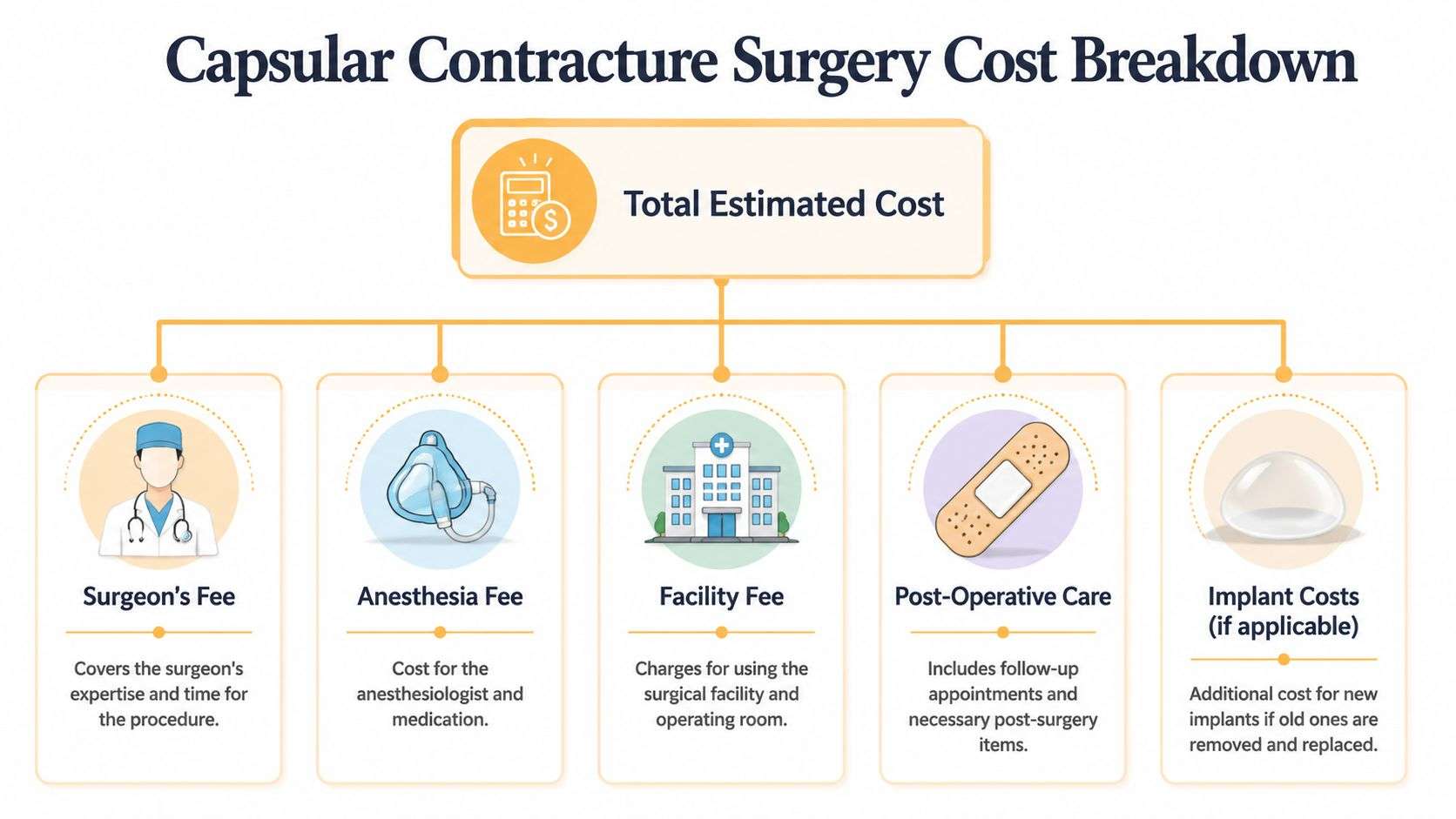
Here's the visual version of what that total usually represents.
What's usually included in the total
Patients often look at a surgical quote and assume it's one fee paid to one person. It isn't. The total usually combines several essential parts of care.
Typical components include:
- Surgeon's fee for the operative planning, technical work, and revision expertise
- Anesthesia fee for the anesthesia professional and medications
- Facility fee for the operating room, staff, equipment, and recovery area
- Post-surgical care such as follow-up visits and immediate postoperative management
- Implant costs if implants are being replaced rather than removed
That's why two quotes can look very different even when both are described as revision surgery. One patient may need capsule release and removal only. Another may need extensive scar-tissue removal plus new implants and pocket reconstruction.
Why online estimates often feel misleading
A number on a website can be useful for orientation, but it can also create false confidence. Someone may see the lower end of a range and assume that applies to their case, when their surgery requires more time, more scar dissection, and more operating room resources.
A helpful way to think about it is this:
Practical rule: A quote for capsular contracture surgery is really a quote for the exact surgical plan, not just for the diagnosis.
If you're also trying to understand the financial side from an insurance perspective, it helps to learn how insurance deductibles work before speaking with your carrier. Even when a patient pursues coverage review, out-of-pocket responsibility can still depend on deductible structure, coinsurance, and whether the situation is considered cosmetic or medically necessary.
For another patient-focused discussion of fees related to explant planning, this page on breast implant removal pricing can help frame the conversation.
A simple example
Consider two hypothetical patients:
- Patient A needs a relatively direct implant exchange with limited capsule work.
- Patient B has a hard, painful breast with dense scar tissue that requires more extensive dissection and replacement.
Both are revision patients. They won't receive the same quote, because the operating room time, technical demand, and safety considerations aren't the same.
Key Factors That Influence Your Final Price
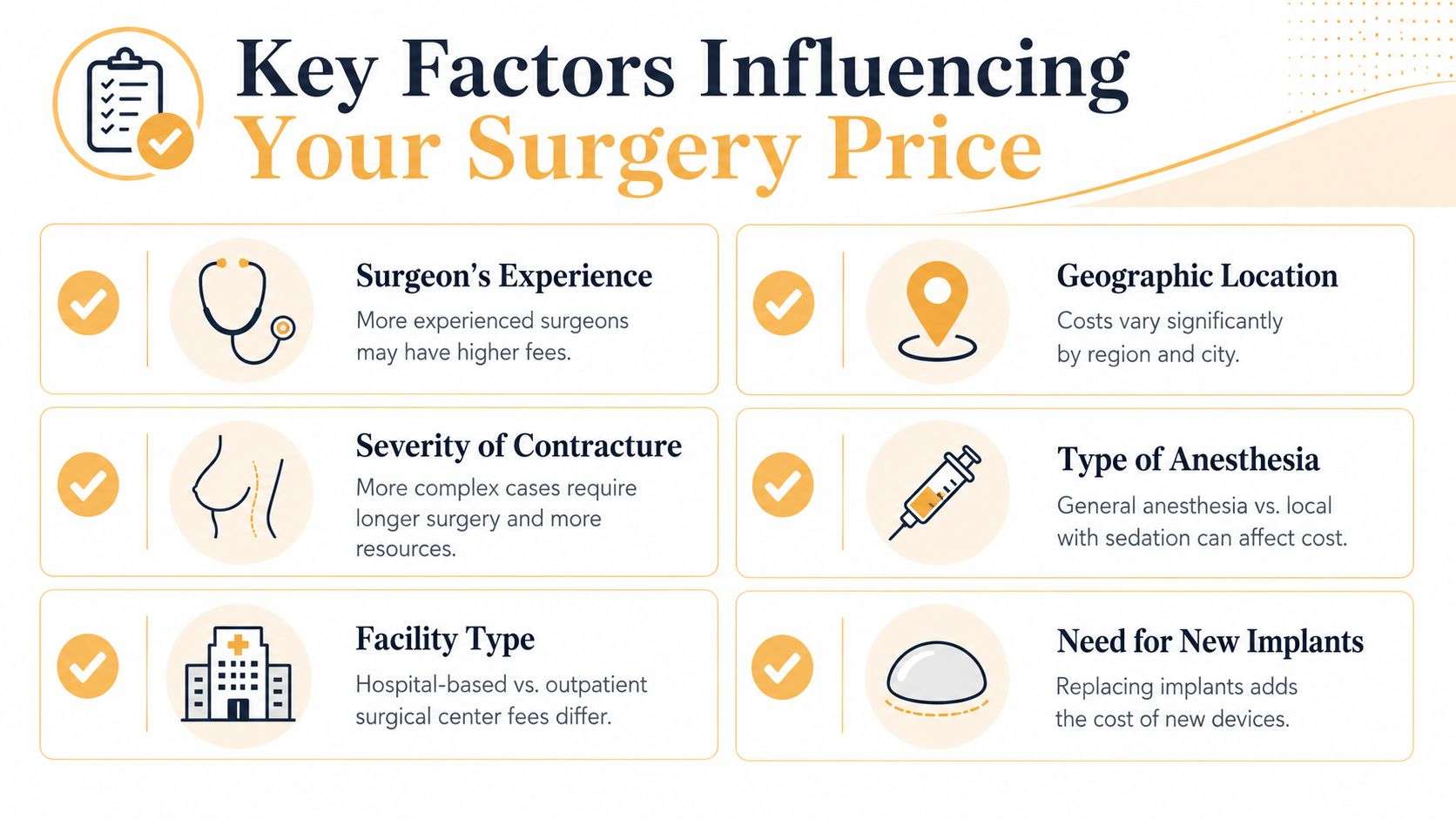
The wide cost range begins to make sense when considering the details. In the United States, complex capsular contracture surgery requiring total capsulectomy and implant exchange typically ranges from $12,000 to $18,000, and geographic location strongly affects price, with major markets such as Los Angeles tending higher than smaller cities, according to this breast implant revision pricing guide.
Surgical complexity changes everything
A revision on untouched anatomy would be one thing. Capsular contracture surgery happens in a breast that already contains scar tissue and has already been operated on. That matters.
A surgeon has to evaluate:
- How tight the capsule is
- Whether the implant has shifted
- How much scar tissue can be safely removed
- Whether the implant should be replaced or removed
- How the breast shape will look after correction
The more distorted or scarred the pocket is, the more carefully the surgeon must work. That often means a longer procedure and a more involved recovery plan.
Total capsulectomy versus simpler revision
Not every patient needs the most extensive operation. But when a total capsulectomy is necessary, the surgery usually becomes more time-intensive.
Think about the difference this way:
| Surgical scenario | Why it may cost less or more |
|---|---|
| Simple implant exchange | Less scar-tissue dissection, fewer reconstruction steps |
| Capsule release | May reduce some operative burden if full removal isn't required |
| Total capsulectomy with exchange | More dissection, more operative time, higher technical demand |
That's the core “why” behind price variation. The fee follows the work required to perform the operation safely.
Implant decisions also affect the quote
Some patients choose to remove implants and stay implant-free. Others want implant exchange. That decision changes the financial picture because new implants add a device cost and can also affect surgical planning.
The surgeon also has to consider pocket support, skin quality, symmetry, and whether keeping the same size is realistic after scar-tissue correction. Those decisions aren't just aesthetic. They can affect long-term tissue behavior and immediate surgical safety.
A lower quote isn't automatically a better value if it leaves out necessary parts of the operation or doesn't reflect the true complexity of the revision.
Location and specialist expertise
Geography affects fees because facility costs, staffing, and regional market conditions differ. Specialist experience matters for a different reason. Revision surgery often demands judgment that goes beyond routine implant surgery.
A breast surgery specialist evaluates not only what can be done, but what should be done to protect tissue, improve contour, and reduce the chance of repeating the same problem. In an area like Newport Beach and the broader Orange County market, patients should expect pricing to reflect both regional overhead and subspecialized surgical care.
Factors patients sometimes overlook
Patients usually focus on implants, but surgeons often focus on what surrounds them.
Other practical drivers include:
- Anesthesia needs based on the complexity of the operation
- Facility selection and the resources required for revision surgery
- Tissue quality after prior surgeries
- Asymmetry correction if one side differs significantly from the other
- Need for contour restoration after implant removal or exchange
Those details are why an in-person consultation matters so much. The final number isn't pulled from a menu. It's built from the anatomy and the surgical plan.
Does Insurance Cover Capsular Contracture Surgery
A patient comes in with a breast that feels tight, sits higher than the other side, and aches when she rolls onto it at night. From her perspective, the problem feels medical because it affects comfort, shape, and peace of mind. From an insurance company's perspective, the first question is often different: was the original surgery cosmetic, reconstructive, or tied to a covered medical condition?
That difference explains why coverage is often inconsistent.
In many cases, capsular contracture surgery after cosmetic breast augmentation is classified as a cosmetic revision, which means the patient may be responsible for the cost. That can feel unfair, especially when the capsule has become firm, distorted, or painful. Still, insurers usually focus on how the procedure is categorized, not only on how frustrating the symptoms are.

Why approval is often difficult
Insurance review works a bit like a checklist. The carrier is usually asking whether the operation is medically necessary under the terms of the policy, and whether the planned procedure matches that standard.
A mild firmness that bothers a patient cosmetically may be viewed very differently from a painful, distorted breast that interferes with daily life. Coverage may also be looked at differently in reconstruction patients, where the breast surgery was part of treatment after mastectomy rather than elective cosmetic augmentation.
The details matter here. Severe asymmetry, persistent pain, marked hardness, implant malposition, or documented functional symptoms may strengthen a request for review. They do not guarantee payment.
What to ask before you assume anything
Patients are often told a procedure is "possibly covered," which sounds reassuring but does not mean a claim will be paid. The safer approach is to get specific answers in writing when possible.
Ask your insurance carrier:
- How they classify capsular contracture surgery in your situation
- Whether prior authorization or predetermination is required
- What records they want submitted, such as operative notes, photos, symptom history, or a surgeon's letter
- Which parts of care they may cover, since surgeon fees, anesthesia, facility charges, implants, and pathology are not always handled the same way
A revision can be approved in part and still leave substantial out-of-pocket costs. That is where confusion starts for many patients.
“Eligible for review” means the carrier is willing to look at the case. It does not mean the procedure has been approved or paid.
Where implant warranties fit in
Manufacturer warranties are a separate issue from insurance. In some cases, a warranty may help with the cost of a replacement implant if there is a covered device problem or a qualifying contracture policy. That support is often limited.
Patients are sometimes surprised to learn that a warranty may help with the implant itself while leaving the surgeon's fee, anesthesia, operating room costs, and other revision work unpaid. In practical terms, it can reduce one slice of the bill, not erase the whole expense.
A surgeon's advice on planning
From a specialist's perspective, the safest financial plan is to assume you may have some personal responsibility unless coverage has been clearly confirmed. That mindset helps you make decisions based on the operation you need, not on an approval that may never come through.
The goal is clarity. You want to know what the insurer might pay, what a warranty might offset, and what still remains your responsibility before surgery is scheduled.
Financing and How OC Breast Surgery Provides Your Quote
Once patients understand the likely price range, the next question is usually simpler and more practical. How do you plan for it?
Financing can help make revision surgery more manageable over time. One published example notes that an implant exchange may be structured at about $1,500 per month for 12 months through a payment plan, while also emphasizing that this may cover only the surgeon's fee and not operating room, anesthesia, or implant costs, as explained on this page about implant exchange financing and payment structure.

What financing really helps with
Third-party financing can spread the cost into monthly payments instead of one large upfront expense. That can be helpful, especially for revision surgery patients who didn't expect to need another operation.
Still, it's important to ask clear questions:
- What portion is financed
- Whether implants are included
- Whether facility and anesthesia are billed separately
- What your monthly obligation would look like
Many people are often confused. A payment estimate may sound lower than expected because it applies to only one part of the overall quote.
How a personalized quote is built
At OC Breast Surgery, the meaningful quote comes after consultation and examination, not from an online estimate. Dr. Mark Anton, the medical director and founder of OC Breast Surgery, evaluates the breast, reviews implant history when available, discusses your goals, and determines the safest surgical plan.
That process matters because the quote depends on questions like these:
- Is the capsule mild, severe, or asymmetrical?
- Will the plan involve implant exchange or Breast Implant Removal?
- Is more extensive scar-tissue surgery likely?
- Are there shape concerns that need to be corrected at the same time?
A carefully built quote reduces surprises and gives you a clearer basis for comparing options. It also helps you plan realistically, whether you're paying directly or exploring financing such as PatientFi.
Preparing for Your Consultation in Newport Beach
A consultation goes better when you arrive with useful information and a clear sense of your priorities. You don't need to know the surgical answer before you walk in, but it helps to know what's bothering you most.
Some patients care most about pain. Others care most about shape. Others want their implants out and don't want another exchange. Those are different goals, and they can lead to different surgical plans.
What to bring and what to think about
Before your visit, it helps to gather:
- Implant history if you have it, including when surgery was done and whether records or implant cards are available
- A short symptom timeline covering when the breast started feeling firm, changing shape, or becoming uncomfortable
- Questions about your options such as exchange versus removal, likely recovery, and what the quote includes
- Your desired outcome whether that means keeping implants, going smaller, or moving toward explant surgery
If one breast changed first, write that down. If the shape looks normal in the morning but tightens later, note that too. Small details can help clarify what's happening.
What a specialist is evaluating
Dr. Mark Anton is a breast surgery specialist, and that focus matters in revision cases. Capsular contracture surgery isn't only about removing a problem. It's about judging tissue quality, implant position, breast shape, and how to correct the issue without creating a new one.
That same expertise is relevant across approved breast procedures such as Breast Implant Revision, Breast Implant Removal, Breast Augmentation, Breast Reduction, Super Breast Lift, and Breast Reconstruction. The common thread is thoughtful planning around breast anatomy and long-term contour.
Bring your questions in writing. Patients often remember the first answer and forget the next five.
The best next step
Online research can help you understand ranges, terms, and common scenarios. It can't tell you exactly what your breast will require in surgery.
A proper consultation can.
If you're dealing with firmness, discomfort, distortion, or uncertainty after implants, OC Breast Surgery offers consultation-based evaluation in Newport Beach with Dr. Mark Anton. Schedule a consultation with OC Breast Surgery in Newport Beach to learn which breast surgery option may be right for your goals.