
How to Move Belly Fat to Your Breasts Naturally
Can You Really Move Belly Fat to Your Breasts?
Moving belly fat to breasts is possible through a surgical procedure called fat transfer breast augmentation — and it’s one of the most sought-after natural alternatives to implants.
Here’s a quick summary of how it works:
- What it is: A surgeon uses liposuction to remove fat from your abdomen, then injects it into your breasts
- Results: Expect roughly one cup size increase, with natural-looking and natural-feeling results
- Fat survival: Around 50–70% of transferred fat cells successfully integrate long-term
- Best candidates: Women with sufficient belly fat, stable weight, and realistic expectations
- Key benefit: You slim your midsection and enhance your breasts in a single procedure
It’s not magic — and it’s not the right fit for everyone. But for the right candidate, the results can be transformative.
I’m Dr. Mark Anton, a breast surgery specialist based in Newport Beach, CA, with over 33 years of experience performing thousands of breast procedures, including fat transfer breast augmentation for patients looking to move belly fat to breasts naturally and safely. In the sections below, I’ll walk you through everything you need to know to decide if this procedure is right for you.
Explore more about move belly fat to breasts:
The Science Behind How to Move Belly Fat to Breasts
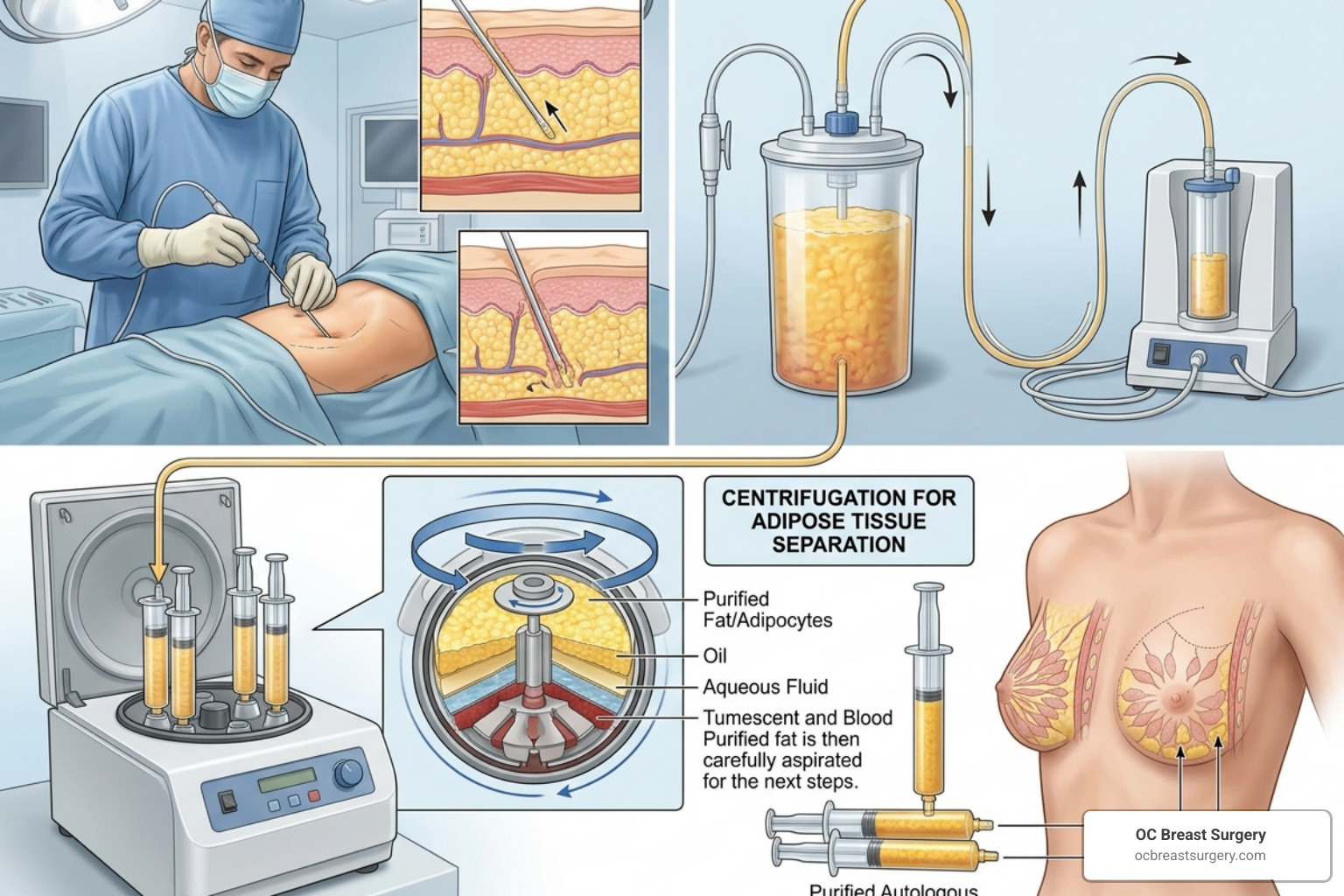
To understand how we can move belly fat to breasts, we have to look at fat not just as “extra weight,” but as a living tissue graft. The medical term for this is autologous fat grafting. “Autologous” simply means it comes from your own body, which is the ultimate “organic” filler.
The process begins with liposuction. We don’t just “suck out” the fat; we harvest it using specialized, gentle cannulas designed to keep the fat cells (adipocytes) alive. The abdomen is a premier donor site because belly fat is often rich in regenerative cells and is usually available in sufficient quantities.
Once the fat is removed, it undergoes a purification process. We use a centrifuge or a specialized filtration system to separate the healthy fat cells from unwanted fluids, oil, and debris. Only the “liquid gold”—the purest, most viable fat cells—is used for the transfer. These purified cells are then meticulously injected into the breast tissue in tiny droplets. This technique ensures that each fat cell is surrounded by healthy tissue, allowing it to establish a new blood supply and survive permanently in its new home.
For a deeper dive into the clinical overview, you can read more about Fat Transfer Breast Augmentation or consult the Fat Transfer Breast Augmentation: Procedure, Results & Risks guide from the Cleveland Clinic.
Who is a Good Candidate to Move Belly Fat to Breasts?
While the idea of a “two-for-one” surgery is appealing, not everyone is a perfect match for this technique. In our Newport Beach, CA practice, we look for several key factors during a consultation for Fat Transfer California:
- Sufficient Donor Fat: You need to have enough “pinchable” fat on your belly, flanks, or thighs. If you are extremely lean or have a very high muscle-to-fat ratio, there may not be enough material to achieve a visible difference in the breasts.
- Stable Weight: Fat cells expand and shrink with weight gain and loss. To ensure your results stay consistent, you should be at a stable weight that you plan to maintain.
- Non-Smokers: Smoking severely restricts blood flow, which is the “life support” for newly transferred fat cells. We require patients to be nicotine-free to ensure the best fat survival rates.
- Realistic Expectations: This procedure is about subtle, natural enhancement. If you are looking to go from an A-cup to a DD-cup, implants are likely a better choice.
- Good Skin Elasticity: Your breast skin needs to be supple enough to accommodate the new volume without sagging.
Realistic Results When You Move Belly Fat to Breasts
One of the most common questions we hear is, “How much bigger can I get?” Realistically, when you move belly fat to breasts, you can expect an increase of about one cup size. Some patients may achieve up to two cup sizes, but this often requires a second session.
It is important to remember that not all the fat we inject will stay. Industry statistics show that typically 50% to 70% (and in some cases up to 80%) of the transferred fat survives. The portion that doesn’t “take” is naturally reabsorbed by your body over the first few months. This is why we often slightly over-fill the area during surgery—to account for that natural settling.
The result is a breast that looks and feels 100% natural because it is natural. There are no edges to feel, no risk of “rippling,” and the breasts will move and age just like the rest of your body tissue. You can see more about the nature of these results on our page about Body Fat Transfer To Breast.
The Step-by-Step Fat Transfer Procedure

As of April 2026, the Fat Transfer Procedure has become incredibly refined. Here is what you can expect on the day of your surgery in Newport Beach:
- Step 1: Anesthesia: The procedure is performed under general anesthesia to ensure you are completely comfortable and still while we perform the precision work.
- Step 2: Harvesting: We perform liposuction on the belly (and sometimes the “love handles” or thighs) using a gentle, low-pressure technique. This protects the delicate cell membranes of the fat.
- Step 3: Purification: The harvested fat is placed in a centrifuge or a closed-loop filtration system. This spins or filters the fat to remove excess lidocaine, blood, and oil, leaving us with concentrated, healthy fat cells.
- Step 4: Injection: Using very thin, blunt-tipped needles called cannulas, I carefully inject the fat into the breast. I use a “micro-droplet” technique, placing the fat in different layers and locations to ensure maximum contact with blood vessels. We avoid injecting fat directly into the breast gland itself, focusing instead on the subcutaneous space and behind the gland.
- Step 5: Closing: The liposuction incisions are tiny (usually about 4mm) and typically don’t even require visible stitches. The injection sites in the breasts are even smaller, similar to a needle prick, leaving virtually no scarring.
Benefits and Risks of Natural Augmentation
When deciding whether to move belly fat to breasts or opt for traditional implants, it helps to see the pros and cons side-by-side.
| Feature | Fat Transfer (Natural) | Breast Implants |
|---|---|---|
| Material | Your own living tissue | Silicone or Saline |
| Feel | Soft, natural, moves with you | Firmer, may have palpable edges |
| Scars | Tiny, pin-point marks | 1-2 inch incisions |
| Longevity | Permanent (once settled) | May need replacement (10-15 years) |
| Size Increase | Limited (1 cup size) | Significant (multiple sizes) |
| Body Contouring | Includes liposuction of belly | No change to other body areas |
| Maintenance | None | Regular imaging/monitoring |
Potential Risks to Consider: While generally very safe, you should be aware of the Fat Transfer To Breast Pros And Cons. The main “con” is unpredictability. If you lose a significant amount of weight, your breasts will shrink. There is also a risk of fat necrosis (where small lumps of firm fat form) or the development of oil cysts. While these are usually harmless, they can sometimes be felt or seen on imaging.
Recovery and Long-Term Fat Survival
Recovery from a fat transfer is often described as “easier” than implant surgery because we aren’t cutting through or placing anything under the chest muscle. However, you are recovering from two different sites: the belly (liposuction site) and the breasts.
- The First Week: You will feel “sore” rather than in sharp pain. Most patients describe it as feeling like they had a very intense abdominal workout. You will need to wear a compression garment on your belly to help the skin snap back and minimize swelling.
- Protecting the “Graft”: This is the most critical part of Fat Transfer Recovery. You must not put pressure on your breasts. This means sleeping on your back for several weeks and avoiding tight, underwired bras. We want those fat cells to be “disturbed” as little as possible while they grow new blood vessels.
- The Six-Month Mark: You will see your final results around six months. By this time, the swelling has completely subsided, and the fat that has survived is there to stay.
- Long-Term Survival: Does it last? Yes. Unlike implants, which are medical devices that can wear out, surviving fat is permanent. However, it will behave like natural fat. If you gain weight, your breasts may get larger; if you lose weight, they will get smaller. You can read more about longevity here: Does Fat Transfer Breast Augmentation Last.
Non-Surgical Alternatives and Myths
If you’ve spent any time on social media, you might have seen “hacks” or routines claiming to move belly fat to breasts without surgery. One famous example is the “Chiyomilk” routine, which involves daily “brushing massages” and wearing specific bras (like the Bradelis bra) to supposedly “push” fat from the stomach and back into the breast tissue.
As a medical professional, I have to be honest: There is no clinical evidence that massage can move fat deposits from one part of the body to another.
Fat cells are anchored by fibrous connective tissue (septae). You cannot simply “massage” them loose and slide them up your torso. While massage can improve circulation and skin tone—and a great bra can certainly create a better silhouette—the only way to physically relocate fat cells is through the surgical harvesting and injection process we’ve discussed. For a look at the skepticism surrounding these myths, The Fittest Blogger provides an entertaining take on these internet legends.
Frequently Asked Questions
How much does the procedure typically cost?
The cost of fat transfer is often higher than traditional implants because it is essentially two surgeries in one (liposuction plus augmentation). On average, prices range from $8,000 to $17,000.
Factors that influence the Fat Transfer Cost include:
- The number of donor sites (just the belly, or belly plus thighs?)
- Anesthesia and facility fees in Newport Beach, CA
- The complexity of the purification process
- Whether it is a primary surgery or a revision (such as Fat Transfer After Explant)
Does fat transfer affect breast cancer screening?
This is a vital question for every woman. The short answer is: Fat Transfer is Safe and does not increase your risk of breast cancer.
However, it can change how your mammograms look. Fat necrosis or microcalcifications (small calcium deposits) can sometimes appear where fat was injected. In the past, these were sometimes confused with early signs of cancer. Today, however, experienced radiologists are very skilled at distinguishing between “fat grafting changes” and actual suspicious lesions. We always recommend getting a “baseline” mammogram before your surgery so your future scans have a clear point of comparison.
Can fat be moved from the buttocks instead of the belly?
Yes! While the abdomen is the most common donor site, we can harvest fat from almost anywhere you have an excess. Many patients choose Fat Transfer From Buttocks To Breast, or use the “love handles” (flanks) and inner/outer thighs. During your consultation, we will assess which areas will give you the best “sculpting” benefit while providing the highest quality fat for your breasts.
Conclusion
Deciding to move belly fat to breasts is a journey toward a more confident, natural version of yourself. It’s the ultimate “upcycling” for your body—taking volume from where you don’t want it and placing it where you do.
At OC Breast Surgery in Newport Beach, CA, Dr. Mark Anton and our team are dedicated to the artistry and safety of this procedure. We believe that breast surgery should never look “obvious.” Whether you are looking for a subtle boost, a correction of asymmetry, or a way to restore volume lost after pregnancy, fat transfer offers a sophisticated, implant-free solution.
If you’re ready to see if you’re a candidate for this dual-benefit surgery, we invite you to Schedule a consultation for breast procedures with us today. Let’s discuss how we can help you achieve the natural-looking results you deserve.