
Inverted nipple surgery results: Top 5 Powerful Positive Outcomes 2025
Understanding Inverted Nipple Surgery Results: What to Expect
Inverted nipple surgery results are typically excellent, with high patient satisfaction and long-lasting outcomes. Here’s what research shows about the results you can expect:
| Outcome Measure | Statistics |
|---|---|
| Overall satisfaction rate | 88.6% |
| Average recurrence rate | 3.89% |
| Typical recovery time | 1-2 weeks |
| Return to work | Usually 1 day |
| Final results visible | 2-3 weeks |
| Sensation return | Gradually over 6 weeks to 12 months |
| Breastfeeding ability | Often preserved with duct-sparing techniques |
Inverted nipples affect approximately 10-20% of women and can cause both functional challenges and self-confidence issues. The condition occurs when internal fibrous bands or shortened milk ducts pull the nipple inward instead of allowing it to project outward. While some cases are present from birth, others develop after pregnancy, breastfeeding, or trauma.
Surgical correction of inverted nipples has evolved significantly, with modern techniques focusing on both aesthetic improvement and functional preservation. The procedure is relatively straightforward, typically taking 30-60 minutes under local anesthesia, with most patients able to return to normal activities within a day.
“I love not wearing bras and having great/symmetric nipple projection,” reports one patient after successful inverted nipple correction surgery.
The severity of nipple inversion is classified on a three-grade scale, which helps determine the most appropriate surgical approach. Grade 1 (mild) cases may sometimes respond to non-surgical interventions, while Grade 2 (moderate) and Grade 3 (severe) inversions typically require surgical correction for lasting results.

I’m Dr. Mark Anton, and after performing thousands of breast surgeries during my 33-year career including numerous inverted nipple corrections with exceptional inverted nipple surgery results, I created OC Breast Surgery specialists to provide expert care and education for patients seeking improved breast aesthetics and function.
Explore more about inverted nipple surgery results:
– innie nipple surgery
– inverted nipple repair without surgery
Understanding Inverted Nipples: Causes, Classification & Non-Surgical Paths

Have you ever wondered why some nipples turn inward instead of outward? You’re not alone. Inverted nipples are surprisingly common, affecting about 10-20% of the population—both women and men. At OC Breast Surgery, we find that understanding what’s happening beneath the surface helps our patients make informed decisions about their care.
Think of your nipple as being gently tethered by tiny internal strings. When these strings—actually milk ducts and fibrous bands—are too short or tight, they pull your nipple inward instead of allowing it to project outward normally.
These inversions typically come from two sources:
Congenital inversions are those you’re born with—they’ve been there since your breast tissue developed. This is the most common type we see at our Newport Beach practice.
Acquired inversions develop later in life, perhaps after breastfeeding, from scarring following an infection, or after trauma to the breast.
One important note: if you’ve always had normal nipples and suddenly notice one becoming inverted, please see a healthcare provider promptly. While often harmless, sudden inversion can sometimes signal breast cancer and deserves immediate attention.
Types of Inversion and Severity Scale
Not all inverted nipples are the same. Doctors use the Han-Hong grading system to classify the severity, which helps determine treatment options and predict inverted nipple surgery results:
Grade I (Mild): These nipples can be easily pulled out with your fingers and might stay out for a while. They sometimes even pop out on their own when cold or stimulated. Your milk ducts are likely intact, and breastfeeding is usually possible.
Grade II (Moderate): You can manually pull these nipples out, but they quickly retreat back inside. There’s more fibrous tissue present, making them more stubborn. Breastfeeding might be challenging but is often still possible.
Grade III (Severe): These nipples resist manual eversion due to significant fibrosis and shortened ducts. They’re firmly tethered inside, and breastfeeding is typically difficult without intervention.
At OC Breast Surgery, we carefully assess your specific grade of inversion to recommend the most appropriate approach for your unique situation.
Non-Surgical Management Options
Surgery isn’t always necessary, especially for milder cases. Several non-invasive approaches might help:
The Hoffman Technique involves using your fingers to gently stretch the tissue around the nipple outward several times daily. It requires consistency but can be effective for Grade I inversions.
Vacuum devices like suction cups or breast pumps create gentle negative pressure that gradually pulls the nipple outward. The Niplette™ is a popular option that’s worn inside your bra.
Nipple shells or shields are discreet plastic domes worn inside your bra that apply gentle pressure around the areola, encouraging the nipple to protrude through the center opening.
Interestingly, pregnancy and breastfeeding sometimes naturally resolve nipple inversion due to hormonal changes and the physical effects of a baby nursing.
In our experience at OC Breast Surgery, these non-surgical methods work best for Grade I inversions and occasionally Grade II. For more severe Grade III inversions, these approaches rarely produce lasting results, and surgical correction typically provides the most reliable outcome.
Want to learn more about nipple classification? Check out this scientific research on nipple classification for a deeper dive into the medical understanding of this common condition.
The Surgical Playbook: Techniques, Procedure & Combination Options

When Mother Nature needs a helping hand, surgical correction offers a reliable path to beautiful, lasting inverted nipple surgery results. At OC Breast Surgery, we tailor each procedure to your unique anatomy and personal priorities—especially whether future breastfeeding matters to you.
Think of inverted nipple surgery as having two main approaches—like choosing between two different roads to the same destination. Each has its benefits:
Duct-Preserving Methods are perfect if you’re planning to breastfeed someday. These gentler techniques work with your natural anatomy by creating supportive dermal flaps, V-Y advancement flaps, or what we call the “parachute-flap” technique. These methods maintain the milk ducts while creating beautiful projection.
Duct-Dividing Methods offer the highest success rates with minimal chance of recurrence. Using simple release with duct division, distractor systems, or our specialized “marionette stitch,” these approaches create dramatic, lasting projection—though they do impact future breastfeeding ability.
The numbers speak for themselves. In a review of over 3,300 cases, duct-preserving techniques showed an impressive 97.6% success rate with only 1.5% recurrence. Duct-dividing approaches push those numbers even higher to 99.1% success with just 0.9% recurrence. Here’s how they compare:
| Technique | Success Rate | Recurrence Rate | Breastfeeding Possible |
|---|---|---|---|
| Duct-Preserving | 97.6% | 1.5% | Yes (70-90%) |
| Duct-Dividing | 99.1% | 0.9% | Limited/No |
Operating Room Basics
When you choose inverted nipple correction at OC Breast Surgery, your experience will be surprisingly straightforward. Most patients are pleasantly surprised by how quick and comfortable the process is:
We typically use local anesthesia with optional twilight sedation if you’re feeling nervous. The procedure starts with a tiny, hidden incision at the base of your nipple—completely concealed within the areola. Dr. Anton then carefully releases the tight bands or shortened ducts causing the inversion, places supporting sutures to maintain that beautiful projection, and closes with dissolvable stitches (no removal needed!).
To protect your newly projected nipple during healing, we apply a special “donut” dressing that maintains position without pressure. The entire procedure typically takes just 30-60 minutes, and you’ll head home the same day—many patients even return to desk work the very next day!
Combining Procedures for Comprehensive Breast Aesthetics
Why not address multiple concerns in one go? At OC Breast Surgery in Newport Beach, we often combine nipple correction with other breast improvements for a complete change with a single recovery period.
Breast augmentation pairs beautifully with nipple correction, improving both volume and projection in one procedure. For those experiencing drooping, breast lift (mastopexy) can reposition your breasts while simultaneously correcting inverted nipples. And if you’re concerned about areola size, we can include areola reduction alongside your nipple correction.
Dr. Anton’s 33 years of experience means these combined approaches are handled with exceptional skill. For these more comprehensive procedures, we’ll typically use general anesthesia rather than local, ensuring your complete comfort throughout.
Want to learn more about your options? Visit our nipple correction surgery page for additional details on how we can help you achieve the projection and confidence you deserve.
Inverted Nipple Surgery Results: Data, Durability & Satisfaction
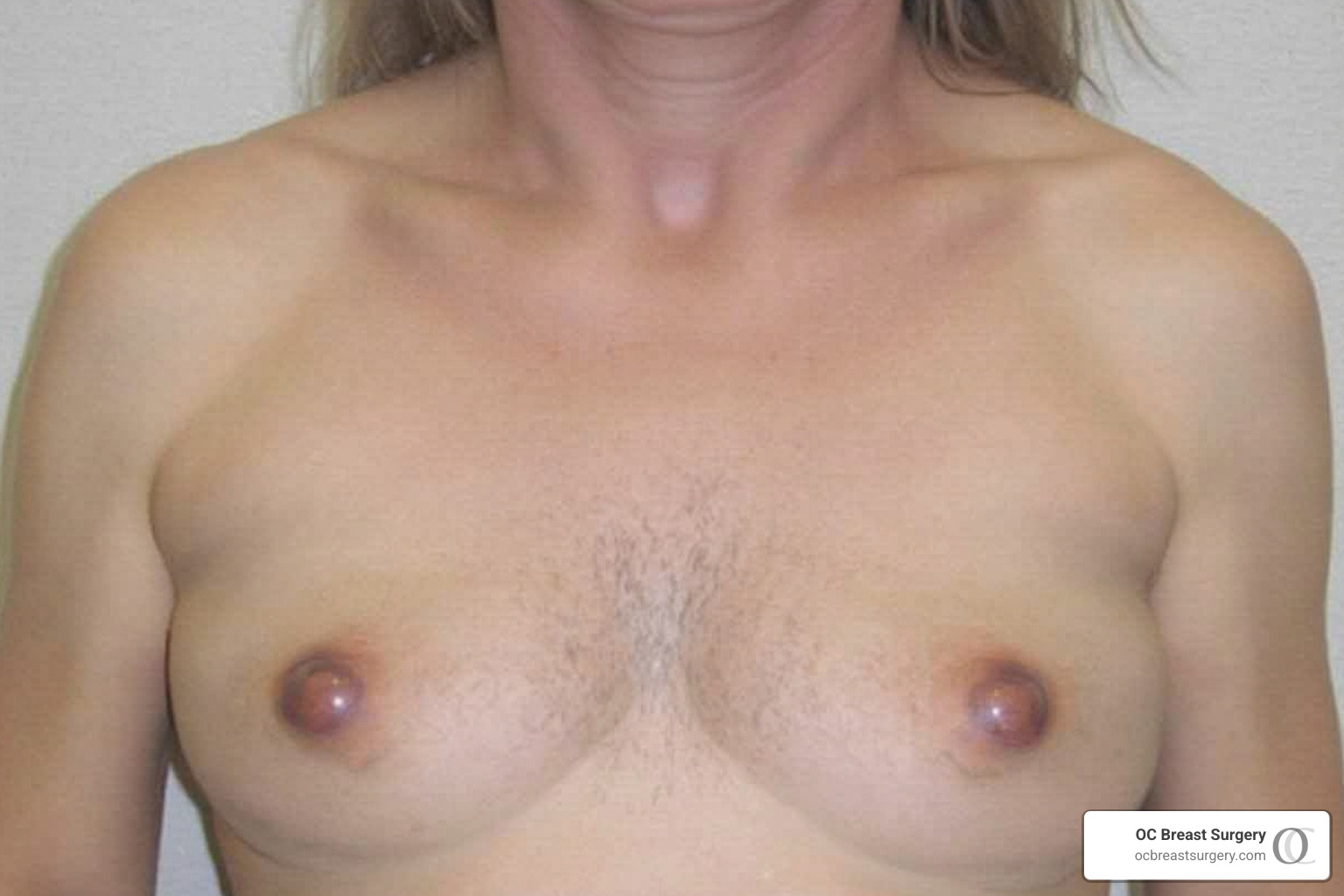
When considering any cosmetic procedure, you naturally want to know: “Will it actually work?” The good news about inverted nipple surgery results is that the data is overwhelmingly positive.
Medical research tells a compelling story. A major review analyzing 3,369 cases found that 88.6% of patients were satisfied with their results, with only a tiny 3.89% experiencing recurrence. That’s a pretty impressive track record!
Now, I should mention that a different 7-year study looking at 103 patients (191 nipple corrections) found slightly higher numbers – about 12.6% recurrence and 15.74% overall complications. This difference highlights something important: the technique used and your post-op care really matter.
“My results have been incredible,” shared one of our patients at OC Breast Surgery. “For the first time in my adult life, I feel confident in swimwear without padding or constant adjustments.”
Complications are rare but can include partial nipple necrosis (just 1.05% of cases), breast cellulitis (1.57%), and delayed healing (0.5%). The vast majority of our patients see noticeable improvement within 2-3 weeks, with results that continue to stabilize and look natural over the following months.
According to research published in Plastic and Reconstructive Surgery Global Open, these corrections typically maintain stable projection for 5+ years when performed correctly.
Factors Influencing Inverted Nipple Surgery Results
Several key elements determine how successful your nipple correction will be:
The severity of your inversion plays a major role. Grade III inversions (the most severe) generally need more extensive correction and might have a slightly higher chance of recurrence. That’s why at OC Breast Surgery, we carefully assess each case individually.
Your surgical technique matters tremendously. Duct-dividing approaches typically have lower recurrence rates but impact breastfeeding. Duct-preserving techniques balance functional preservation with aesthetic improvement. Dr. Anton will discuss which approach makes the most sense for your specific situation.
Surgeon expertise is perhaps the most critical factor. This isn’t a procedure you want performed by someone who does it occasionally. Dr. Anton’s extensive experience specifically with nipple correction ensures optimal inverted nipple surgery results.
Your post-operative care can’t be overlooked. Following instructions about wearing the protective “donut dressing” and avoiding certain activities directly impacts your long-term results.
Finally, patient-specific factors like age, tissue quality, and natural healing capacity influence outcomes. During your consultation, we’ll discuss realistic expectations based on your unique anatomy.
Real-World Patient Satisfaction
Beyond statistics, the real-world impact of successful nipple correction is what matters most. Our patients consistently report meaningful improvements in their daily lives:
Self-confidence skyrockets for most patients. “I used to avoid intimacy because I was so self-conscious,” one patient told us. “Now I don’t give it a second thought.”
Clothing options expand dramatically. Many patients enjoy wearing fitted tops or swimwear without constant worry about visibility or the need for heavily padded bras.
Intimate relationships often improve as patients report feeling less self-conscious during romantic moments. The psychological benefit here shouldn’t be underestimated.
For patients with Grade I or II inversions who undergo duct-preserving techniques, functional improvements for future breastfeeding can be significant.
BREAST-Q scores (a standardized measurement of satisfaction) consistently show marked improvement in body image and quality of life following successful correction. The symmetry and natural-looking projection achieved with proper technique contribute significantly to these positive outcomes.
At OC Breast Surgery in Newport Beach, we pride ourselves on delivering inverted nipple surgery results that not only look aesthetically pleasing but also stand the test of time. The combination of surgical expertise, personalized approach, and comprehensive aftercare creates outcomes that truly change how our patients feel about themselves.
Recovery & Long-Term Outcomes: Sensation, Breastfeeding & Recurrence
The road to recovery after inverted nipple surgery is surprisingly smooth for most patients. In fact, you’ll likely be back at your desk job within just 24 hours! Understanding what lies ahead in your healing journey is key to achieving those beautiful inverted nipple surgery results you’re hoping for.
Most of our patients at OC Breast Surgery follow a pretty predictable healing timeline. That first day, you’ll feel some mild discomfort, but nothing that over-the-counter pain relievers can’t handle. The special “donut dressing” we apply acts like a protective cushion for your newly projecting nipples during that crucial first week.
“The donut dressing was honestly my security blanket,” shared one patient. “Knowing it was there protecting my results gave me such peace of mind during recovery.”
About a week after your procedure, you’ll come back to see us for a follow-up where we’ll change your dressing and check how you’re healing. You’ll continue wearing protective dressing for another week or so, which helps ensure those nipples maintain their new outward position.
By weeks 2-4, most swelling subsides and you can gradually return to your normal activities. Just hold off on those intense workouts a bit longer! After the one-month mark, you’re typically cleared for all activities, though some subtle healing continues beneath the surface for up to a year.
Protecting Sensation and Milk Flow
One of the most common questions we hear at our Newport Beach practice concerns nipple sensation after surgery. Let’s be honest – nipple sensitivity matters! The good news is that while you might experience temporary numbness or heightened sensitivity initially, normal sensation typically returns within 6 weeks to 12 months.
Our surgical techniques at OC Breast Surgery carefully preserve the fourth intercostal nerve branches whenever possible, which helps minimize any long-term sensory changes. As one patient put it, “I was so worried about losing sensation, but within a few months, everything felt completely normal again!”
For women hoping to breastfeed in the future, the choice of surgical technique is crucial. Our duct-preserving approaches maintain breastfeeding ability in about 70-90% of cases. However, duct-dividing techniques, while offering slightly better projection and lower recurrence rates, generally eliminate breastfeeding capability.
Dr. Anton always takes time during consultations to discuss these tradeoffs, ensuring you can make an informed decision based on your life plans and priorities. For younger patients who might want children later, we typically recommend duct-sparing techniques whenever the severity of inversion allows.
Preventing Re-Inversion
While inverted nipple surgery results are permanent for the vast majority of patients, about 3.89% experience some degree of recurrence. Think of your recovery period as laying the foundation for long-lasting results!
Consistent use of your post-surgical splinting device (like the donut dressing) for the recommended 1-2 weeks is perhaps the single most important factor in preventing recurrence. This simple step gives your tissues time to heal in their new position.
Once you’re fully healed, gentle scar massage can work wonders in preventing the contracture of scar tissue that sometimes pulls nipples back inward. And please, don’t skip those follow-up appointments! They allow us to catch and address any early signs of recurrence before they become problematic.
If recurrence does happen despite your best efforts, don’t worry. A revision procedure can be performed as early as 3-6 weeks after your initial surgery or even years later. These touch-up procedures are typically quick, performed under local anesthesia right in our office, and have excellent success rates.
“I had a slight recurrence on one side about a year after my surgery,” one patient shared. “Dr. Anton fixed it in a simple office procedure, and five years later, both nipples are still perfectly everted!”
At OC Breast Surgery, we’re committed to supporting you throughout your entire journey, from consultation through recovery and beyond, ensuring your inverted nipple surgery results stand the test of time.
Costs, Risks & Decision Guide (+ FAQs)
Let’s talk about the practical side of inverted nipple correction – what it costs, what risks to consider, and how to decide if it’s right for you.
Cost Considerations
“How much will this set me back?” It’s probably one of your first questions, and understandably so!
The investment for inverted nipple correction typically ranges from $3,000 to $7,000. Why such a range? Several factors come into play:
The price varies depending on whether you’re correcting one or both nipples, the complexity of your specific case, and the surgical technique required. Geographic location matters too – here in Newport Beach, costs may differ from other areas. The surgeon’s expertise and reputation also influence pricing, as do facility and anesthesia fees.
Many of our patients at OC Breast Surgery choose to combine nipple correction with other procedures like breast augmentation or lifts, which can be more cost-effective than having separate surgeries.
During your consultation, we’ll provide a transparent, detailed cost breakdown custom to your unique situation. We understand this is an investment, which is why we offer financing options to help make your journey to confidence more accessible.
Potential Risks and Complications
While inverted nipple surgery results are overwhelmingly positive, it’s important to understand the potential risks – just as you would with any surgical procedure.
The most common concerns include temporary changes in nipple sensation (which typically resolves within a few months), minimal scarring (usually hidden within the natural contours of your nipple and areola), and a small chance of recurrence (studies show recurrence rates of 3.89-12.6%).
Less common risks include infection (rare with proper care), bleeding or hematoma, asymmetry between nipples, and partial nipple necrosis (occurring in just about 1% of cases).
For women considering future pregnancies, it’s worth noting that duct-dividing techniques will likely affect your ability to breastfeed. This is why we take the time to thoroughly discuss your life plans and priorities before recommending a specific approach.
Dr. Anton’s 33+ years of surgical experience means you’re in skilled hands, with every precaution taken to minimize these risks.
Ideal Candidate Profile
You might be wondering if you’re a good candidate for this procedure. The ideal person for inverted nipple correction:
Is generally healthy and doesn’t smoke (or is willing to take a break before and after surgery). Has realistic expectations about what the surgery can achieve. Isn’t currently pregnant or breastfeeding. Has completed their family if breastfeeding is important (or chooses a duct-preserving technique). And most importantly – feels bothered by the appearance or function of their inverted nipples.
During your consultation at OC Breast Surgery, we’ll have an honest conversation about your goals and health history to determine if this procedure is right for you, and which approach would give you the best inverted nipple surgery results.
Frequently Asked Questions about Inverted Nipple Surgery Results
Q: Are the results of inverted nipple surgery permanent?
A: Good news – for the vast majority of patients, yes! Studies show recurrence rates of only 3.89-12.6%, depending on the technique used and severity of the original inversion. Following our post-operative care instructions (especially using those protective “donut” dressings) significantly reduces your risk of the nipple reinverting.
Q: Will I be able to breastfeed after inverted nipple surgery?
A: It depends on the surgical technique we choose together. If future breastfeeding is important to you, we’ll likely recommend a duct-preserving technique, which maintains breastfeeding ability in 70-90% of cases. Duct-dividing techniques generally eliminate breastfeeding ability but have slightly lower recurrence rates. We’ll discuss your priorities during consultation to find the right balance for your life plans.
Q: How long until I see final results?
A: You’ll notice an immediate improvement in nipple projection right after surgery. As swelling subsides over 2-3 weeks, your results will become more defined. Most patients see their final, stable results within 3-6 months, though subtle improvements can continue for up to a year.
Q: When will normal sensation return?
A: Most patients experience some changes in nipple sensitivity right after surgery – this is completely normal. Sensation typically returns gradually over 6 weeks to 12 months, with the vast majority of patients regaining complete normal sensation.
Q: Can I have inverted nipple correction combined with other breast procedures?
A: Absolutely! Many of our patients at OC Breast Surgery choose to combine nipple correction with breast augmentation, breast lift, or areola reduction. Dr. Anton frequently performs these combined procedures, giving you comprehensive improvement with just one recovery period. It’s efficient and often more cost-effective than separate surgeries.
Have more questions? We’d love to address them during your personal consultation. You can learn more about costs on our page how much is surgery to correct inverted nipples? or explore additional information about inverted nipple correction.
Conclusion
Inverted nipple correction surgery offers remarkable results with high satisfaction rates and minimal downtime. The procedure has evolved significantly, with modern techniques balancing aesthetic improvement with functional preservation when desired.
The impressive inverted nipple surgery results speak for themselves: an overall satisfaction rate of 88.6%, low recurrence rates, and significant improvements in patient confidence and quality of life. The procedure’s relatively short recovery period and minimal discomfort make it an attractive option for those affected by nipple inversion.
At OC Breast Surgery in Newport Beach, Dr. Mark Anton brings over three decades of surgical expertise to each procedure. Our comprehensive approach includes thorough consultation, customized surgical planning, and attentive follow-up care to ensure optimal outcomes.
If you’re considering inverted nipple correction, we invite you to schedule a consultation to discuss your goals and explore the best approach for your specific situation. With the right technique and proper care, you can achieve the natural-looking, long-lasting results you desire.
For more information about inverted nipple correction and to see examples of our results, please visit our inverted nipple correction page or contact our Newport Beach office to schedule your consultation.