
Lopsided Breasts: Common Causes and What You Should Know
One Breast Bigger Than the Other? You’re Not Alone
Why is one breast bigger than the other one is one of the most common questions women ask — and the short answer is: it’s completely normal.
Here are the most common reasons:
- Genetics — your natural tissue distribution is largely inherited
- Hormonal changes — estrogen and progesterone shift breast volume throughout your cycle
- Puberty — one breast often develops faster than the other
- Pregnancy and breastfeeding — milk production and engorgement are rarely equal on both sides
- Medical conditions — such as scoliosis, juvenile hypertrophy, or hypoplastic breasts
- Weight fluctuations — fat tissue doesn’t always distribute evenly
In fact, research shows that 88% of women have breasts that differ in size, shape, or position. There’s even a well-known saying in breast surgery: “Breasts are sisters, not twins.” Mild asymmetry is the rule, not the exception.
That said, sudden or significant changes in breast size are worth paying attention to — and we’ll cover exactly when to seek medical advice.
I’m Dr. Mark Anton, a breast surgery specialist with over 33 years of experience and thousands of breast procedures performed at OC Breast Surgery in Newport Beach, CA. Understanding why is one breast bigger than the other one is something I help patients navigate every day, and this guide covers everything you need to know — from causes to your options.
Why is one breast bigger than the other one vocabulary:

Why Is One Breast Bigger Than the Other One? Common Causes
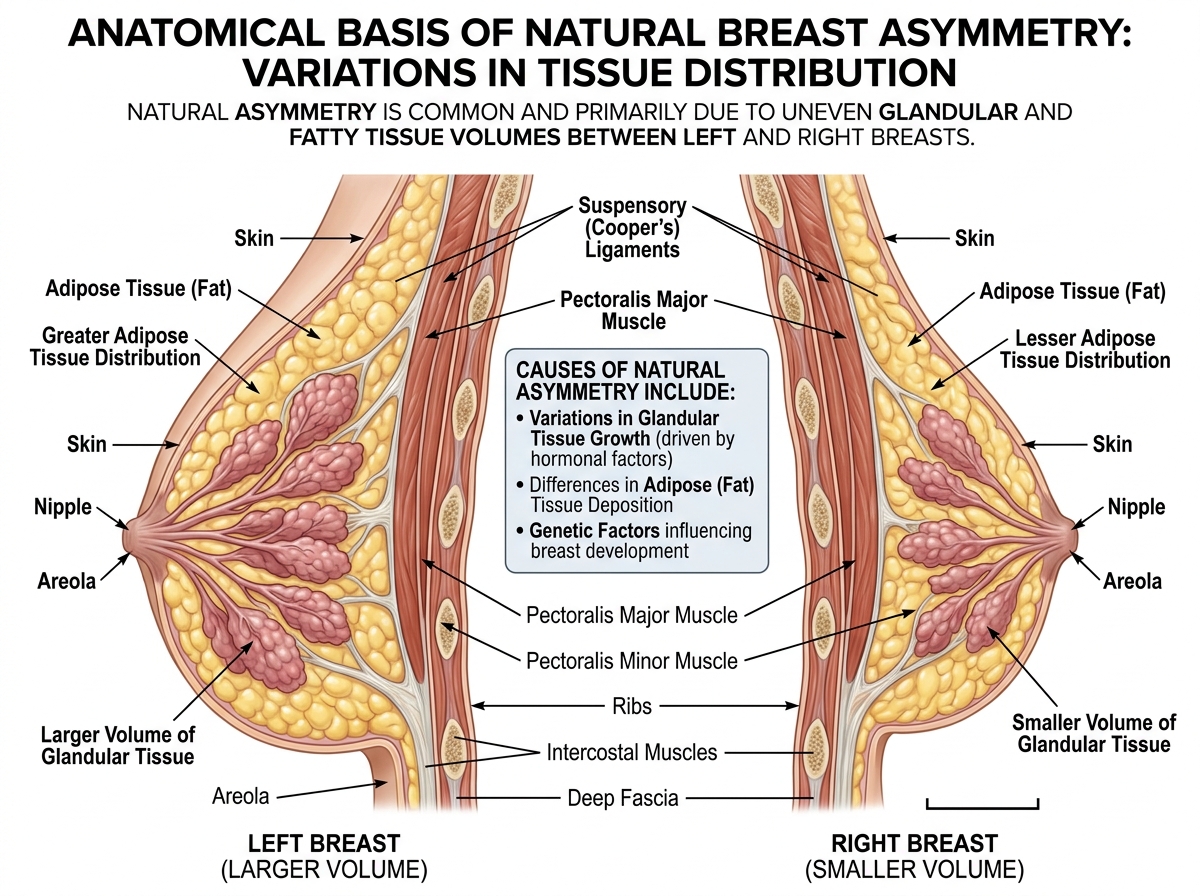
When we look in the mirror, we often expect a mirror image, but the human body is rarely perfectly symmetrical. Think about your feet or your eyebrows—one is almost always slightly different than the other. The same applies to breast tissue.
One of the primary drivers behind why are my boobs uneven is genetics. If your mother or grandmother had noticeable asymmetry, there is a high likelihood you will too. Your DNA dictates how your body stores fat and develops glandular tissue. Since breasts are composed of a mix of fatty tissue and specialized milk-producing glands, even a slight variation in how these tissues are distributed can lead to a visible difference in volume or shape.
Puberty is usually the first time women notice this. It is incredibly common for one “breast bud” to appear weeks or even months before the other. This head start can lead to one side remaining larger throughout the teenage years. According to a study on natural breast asymmetry, as many as 91% of women requesting breast implants cited asymmetrical breasts as a primary reason for their visit, proving just how widespread this concern is.
Hormonal Fluctuations and Growth
Our breasts are highly sensitive to the ebb and flow of reproductive hormones, specifically estrogen and progesterone. These hormones cause the breast tissue to retain fluid and the milk ducts to swell at various points in the month.
Research on hormonal changes and asymmetry indicates that breasts are often least symmetrical on the first day of ovulation. During the second half of the menstrual cycle, progesterone can cause the breasts to feel heavier or lumpier. Because one breast may have more hormone receptors than the other, it might react more strongly to these shifts, becoming temporarily larger or more tender than its “sister.”
Pregnancy and Breastfeeding Impact
Pregnancy brings about the most dramatic hormonal shift a woman will ever experience. During this time, the average breast volume can increase by nearly 100 mL. However, this growth isn’t always balanced.
In the postpartum period, breastfeeding adds another layer of complexity. Many babies develop a “favorite side,” or one breast may naturally have more functional milk ducts, leading to higher production and frequent engorgement on that side. This can result in one breast appearing significantly larger than the other during the months of nursing. Statistics show that 73% of mothers report lasting breast changes after pregnancy, which often includes new or worsened asymmetry once the anatomy of the breast during lactation returns to its resting state.
Medical Conditions Linked to Asymmetry

While most cases of unevenness are purely cosmetic, certain medical conditions can influence the development of the chest wall and breast tissue.
Scoliosis, a curvature of the spine, is a frequent culprit. When the spine curves, it can rotate the ribcage, pushing one side of the chest forward and pulling the other back. This makes one breast appear more prominent or sit at a different height. Interestingly, research on scoliosis and breast size found that in many idiopathic scoliosis cases, the left breast is naturally larger.
Other conditions include:
- Poland Syndrome: A rare congenital condition where the chest muscle (pectoralis) is missing or underdeveloped on one side, leading to a significantly smaller or absent breast.
- Diabetic Mastopathy: A condition seen in some long-term insulin-dependent diabetics where firm, non-cancerous lesions develop, potentially altering the breast’s shape and size.
Atypical Ductal Hyperplasia and why is one breast bigger than the other one
Atypical Ductal Hyperplasia (ADH) is a condition where the cells lining the milk ducts grow excessively and develop an unusual shape. While ADH is not cancer, it is considered a “high-risk” lesion.
According to an update on ADH diagnosis, these clusters of abnormal cells can sometimes cause a focal area of the breast to feel denser or appear different on imaging. Because ADH increases the future risk of breast cancer, any new lump or area of thickening that contributes to asymmetry should be evaluated by a specialist.
Juvenile Hypertrophy and Hypoplasia
On the opposite ends of the growth spectrum are Juvenile Hypertrophy and Breast Hypoplasia.
Juvenile Hypertrophy involves extremely rapid breast growth during puberty, sometimes occurring over just six months. Often, one breast reacts much more aggressively to pubertal hormones, leading to extreme lopsided boobs that can cause physical back pain and deep emotional distress. A study on juvenile breast hypertrophy notes that surgical intervention is often required to restore balance and physical comfort.
Conversely, Hypoplasia refers to underdeveloped breast tissue. This occurs when the glandular tissue fails to grow sufficiently, often leaving the breasts looking “tubular” or widely spaced.
When to Worry: Breast Asymmetry and Cancer Risk
We always tell our patients in Newport Beach: know your normal. While most asymmetry is lifelong, a new or sudden change in the size of one breast is a red flag that requires a professional exam.
When wondering why is one breast bigger than the other one suddenly, look for these accompanying signs of breast cancer:
- A new, hard lump that feels fixed in place.
- Skin dimpling or an “orange peel” texture (peau d’orange).
- Nipple retraction (a nipple that suddenly turns inward).
- Persistent redness or heat on one side.
- Spontaneous nipple discharge.
Mammogram Findings and Density
If you undergo a screening and the report mentions “asymmetry,” don’t panic. This is a very common finding, appearing in about 7% of mammograms. Radiologists categorize these findings to determine the next steps:
- Focal Asymmetry: A small, specific area of density seen in two different views.
- Global Asymmetry: A general difference in the amount of tissue between the two breasts (very common and usually normal).
- Developing Asymmetry: A new area of density that wasn’t there on your last mammogram. This is the type that doctors watch most closely.
According to understanding breast asymmetry on mammograms, up to half of these findings are simply “summation artifacts”—an illusion caused by overlapping layers of normal tissue. However, follow-up tests like ultrasound or 3D mammography are essential to be sure.
Understanding why is one breast bigger than the other one in relation to risk
Does having uneven breasts mean you are at higher risk for cancer? Not necessarily. However, a study on breast volume asymmetry and cancer risk suggested that women with a volume difference of more than 20% might have a statistically higher risk.
This doesn’t mean the asymmetry causes cancer; rather, it may be a marker of how the breast tissue responds to estrogen over time. Regular screenings are the best way to manage this risk, especially if you have dense breast tissue or a family history of invasive lobular carcinoma.
Options for Correcting Breast Asymmetry
If your asymmetry is benign but affects your confidence or how your clothes fit, you have several paths forward. Many women start with non-surgical solutions, such as:
- Professional Bra Fitting: A specialist can help you find bras that fit the larger breast comfortably while using a “shaper” or “chicken cutlet” insert to fill out the cup on the smaller side.
- Posture Correction: Since scoliosis or muscular imbalances can contribute to asymmetrical boobs, physical therapy or posture-correcting garments can sometimes improve the visual alignment of the chest.
Surgical Treatments for Balance
For those seeking a permanent solution, breast asymmetry correction surgery is highly effective. Because every woman’s body is unique, we often combine different techniques to achieve a natural-looking result.
| Procedure | Best For… | How It Works |
|---|---|---|
| Augmentation | Increasing the smaller side | Using a single implant or two different-sized implants. |
| Breast Lift | Correcting nipple height | Removing excess skin to “lift” a sagging breast to match the other. |
| Reduction | Decreasing the larger side | Removing tissue and skin from the larger breast for a lighter feel. |
| Fat Transfer | Subtle volume adjustments | Using your own fat to fill in small “hollow” areas or minor size gaps. |
Using different-sized implants is a common strategy. For example, we might place a 300cc implant on the left and a 350cc implant on the right to bridge a half-cup size gap. In more complex cases, we might perform a lift on one side and an augmentation on the other to ensure both the volume and the nipple position match.
Frequently Asked Questions about Uneven Breasts
Does sleeping on your side cause uneven breasts?
This is a common myth! There is no scientific evidence that sleeping on your side “squishes” one breast into a smaller size. While your breasts might look slightly different immediately after waking due to temporary tissue compression, they will return to their normal shape once you are upright and moving. The only time sleeping position is critical is immediately following breast-asymmetry-correction, where we advise sleeping on your back to ensure the implants or incisions heal symmetrically.
Is it normal for the left breast to be larger?
Statistically, yes. In studies of women with natural asymmetry, the left breast is more frequently the larger of the two. There are several theories for this, ranging from the position of the heart (which is slightly left of center) to the fact that most people are right-handed. Dominant right-hand usage can lead to more developed pectoral muscles on the right, which can actually pull the right breast tissue tighter against the chest, making it appear smaller than the left.
Can exercise fix breast asymmetry?
Exercise can change the shape of the pectoral muscle underneath the breast, but it cannot change the amount of fat or glandular tissue within the breast itself. If one side of your chest is weaker, targeted exercises like single-arm chest presses might help “lift” the appearance of the breast on that side. However, for significant volume differences, fitness alone usually isn’t enough to create perfect symmetry.
Conclusion: Finding Confidence at OC Breast Surgery
At the end of the day, why is one breast bigger than the other one usually comes down to the beautiful, imperfect way our bodies grow. Whether your asymmetry is a result of puberty, the journey of motherhood, or simply your genetic blueprint, you deserve to feel comfortable in your skin.
At OC Breast Surgery in Newport Beach, CA, Dr. Mark Anton specializes in the art of symmetry. We understand that “natural-looking results” aren’t about perfection—they’re about harmony and proportion. We take great pride in our expertise in breast revision and reconstruction, helping women who have had poor results elsewhere or who are simply ready to address lifelong asymmetry.
If you are ready to stop worrying about lopsided boobs and start feeling confident in every outfit, we are here to help. Schedule a breast asymmetry correction surgery consultation with us today in our Newport Beach office and let’s discuss a plan tailored specifically to you.