
Breast Implant Rupture MRI: 1st Accurate Guide
Why Accurate Rupture Detection Matters for Your Health
Breast implant rupture mri is the most accurate method for detecting implant failures, with a sensitivity of 72-94% and specificity of 85-100%. It can identify both intracapsular ruptures (silicone contained within the scar tissue capsule) and extracapsular ruptures (silicone leaking into surrounding tissue) using specific signs like the “linguine sign.”
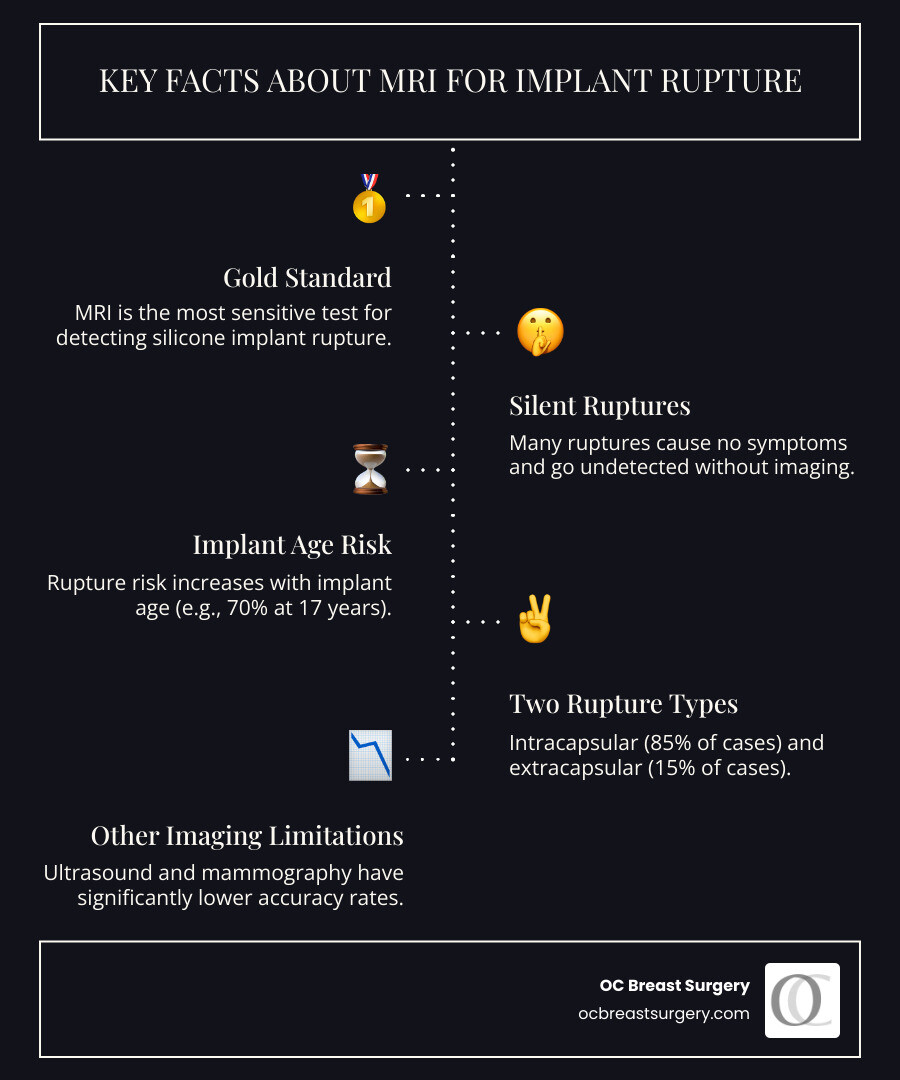
Quick Answer: Key Facts About MRI for Implant Rupture
- MRI is the gold standard – Most sensitive test for detecting silicone implant rupture
- Silent ruptures are common – Many ruptures cause no symptoms and go undetected without imaging
- Timing matters – Rupture risk increases with implant age (30% at 5 years, 50% at 10 years, 70% at 17 years)
- Two rupture types exist – Intracapsular (85% of cases) and extracapsular (15% of cases)
- Other imaging falls short – Ultrasound and mammography have significantly lower accuracy rates
Breast implants are not lifetime devices, and their risk of rupture increases with age. Many women experience a “silent rupture,” where the implant fails without obvious symptoms because the silicone gel is trapped within the surrounding scar tissue capsule. This makes imaging critical, as you can’t rely on physical symptoms alone. While ultrasound and mammography are common, neither matches the accuracy of MRI for confidently diagnosing a rupture.
I’m Dr. Mark Anton, founder of OC Breast Surgery in Newport Beach, California. With over 33 years of specialized breast surgery experience, I’ve seen how a precise breast implant rupture mri diagnosis is essential for making the right treatment decisions. This guide will walk you through everything you need to know.
Understanding Breast Implant Rupture
Breast implants are durable, but they don’t last forever. When the outer shell fails, it’s called a rupture. Your body naturally forms a fibrous capsule (a pocket of scar tissue) around each implant. Inside this is the implant shell, which holds the silicone gel. Saline implants are filled with sterile saltwater instead.
Several risk factors increase your chances of rupture. The biggest one is implant age. Research shows a rupture prevalence of 30% at 5 years, 50% at 10 years, and 70% at 17 years, with a median implant age at rupture of 10.8 years. This is why the FDA recommends regular breast implant rupture mri screening. Trauma from an accident or even aggressive mammography can also cause damage. Additionally, Capsular Contracture, where the fibrous capsule tightens excessively, can lead to shell failure.

Intracapsular vs. Extracapsular Rupture
Not all ruptures are the same. Understanding the two types helps explain why some go unnoticed while others cause obvious problems.
Intracapsular rupture is the most common, accounting for about 85% of all ruptures. The implant shell breaks, but the silicone gel remains contained within the fibrous capsule. Because the silicone has nowhere to go, these ruptures are often contained and completely silent—you can’t tell anything has changed.
Extracapsular rupture, occurring in about 15% of cases, is more serious. Here, both the implant shell and the fibrous capsule tear, allowing silicone leakage into breast tissue and potentially beyond. This can cause inflammatory lumps (granulomas) and is more likely to produce symptoms.
Symptoms of a Ruptured Implant
Many ruptured implants cause no symptoms at all; these are called silent ruptures. This is why routine imaging is so important for asymptomatic patients. When symptoms do occur, they can include:
- Changes in breast size or shape
- Hardening of the breast
- Palpable lumps or knots
- Pain or tenderness
- Swelling
However, these symptoms overlap with other conditions, so imaging is necessary for a definitive diagnosis. If you’re experiencing these signs, contact your plastic surgeon. For information on broader symptoms, see our page on Breast Implant Illness Symptoms.
Comparing Imaging Modalities for Rupture Detection
When a rupture is suspected, choosing the right imaging test is crucial. The FDA recommends regular MRI screening for silicone implants because these failures are often silent. While mammography and ultrasound have roles in breast health, they lack the accuracy needed for a definitive rupture diagnosis. For this, breast implant rupture mri is the superior tool. You can learn more about the technical details at Breast implant rupture | Radiology Reference Article | Radiopaedia.org.
Magnetic Resonance Imaging (MRI)
MRI is the gold standard for evaluating silicone implants, with sensitivity between 72-94% and specificity between 85-100%. It uses specialized silicone-specific sequences and water-suppression techniques to create exceptionally clear images of the silicone gel, revealing subtle leaks other methods miss. A key benefit is that MRI uses no radiation, making it safe for repeated screenings.
Ultrasound
Ultrasound is often a first step because it’s accessible and uses no radiation. However, its accuracy is highly operator-dependent, and it has lower sensitivity than MRI, especially for intracapsular ruptures. It can detect some signs, like the “snowstorm” sign in an extracapsular rupture or the stepladder sign in an intracapsular one. If an ultrasound is suspicious, an MRI is needed for confirmation.
Mammography
Mammograms are for breast cancer screening, not implant evaluation. The dense silicone appears white, obscuring the view inside the implant. While Eklund displacement views help visualize breast tissue, mammography is severely limited for detecting intracapsular rupture. It may only show free silicone from an obvious extracapsular rupture. There is also a small risk that the compression could damage a weakened implant.
Here’s how these three imaging methods compare for detecting silicone implant rupture:
| Modality | Sensitivity | Specificity | Best For | Key Limitations |
|---|---|---|---|---|
| MRI | 72–94% | 85–100% | Definitive diagnosis of both rupture types | Higher cost, longer exam time, some cannot undergo MRI |
| Ultrasound | 50–77% | 55–84% | Initial evaluation, accessible screening | Operator skill dependent, misses subtle intracapsular ruptures |
| Mammography | 25–30% | 88–89% | Breast cancer screening, obvious extracapsular leaks | Cannot detect intracapsular ruptures reliably, obscures breast tissue |
These numbers make the superiority of breast implant rupture mri clear. While other imaging serves important purposes, only MRI provides the accuracy needed for a confident diagnosis.
A Closer Look at Breast Implant Rupture MRI Findings
At OC Breast Surgery, we work with expert radiologists to interpret breast implant rupture mri scans. The quality of the MRI is vital, which is why we use dedicated breast MRI coils for the most detailed images. The findings also depend on your implant type. As our page on Saline vs. Silicone Implants explains, saline ruptures are obvious, but silicone ruptures require advanced imaging like MRI.
Characteristic MRI Findings for Intracapsular Rupture
Since most ruptures are intracapsular, radiologists look for specific signs. The most definitive is the linguine sign, where the collapsed implant shell appears as wavy dark lines floating within the silicone. Other more subtle clues include the keyhole sign, teardrop sign, or the subcapsular line sign, which indicate small amounts of silicone have escaped the shell but not the capsule. These uncollapsed ruptures require an expert eye to spot.
Characteristic MRI Findings for Extracapsular Rupture
Extracapsular ruptures (about 15% of cases) are often more dramatic on an MRI. The key finding is silicone outside the fibrous capsule, seen as bright signals in the breast tissue. The body may form inflammatory lumps called a silicone granuloma (or siliconoma) around the leaked gel. In some cases, we can see silicone in lymph nodes, indicating it has migrated.
Understanding False-Positives and Other Factors in Breast Implant Rupture MRI
While MRI is the best tool we have, it’s not perfect, and false positives can occur. Normal radial folds in the implant shell can sometimes be mistaken for a rupture by less experienced readers. Gel bleed, a microscopic seepage of silicone through an intact shell, can also complicate interpretation.
Newer, highly cohesive Gummy Bear Breast Implants may not show the classic linguine sign even when ruptured because the thick gel holds its shape, creating an uncollapsed rupture. One study noted that surgical exploration confirmed an MRI-suspected rupture in only 41% of cases, highlighting the issue of false positives.
This is why we don’t rely on imaging alone. We correlate MRI findings with your physical exam and symptoms to ensure an accurate diagnosis and avoid unnecessary surgery. An experienced breast imaging specialist is crucial to distinguish a true rupture from these mimics.
Management and Next Steps After Diagnosis
Receiving a rupture diagnosis from a breast implant rupture mri can be overwhelming, but it provides a clear path forward. The American Society of Plastic Surgeons confirms that MRI Is Most Accurate Test for Detecting Ruptured Silicone Breast Implants, giving us a solid basis for your care plan. At OC Breast Surgery, Dr. Anton’s 33 years of experience will guide you through this process.

Surgical Treatment for Implant Rupture
For a confirmed silicone rupture, surgery is the recommended treatment. The core procedure is Breast Implant Removal, where we carefully remove the damaged implant and any leaked silicone. Many women opt for Breast Implant Revision Surgery at the same time, replacing the old implant with a new one. For extracapsular ruptures, we often perform a total capsulectomy, removing the entire fibrous capsule to ensure all silicone particles and inflammatory tissue are gone. We provide transparent information on Explant Surgery Cost to help you plan.
Complications of Untreated Rupture
Leaving a ruptured silicone implant untreated is not recommended due to potential complications. Silicone migration can occur, where free silicone spreads to breast tissue, lymph nodes, or the chest wall. This triggers granulomatous reactions, forming painful inflammatory lumps. Lymphadenopathy (swollen lymph nodes) and chronic inflammation can also result. Furthermore, leaked silicone and granulomas can interfere with breast cancer detection on future mammograms, potentially leading to unnecessary biopsies or diagnostic delays. Addressing a rupture promptly provides the best long-term outcome.
Frequently Asked Questions about MRI and Implant Rupture
We know that a breast implant rupture mri can bring up many questions. Here are answers to the most common concerns we hear from patients at our Newport Beach practice.
How often should I get an MRI to check for implant rupture?
The FDA recommends that women with silicone implants get their first MRI screening 5-6 years after surgery, followed by scans every 2-3 years. This schedule is for asymptomatic patients to detect silent ruptures. If you experience any symptoms like pain or changes in breast shape, contact your plastic surgeon immediately for an evaluation.
Is an MRI for breast implant rupture painful?
No, an MRI is non-invasive and painless. You will lie face down on a table with your breasts in cushioned openings for 30 to 60 minutes. The main challenge is staying still. Some find the position uncomfortable or feel claustrophobic. If you have concerns about claustrophobia, let us know so we can discuss options to make you more comfortable.
What if my implant ruptures but I have no symptoms?
Silent ruptures are common, which is why screening is so important. Even without symptoms, a rupture can lead to complications over time, such as silicone migration, granulomas, and chronic inflammation. The best step is to consult with a plastic surgeon to review your MRI and discuss the pros and cons of monitoring the situation versus surgical intervention. We can help you make an informed decision based on your specific case, whether it’s removal, replacement, or another corrective procedure.
Conclusion
Understanding the role of breast implant rupture mri is a key part of your long-term breast health. Implants don’t last forever, and MRI provides the most reliable way to check their integrity, catching both silent and symptomatic ruptures. Early detection allows us to act before complications like silicone migration arise, giving you control over your health choices.
At OC Breast Surgery in Newport Beach, California, Dr. Mark Anton and our team specialize in guiding women through these concerns. We know a rupture diagnosis is stressful, and we are here to explain your options and answer every question.
If your silicone implants are over five years old, or if something doesn’t feel right, don’t wait for symptoms. Proactive screening provides peace of mind. We are ready to help you with the specialized knowledge that complex breast surgery requires.
Contact us for a consultation about Breast Implant Revision Surgery and let us help you move forward with confidence.