
Inverted Nipples: Spontaneous Correction vs. Needing a Helping Hand
What It Means When a Nipple Points Inward — And Whether It Can Fix Itself
Can an inverted nipple correct itself? The short answer is: sometimes, but it depends on the cause and severity.
Here’s a quick breakdown:
| Situation | Likely to Self-Correct? |
|---|---|
| Congenital inversion, Grade 1 (mild) | Possibly — especially during puberty or pregnancy |
| Congenital inversion, Grade 2 (moderate) | Sometimes, with hormonal changes or breastfeeding |
| Congenital inversion, Grade 3 (severe) | Rarely — usually requires medical help |
| Acquired inversion (new, sudden change) | Unlikely without treating the underlying cause |
Inverted nipples are more common than most people think. Between 10% and 20% of the general population has at least one flat or inverted nipple. For many, it’s simply how they were born — a harmless variation in breast anatomy. For others, it develops later in life and can signal something that needs medical attention.
Beyond the physical side, nipple inversion can quietly affect confidence, self-image, and intimacy. It’s not just a cosmetic issue — it can also make breastfeeding difficult, depending on severity.
There’s an important distinction to understand right away: congenital inversion (present since birth or puberty) behaves very differently from acquired inversion (a new change in an adult). That difference shapes everything about whether self-correction is realistic — or whether you need a helping hand.
I’m Dr. Mark Anton, a breast surgery specialist with over 33 years of experience and thousands of procedures performed, and one of the questions I’m asked most often is can an inverted nipple correct itself — which is exactly what this guide will walk you through. Whether you’re navigating this for the first time or looking for clarity after a previous procedure, I’ll help you understand your options at every grade of inversion.

Must-know can an inverted nipple correct itself terms:
Understanding Nipple Inversion: Grades and Prevalence
To answer the question, “can an inverted nipple correct itself,” we first have to look at what we are dealing with. Not all “innies” are created equal. In the medical world, we use a grading system to determine how tethered the nipple tissue is to the underlying structures. This classification helps us predict if the nipple will ever pop out on its own or if it needs a little nudge.
The Three Grades of Nipple Inversion
| Feature | Grade 1 (Mild) | Grade 2 (Moderate) | Grade 3 (Severe) |
|---|---|---|---|
| Ease of Eversion | Everts easily with touch or cold; can stay out for a while. | Can be pulled out but retracts almost immediately. | Difficult or impossible to pull out manually. |
| Fibrosis (Scarring) | Little to no internal scarring or tightness. | Moderate fibrosis; some tension in the ducts. | Significant fibrosis; very short, tight milk ducts. |
| Breastfeeding | Usually no issues; baby’s suction keeps it out. | Can be challenging; may require specialized aids. | Often impossible without surgical intervention. |
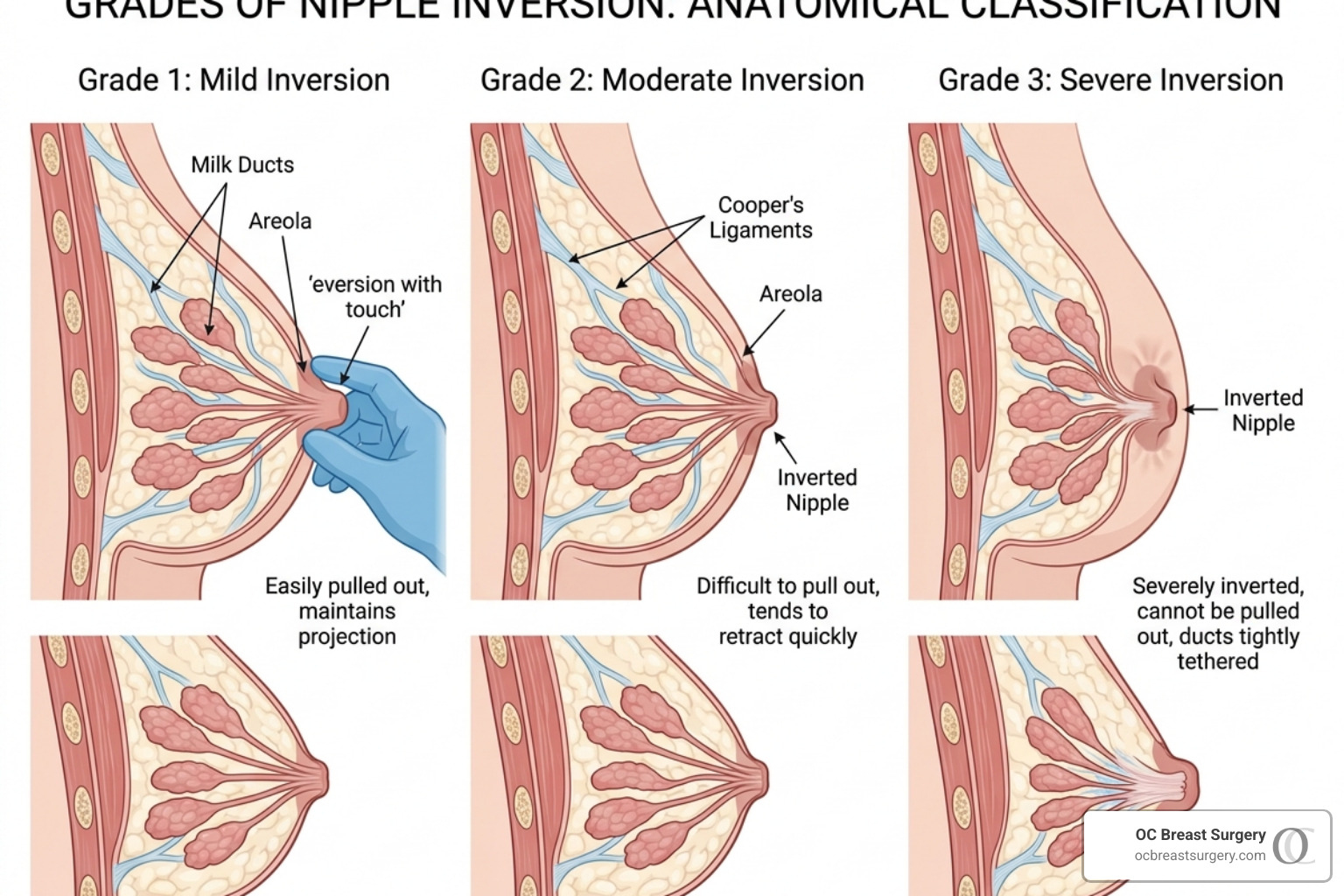
Alt text: Diagram showing Grade 1, 2, and 3 nipple inversion in Newport Beach, CA.
Statistically, about 10% to 20% of the population has some form of nipple inversion. Interestingly, about 87% of congenital cases are bilateral (affecting both sides), and half of those cases are familial, meaning it likely runs in your family.
According to Inverted & Flat Nipples: Causes & Treatment, these variations are usually harmless. However, the higher the grade, the less likely the tissue is to “relax” into a protruding position without intervention. Grade 1 nipples are often called “shy nipples” because they only hide occasionally, whereas Grade 3 nipples are firmly tethered by short lactiferous ducts.
Can an Inverted Nipple Correct Itself Naturally?
When we talk about natural correction, we are looking at the body’s own ability to stretch the internal tissues that are pulling the nipple inward. The Inverted Nipple – StatPearls – NCBI Bookshelf research indicates that spontaneous resolution is most common during periods of significant hormonal shift and physical growth.
The primary reason a nipple is inverted is that the milk ducts (lactiferous ducts) or the surrounding connective tissue didn’t lengthen enough during fetal development. Essentially, the “tether” is too short. For the nipple to correct itself, these tethers must either stretch out or be released. While this doesn’t happen for everyone, there are two major life stages where female inverted nipples are most likely to change.
Can an inverted nipple correct itself during puberty?
Puberty is the most common time for spontaneous correction. During this stage, the mesoderm (the middle layer of cells in an embryo) and the mammary pit undergo rapid changes. As the breast tissue expands, the internal structures are under constant, gentle pressure to grow and lengthen.
In many pre-pubescent children, the nipples may appear flat or slightly retracted. However, as the breasts develop, the ducts may naturally lengthen to accommodate the new volume. If you or your child have innie nips during early adolescence, there is a good chance they may evert as the growth process completes. According to the Inverted Nipple Corrected Ultimate Guide, monitoring the situation through the end of puberty is often the best first step.
Can an inverted nipple correct itself during pregnancy or breastfeeding?
Pregnancy is the second “golden window” for natural correction. During pregnancy, hormonal shifts cause the breasts to enlarge and the milk ducts to prepare for lactation. This natural expansion can provide enough “stretch” to permanently evert a Grade 1 or mild Grade 2 nipple.
Breastfeeding itself acts as a form of natural physical therapy. The consistent, rhythmic suction from an infant can gradually lengthen short ducts. Many women find that after a few months of nursing, their nipples remain protruding even when not stimulated. However, this is less likely for those with Grade 3 inversion, where the ducts are so tight that they actually prevent the baby from latching properly. If you are struggling with this, understanding how to fix inverted nipple for breastfeeding is crucial for a successful nursing journey.
When Inversion Doesn’t Resolve: Non-Surgical “Helping Hands”
If puberty and pregnancy haven’t done the trick, you might wonder if you can “train” your nipples to stay out. There are several non-invasive methods designed to apply consistent suction or manual stretching to the internal fibers.
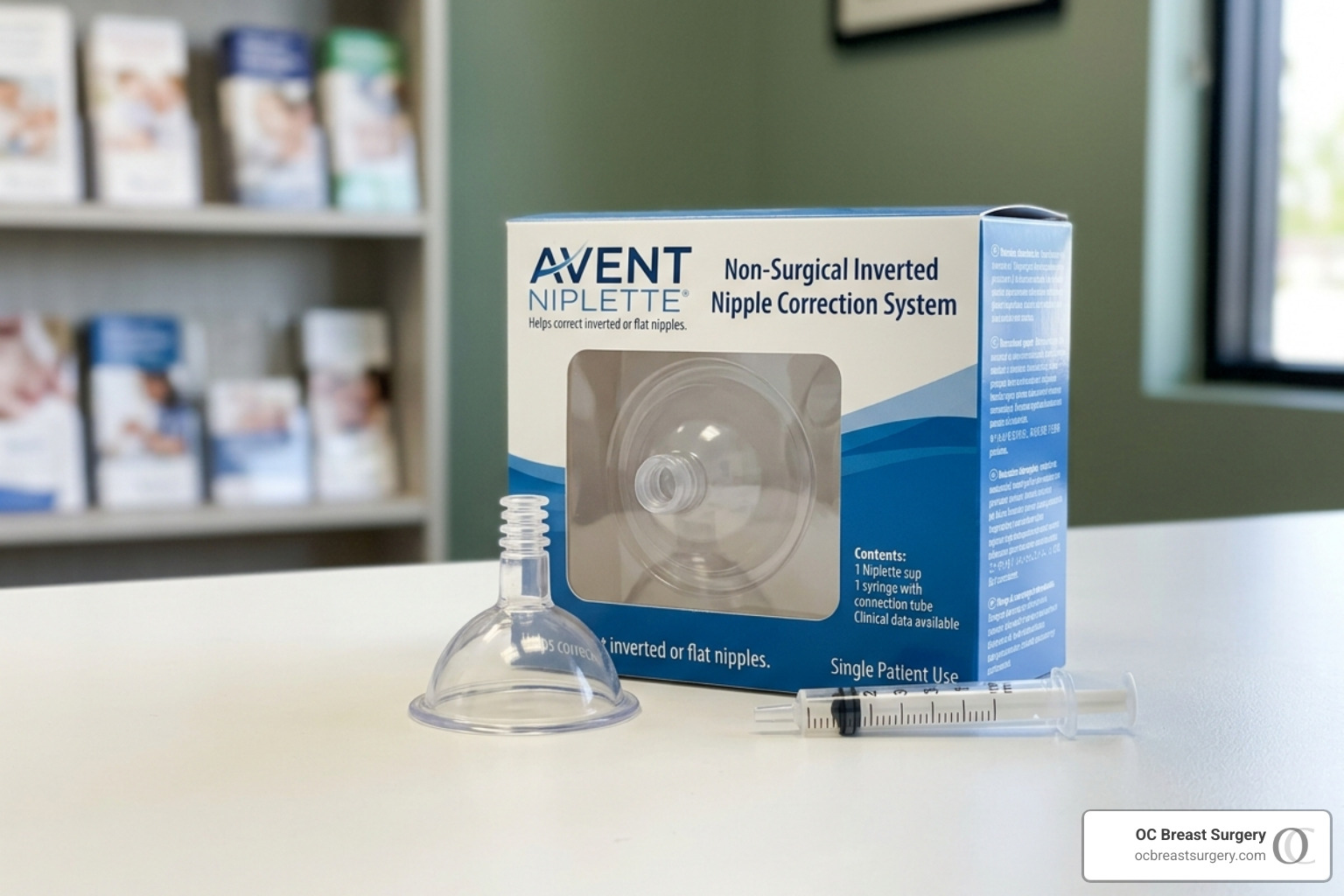
Alt text: A non-surgical nipple suction device used for Grade 1 and 2 inversion in Newport Beach, CA.
The Hoffman Technique
Developed in the 1950s, the Hoffman technique involves placing your thumbs on opposite sides of the nipple base and firmly pulling them away from each other. You then repeat this vertically. The goal is to break up the tiny adhesions or “tethers” pulling the nipple in. While some older studies questioned its effectiveness for breastfeeding, many people still find it a helpful daily exercise for mild cases.
Suction Devices (The Niplette)
Suction devices like the Niplette are highly effective for Grade 1 and 2 inversions. These are small plastic cups worn over the nipple that use a syringe to create a vacuum. Over time—usually about three months of consistent use—the vacuum pressure stretches the ducts.
- Success Rate: Statistics show that over 80% of women using suction devices see their nipples protrude by the first follow-up, and over 90% can discontinue use after three months.
- Limitations: As noted in Can Inverted Nipples Be Corrected Without Surgery?, these devices rarely work for Grade 3 cases because the internal fibrosis is simply too strong for suction to overcome.
Nipple Piercings
Some people opt for nipple piercings as a “mechanical” fix. By placing a bar through the base of the nipple, it acts as a physical block that prevents the nipple from retracting. While this can work, it carries risks of infection and scarring, and it isn’t always a permanent solution if the jewelry is removed.
For more details on these approaches, check our guide on inverted nipple repair without surgery or learn how to fix inverted nipples at home.
Medical Intervention and Surgical Correction
When “can an inverted nipple correct itself” is answered with a “no,” many patients turn to us for a more permanent solution. At OC Breast Surgery in Newport Beach, CA, we specialize in inverted nipple surgery that prioritizes both the aesthetic result and, whenever possible, the preservation of function.
The Procedure: What to Expect
Surgical correction is a relatively quick, outpatient procedure usually performed under local anesthesia. It involves making a tiny micro-incision at the base of the nipple to reach the tight bands of tissue (the tethers).
We generally use two main techniques:
- Duct-Preserving Technique: We carefully release the fibrous bands while keeping the milk ducts intact. This is the preferred method for women who still plan to breastfeed.
- Duct-Release Technique: For severe Grade 3 cases, the ducts themselves are often the primary cause of the inversion. In these instances, we may need to divide the ducts to allow the nipple to project. While this usually precludes breastfeeding, it offers the most stable and permanent cosmetic result.
Alt text: Before and after representation of surgical nipple correction in Newport Beach, CA.
Recovery and Results
Recovery is surprisingly fast. Most of our patients return to work the very next day. We often use a “marionette stitch” or a specialized “donut dressing” for a week or two post-op. Think of this like a cast for a broken bone—it holds the nipple in its new, protruding position while the internal tissues heal and “set.”
The inverted nipple correction results are typically permanent, though there is a small risk of recurrence (about 5-10%) if the internal scarring is particularly aggressive. You can explore inverted nipple surgery cost and more technical details on our innie nipple surgery page.
When to See a Doctor for Acquired Inversion
While congenital inversion is usually just an anatomical quirk, acquired inversion—meaning a nipple that used to stick out but now points in—is a different story. If you notice a sudden change, especially if you are over the age of 30, it is time to schedule an evaluation.
According to Inverted Nipples: Common Causes, acquired inversion can be caused by several factors:
- Duct Ectasia: This is a benign condition where milk ducts become clogged and swollen, often affecting women aged 45-55.
- Mastitis or Abscess: Infections can cause internal scarring that pulls the nipple inward.
- Breast Cancer: A tumor located behind the nipple can pull on the ducts, causing the nipple to retract or “dimple.” This is often a unilateral (one-sided) change.
- Fat Necrosis: Usually caused by an injury to the breast, this can create firm scar tissue that mimics a tumor or pulls on the nipple.
If you experience sudden inversion accompanied by discharge, a lump, redness, or skin changes like “orange peel” texture, please see a professional immediately. We take every inverted nipple case seriously, ensuring we rule out underlying health concerns before discussing cosmetic fixes.
Frequently Asked Questions about Nipple Correction
Can I still breastfeed if my nipples don’t self-correct?
Yes, in many cases! For Grade 1 and 2, the baby’s suction is often enough to draw the nipple out. If you are struggling, a lactation consultant can be your best friend. They can teach you techniques like “reverse pressure softening” or recommend nipple shields. These are thin silicone covers that help the baby latch while the nipple is retracted. For more tips, visit how to fix inverted nipple for breastfeeding.
Does nipple inversion affect sensitivity?
This is a common myth! Inverted nipples are generally just as sensitive as protruding ones. The nerves that provide sensation are different from the “contract nerves” that cause the nipple to become erect. Most patients who undergo how to fix inverted nipple procedures report that their sensation remains intact or even improves as they become more comfortable with their bodies.
How much does it cost to fix inverted nipples if they don’t change?
The cost varies based on whether you are treating one or both nipples and the complexity of the inversion. Generally, you can expect to pay for the surgeon’s fee, local anesthesia, and the facility fee. Because this is often considered a cosmetic procedure, insurance rarely covers it unless it is part of a reconstructive effort. For a detailed breakdown, see how much does it cost to fix inverted nipples and our page on the cost of inverted nipple correction surgery.
Conclusion
So, can an inverted nipple correct itself? While nature sometimes lends a hand during puberty or pregnancy, many people find that their “innies” are a permanent part of their anatomy. Whether your goal is to make breastfeeding easier, improve hygiene, or simply feel more confident in your own skin, you don’t have to wait for a “miracle” stretch that might never happen.
At OC Breast Surgery in Newport Beach, CA, Dr. Mark Anton and our team are dedicated to providing clear answers and natural-looking results. We believe that every patient deserves to feel comfortable and confident. If you’re tired of waiting for your nipples to self-correct, we invite you to schedule a personalized consultation to discuss inverted nipple correction. We’ll help you decide if a “helping hand” is the right choice for your aesthetic and functional goals.