
The Ultimate Guide to Implant Removal and Replacement
What Is Implant Removal and Replacement?
Implant removal and replacement are two of the most common breast revision procedures performed today — and knowing the difference can help you make a confident, informed decision.
Here’s a quick overview:
| Procedure | What It Involves | Common Reasons |
|---|---|---|
| Implant Removal (Explantation) | Implants are taken out, with or without the surrounding scar tissue | Pain, rupture, capsular contracture, Breast Implant Illness, personal preference |
| Implant Replacement (Exchange) | Old implants are swapped for new ones | Size change, implant aging, positioning issues, complications |
| Removal + Lift or Fat Grafting | Removal combined with reshaping procedures | Sagging after removal, desire for a natural result without new implants |
Breast implants are not lifetime devices. The American Society of Plastic Surgeons recommends removal or replacement every 10 to 15 years — and over 40% of implants placed a decade earlier were removed for physical reasons, including capsular contracture.
Whether you’re dealing with a complication, a change in goals, or simply wondering what your options are, this guide walks you through everything you need to know.
I’m Dr. Mark Anton, founder of OC Breast Surgery in Newport Beach, CA, with over 33 years of experience and thousands of breast surgeries performed — including complex implant removal and replacement cases. I created this guide because my first mission has always been patient education.
Key implant removal and replacement vocabulary:
- breast augmentation after pregnancy
- breast augmentation cost CA
- breast augmentation surgery orange county
Understanding Breast Implant Removal (Explantation)
Breast implant removal, often called explantation, is a surgical procedure to take out silicone or saline breast implants. It is not as simple as “zipping” them out; it involves careful dissection to ensure the breast tissue remains healthy and the aesthetic result is as pleasing as possible.
When we perform breast implant removal, we aren’t just removing the device. We are often dealing with the “capsule”—a layer of scar tissue the body naturally forms around any foreign object. Depending on your health needs and the condition of the implant, we may also remove this scar tissue to ensure the best long-term outcome.
Explantation is typically an outpatient procedure performed under general anesthesia. It can take anywhere from one to three hours, depending on whether we are performing a simple removal or a more complex breast explant surgery involving the removal of the entire capsule.
Breast Implant Replacement: How It Differs
While removal focuses on returning the breast to a more natural state (or preparing for a “flat” closure), implant replacement—also called an implant exchange—is about updating the look or addressing a specific issue while maintaining breast volume.
Replacement is often chosen when:
- Size Goals Change: You may want to go larger or smaller than your original choice.
- Implant Aging: Silicone shells can break down over time, even without a noticeable “pop.”
- Positioning Issues: Implants can shift, leading to “bottoming out” or “symmastia” (where implants merge in the middle).
The primary difference is that in a replacement, we utilize the existing “pocket” (the space where the implant sits) or create a slightly different one to house a fresh, new device. This allows you to maintain the fullness you’ve grown accustomed to while ensuring the hardware is safe and modern.
Common Reasons for Implant Removal and Replacement
Why do women walk through our doors in Newport Beach, CA, seeking these procedures? In our experience, the reasons are a mix of medical necessity and lifestyle evolution.
Medical Necessity
- Capsular Contracture: This occurs when the scar tissue around the implant hardens. It can cause the breast to feel tight, look distorted, and even become painful. It is the most common reason for breast implant revision.
- Implant Rupture: While saline ruptures are obvious (the breast deflates), silicone ruptures can be “silent.” This is why regular monitoring is vital.
- BIA-ALCL: Breast Implant-Associated Anaplastic Large Cell Lymphoma is a rare cancer linked to textured implants. While rare, it requires the removal of the implant and the entire capsule.
- Infection or Extrusion: Sometimes, the body rejects the implant, or an infection occurs that cannot be cleared without removing the device.
Personal and Aesthetic Reasons
- Breast Implant Illness (BII): Many women report systemic symptoms like brain fog, joint pain, and fatigue. A study published in the Annals of Plastic Surgery found a 74% reduction in self-reported systemic symptoms six months after explantation.
- Lifestyle Changes: You might find that large implants no longer fit your active lifestyle or professional wardrobe.
- Aging and Gravity: Over time, natural breast tissue sags while the implant stays in place, creating an “Snoopy” or “double-bubble” effect.
The Pros and Cons: Removal vs. Replacement
Deciding between implant removal and replacement is a deeply personal choice. Here is how we help our patients weigh the options:
Breast Implant Removal
- Pros: No more worries about future ruptures or replacements; potential relief from BII symptoms; clearer mammogram results; a return to your natural body.
- Cons: Potential for sagging or “deflated” appearance; loss of upper-pole fullness; psychological adjustment to a smaller breast size.
Breast Implant Replacement
- Pros: Maintains the desired volume and shape; corrects existing complications; uses newer, safer implant technology.
- Cons: You will still have a foreign object in your body; you will likely need another surgery in 10-15 years; continuing costs for monitoring.
Understanding the Capsule: Total, En Bloc, and Partial Capsulectomy
When we talk about implant removal and replacement, the most technical part of the conversation usually revolves around the “capsule.” Every patient has one, but not every patient needs it removed in the same way.
- Partial Capsulectomy: We remove only a portion of the scar tissue. This is common during a simple implant exchange where the capsule is healthy and soft.
- Total Capsulectomy: We remove the entire scar tissue lining. This is often necessary if there is heavy calcification or if the patient is concerned about BII.
- En Bloc Capsulectomy: This is the “gold standard” for many. It involves removing the implant and the capsule as one single, unbroken unit. This is crucial if the implant is ruptured, as it prevents silicone or biofilm from leaking into the surrounding tissue.
Choosing the right approach requires a surgeon who understands the nuances of breast explant and lift and can navigate the delicate chest wall anatomy.
Risks and Complications to Consider
Like any surgery, implant removal and replacement come with risks. We believe in being 100% transparent so you can prepare effectively.
- Seroma and Hematoma: Fluid or blood can collect in the space left behind by the implant. We often use temporary drains to manage this.
- Changes in Sensation: It is common to experience temporary numbness in the nipples or breast skin. While usually temporary, permanent changes can occur.
- Aesthetic Dissatisfaction: If you choose removal without a lift, you may be unhappy with the “empty” look of the skin.
- BIA-ALCL Risk: For those with textured implants, the lifetime prevalence is estimated at 1:30,000, though some studies on specific devices (like Biocell) show risks as high as 1:100 over 20 years.
Deciding Between Removal, Replacement, or a Lift
If you are leaning toward removal, you need to consider what the “new you” will look like. When an implant is removed, the skin that was stretched for years may not simply snap back.
The Breast Lift (Mastopexy)
A breast lift after implant removal is often the best way to achieve a youthful, perky shape. We remove the excess skin and reposition the nipple to a more natural height.
Fat Grafting
For those who want to avoid new implants but fear looking “flat,” fat transfer after explant is a fantastic middle ground. We take fat from areas like your abdomen or thighs and carefully inject it into the breast. This provides a subtle, natural increase in volume using your own living tissue. You can see the possibilities in our breast explant with fat transfer before and after gallery.
The Recovery Process and Timeline
Recovery from implant removal and replacement is generally smoother than the initial augmentation, but it still requires patience.
- Week 1: Most patients can return to desk work. You’ll feel some soreness and “tightness,” especially if a capsulectomy was performed.
- Weeks 2-3: Light walking is encouraged, but no heavy lifting. If you had a breast implant exchange in Newport Beach, you’ll start to see the new shape settle.
- Weeks 6+: You are usually cleared for full exercise.
- Month 3-6: The “fluffing” period. This is when the breast tissue softens and takes on its final, natural contour.
For a detailed breakdown, please see our breast implant removal recovery guide.

Cost and Insurance Considerations
How much does implant removal and replacement cost? Typically, the range is between $6,000 and $12,000.
Factors that influence the price include:
- The complexity of the capsulectomy (En bloc is more time-consuming).
- Whether you are adding a lift or fat grafting.
- The type of new implants chosen (Silicone “Gummy Bear” implants are generally more expensive than saline).
You can find more specifics in our explant surgery cost California guide.
Does insurance cover it? Generally, cosmetic removals are not covered. However, if the removal is “medically necessary”—such as for a proven rupture of a silicone implant, severe capsular contracture (Baker Grade IV), or BIA-ALCL—insurance may step in. Additionally, the Women’s Health and Cancer Rights Act (WHCRA) mandates coverage for explant surgery if the original implants were part of a medically necessary mastectomy reconstruction.
Choosing the Right Surgeon in Newport Beach, CA
Not all plastic surgeons are experts in revision work. When looking for a provider for breast implant removal in Orange County, ask these questions:
- How many explant surgeries do you perform monthly?
- Are you comfortable performing a total or en bloc capsulectomy?
- Do you have a gallery of breast explant before and after photos for patients with my body type?
- Will you send my capsule tissue to pathology for testing?
At OC Breast Surgery, we pride ourselves on our breast implant removal results. We focus on the “natural look,” ensuring that whether you choose new implants or go back to your natural state, you feel confident in your skin.
Frequently Asked Questions
Do breast implants need to be replaced every 10 years?
There is no “expiration date” stamped on a breast implant. However, the 10-to-15-year mark is a standard recommendation for a thorough evaluation. Implants are mechanical devices; they experience wear and tear. While you don’t have to replace them if they look and feel perfect, the risk of rupture increases significantly after a decade.
What happens to the breasts after implant removal?
Expect some changes. Initially, the skin may look wrinkled or saggy. This is why many women opt for a lift. However, over 3 to 6 months, the internal tissues will “re-expand” slightly, and the skin will contract. You can view our breast implant removal no lift photos to see how the body heals naturally.
Can symptoms of Breast Implant Illness (BII) improve after removal?
While BII is not yet a formal medical diagnosis, the anecdotal and clinical evidence is strong. Many of our patients report a “lifting of the fog” almost immediately after surgery. A significant study, often cited by the FDA, showed a highly significant improvement in 11 different symptom categories post-explantation.
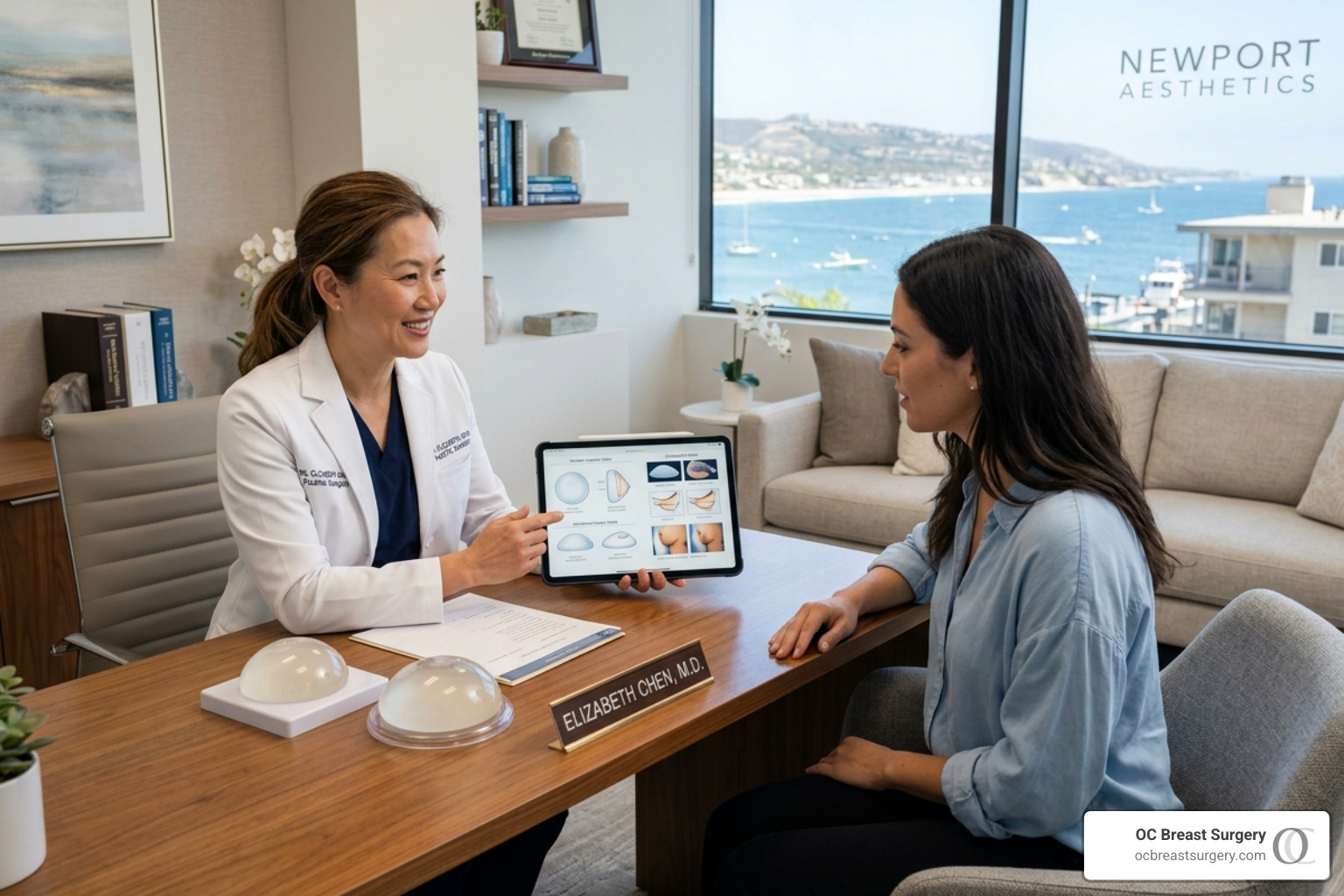
What should I expect during my consultation?
We will perform a physical exam and likely order imaging (like an ultrasound or MRI) to check for “silent” ruptures. We’ll discuss your goals—do you want to stay the same size, go smaller, or be “implant-free”? We will create a breast implant removal complete guide tailored specifically to your anatomy.
Your Next Steps
Deciding on implant removal and replacement is a journey of self-care. Whether you are seeking relief from pain or simply want to update your aesthetic to match who you are in 2026, we are here to guide you.
If you’re in the Newport Beach area and want to discuss your options, we invite you to explore our breast implant removal and replacement Newport Beach services. Your health, safety, and confidence are our only priorities.
Ready to start the conversation? Contact us today to schedule your consultation.