
You may be looking at yourself in the mirror and thinking, “My breasts still feel like me, but they don't sit where they used to.” That's a very common concern after pregnancy, weight changes, or the natural passage of time. Many women aren't asking for a larger size. They want better shape, better position, and a result that feels natural.
A breast lift without implants can do exactly that for the right person. It lifts the breast higher on the chest, reshapes stretched tissue, and repositions the nipple to a more youthful location. What it doesn't do is create the kind of added volume that comes from breast augmentation. That distinction matters, because it's often the key to choosing the procedure that will match your goals.
One of the biggest questions I hear is simple and important: how long will the result last if there's no implant holding the shape? That concern deserves a straight answer. Patients also often don't realize there may be ways to restore some lost fullness without implants, depending on their anatomy and goals.
Table of Contents
- The Growing Desire for a Natural Lift
- Are You a Candidate for a Lift Without Implants
- Understanding Lift Techniques and Scar Patterns
- The Super Breast Lift Surgical Process
- Your Recovery Timeline and Aftercare Guide
- Results Longevity and Surgical Alternatives
- Common Questions About Your Breast Lift
The Growing Desire for a Natural Lift
A lot of women reach the same point. Their breasts may have lost upper fullness, the nipples may sit lower, bras may fit differently, and clothing may no longer look the way it once did. The issue often isn't “I want bigger breasts.” It's “I want my shape back.”
That shift in thinking has become much more visible. According to the American Society of Plastic Surgeons trend data summarized here, breast lift procedures have surged by 70% since 2000, outpacing the growth rate of breast implant augmentations by a ratio of 2-to-1. In 2022, 143,364 breast lift procedures were performed in the United States, a 30% increase from 2019. Those numbers reflect a real change in what patients are asking for. Many want reshaping, not necessarily added size.
Why this choice feels different
A breast lift without implants is often about restoration. You're not trying to create a dramatically different body. You're trying to correct sagging, improve nipple position, and bring the breast tissue back to a more youthful contour using your own natural volume.
That's why this operation appeals to women who want a result that fits their frame and lifestyle. They may not want the long-term considerations that can come with implants. They may also prefer a softer, more natural slope rather than a rounder augmented look.
A good breast lift doesn't try to turn you into someone else. It aims to restore balance and shape in a way that still looks like you.
What patients often misunderstand
The phrase breast lift without implants sounds straightforward, but many people still assume it will also create major fullness at the top of the breast. Usually, it won't. A lift works by reshaping and repositioning what you already have. That can make the breast look firmer and younger, but it doesn't function like breast augmentation.
If your main complaint is sagging, this can be an excellent solution. If your main complaint is lost size, that calls for a different conversation. Knowing the difference early saves a lot of disappointment later.
Are You a Candidate for a Lift Without Implants
Some women are ideal candidates for a lift alone. Others need to consider whether they also want volume added or restored. The decision usually comes down to one question: are you unhappy with your shape, or are you unhappy with your size?

What ptosis really means
The medical word for sagging is ptosis. In plain language, it means the breast tissue and nipple have descended lower on the chest over time. Skin stretches. Internal support weakens. Volume can shift downward.
A simple way to think about it is this: the breast may still have enough tissue, but that tissue isn't sitting in the right place anymore. That's why a woman can still feel she has “enough breast,” yet still dislike how her breasts look in a bra, swimsuit, or fitted shirt.
This is especially common after aging, pregnancy, and weight fluctuation. If loose skin after weight change is part of the concern, some patients also find it helpful to understand the broader issue of tightening loose skin after weight loss, since skin quality plays a major role in how any lifting procedure is planned.
The best candidate profile
According to this overview of current breast surgery decision-making, a breast lift without implants is preferred for patients who have adequate natural breast volume but are dissatisfied with sagging or nipple position. It also notes that a lift alone does not add substantial volume, while augmentation alone fails to correct significant drooping. For many patients, another advantage is avoiding implant-related risks such as capsular contracture.
You may be a strong candidate if most of these statements sound like you:
- You like your general breast size: You don't feel a strong need to become larger.
- Your nipples sit lower than before: They may point downward or sit below where you'd like them.
- Your breasts feel deflated or stretched: Not necessarily smaller, just lower and less supported.
- You want a natural-looking result: You'd rather reshape your own tissue than rely on an implant.
- You want to avoid implant-related issues: This matters to many women, especially those who have seen friends or family deal with future implant surgeries.
Practical rule: If you're happy with your volume in a supportive bra but unhappy without one, a lift-only conversation makes sense.
Not every woman with sagging is best served by a lift alone. If your priority is a fuller upper breast, stronger cleavage, or a larger cup size, breast augmentation may be part of the discussion. If you already have implants and no longer want them, breast implant removal with a lift can also be a very relevant option.
Understanding Lift Techniques and Scar Patterns
The right lift technique depends on how much sagging is present, how much extra skin needs to be removed, and how much reshaping your tissue needs. Patients often hear terms like “lollipop” or “anchor” and assume one option is automatically better. It isn't. Each pattern solves a different problem.
Why incision choice matters
A surgeon chooses an incision pattern based on anatomy, not trends. Mild drooping may need only a smaller pattern. More substantial ptosis usually requires a more extensive incision so the breast can be reshaped, not just tightened at the surface.
That's an important point. Longer scars usually mean more power to reposition the breast and create a lasting contour. Shorter scars sound appealing, but if they don't match the degree of sagging, they can compromise the result.
Scars are also something patients worry about understandably. In most lift procedures, scar placement is planned so it can usually be concealed by bras, most tops, and many swimsuits. Over time, scars generally fade, though they never become invisible.
For a more detailed overview of how surgeons think through these patterns, this guide to breast lift techniques is useful background reading before a consultation.
Comparison of Breast Lift Incision Techniques
| Technique | Best For | Incision & Scar Pattern | Key Advantage |
|---|---|---|---|
| Donut | Mild sagging and areola reshaping | Around the areola | Limited scar pattern for select patients |
| Lollipop | Moderate sagging | Around the areola plus a vertical line down to the fold | Better reshaping without a crease incision |
| Anchor | More significant sagging or excess skin | Around the areola, vertical line, and along the breast crease | Most control over lifting and contouring |
What each pattern really does
The donut lift is the most limited. It can help when the main issue is mild drooping or a stretched areola, but it won't correct more advanced sagging well.
The lollipop lift adds more reshaping power. It's often used when the breast needs a noticeable lift but not the largest amount of skin removal.
The anchor lift gives the surgeon the most control. Patients sometimes feel nervous when they hear this option involves more incision lines, but it's often the right choice when there is real ptosis and stretched skin. In those cases, it can produce the most balanced result.
Scar length and result quality are not the same conversation. The better question is whether the incision matches your anatomy well enough to create the shape you actually want.
The Super Breast Lift Surgical Process
Most patients feel less anxious once they understand what happens on the day of surgery. The process is structured, deliberate, and focused on reshaping the breast in a way that looks natural and holds up well.
What happens before surgery
The planning stage matters as much as the operation itself. During a consultation, the surgeon examines nipple position, skin quality, breast symmetry, tissue distribution, and the degree of ptosis. That's how the surgical plan is determined. A woman with mild looseness needs a different strategy than someone with major descent after pregnancy or weight loss.
A lift-only procedure works by repositioning the nipple-areolar complex, removing excess skin, and tightening the underlying tissue so the breast sits higher on the chest. This description of mastopexy without implants explains that the operation reshapes the breast mound without adding volume and that the breast often looks firmer, rounder, and more youthful as healing progresses.
What happens in surgery
At OC Breast Surgery, the Super Breast Lift is designed to be performed under general anesthesia in an outpatient setting and without postoperative drains, according to this description of the Super Breast Lift approach. The same source notes that avoiding drains is intended to reduce discomfort and streamline recovery, while the breast tissue is lifted and reshaped with deep-layered sutures.
That internal support matters. A good lift is not just skin tightening. Skin alone is not strong enough to hold a shape over time. Deep internal suturing helps support the breast from within and creates a more durable contour.
The core steps typically include:
- Repositioning the nipple and areola: This moves them to a more youthful location on the breast.
- Removing stretched skin: This tightens the outer envelope so the breast sits higher.
- Reshaping the breast mound: Internal sutures support the tissue in its new position.
- Refining proportion: If the areola has enlarged over time, it can often be reduced as part of the lift.
A well-performed lift should look intentional, not tight or overdone. The goal is a breast that appears supported and refreshed, while still moving and feeling like natural tissue.
Your Recovery Timeline and Aftercare Guide
Healing after a breast lift without implants is usually very manageable when patients know what to expect and follow instructions closely. Recovery tends to feel more predictable when it's broken into phases rather than treated like one long unknown.
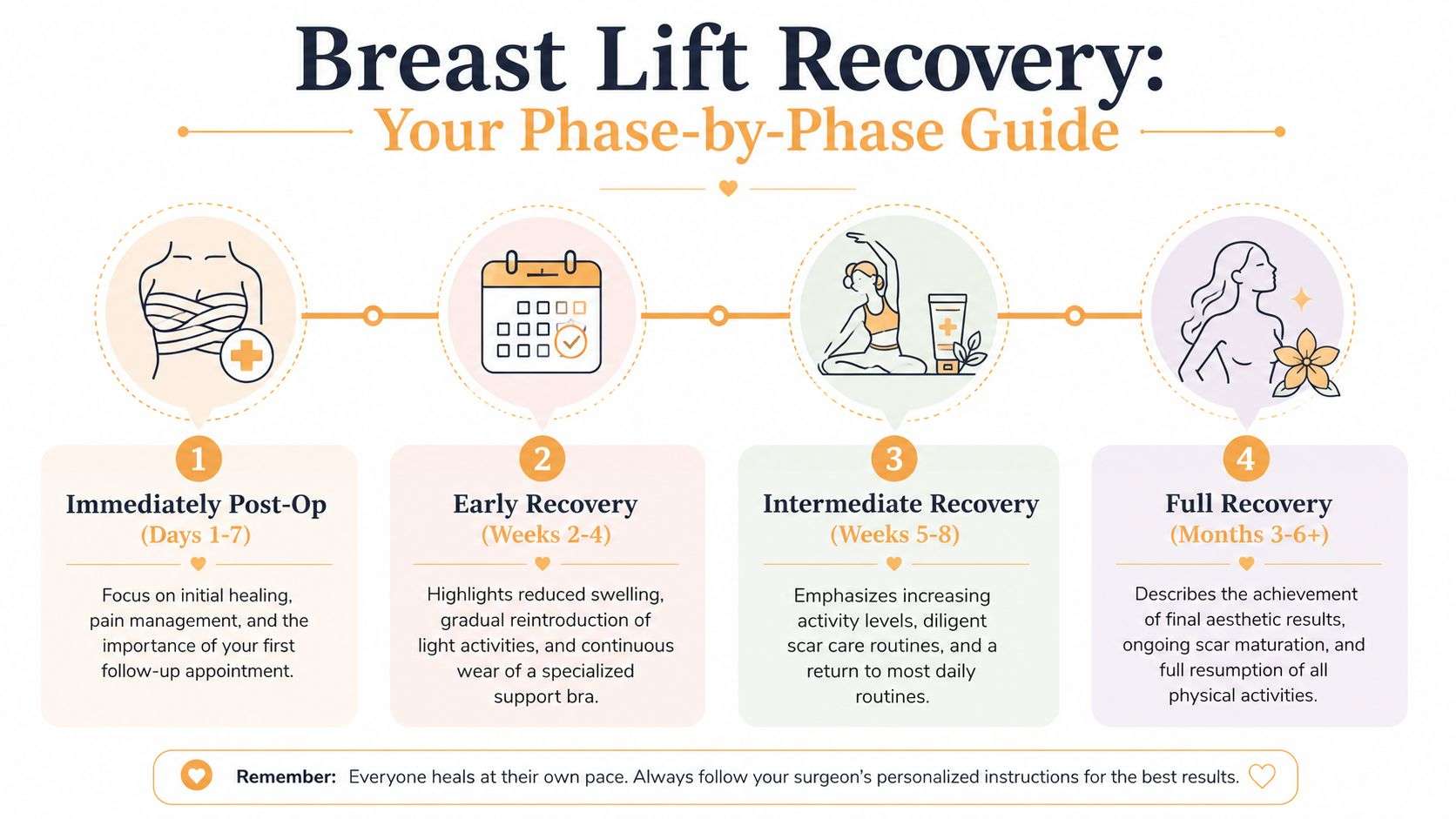
The first days after surgery
In the first several days, most patients feel soreness, tightness, swelling, and fatigue more than sharp pain. The breasts usually sit higher and look somewhat over-corrected early on. That's normal. Early swelling can make the shape seem firmer and rounder than the final result.
The American Society of Plastic Surgeons procedure overview notes that a lift typically takes about two hours, patients can often go home the same day, and a surgical support bra is commonly worn 24 hours a day for 3 to 4 days, followed by a soft support bra for 3 to 4 weeks while the shape settles over the next few months. You can review those details in this breast lift procedure description.
During this stage, think simple:
- Rest: Short walks are helpful, but strenuous activity isn't.
- Support: The bra is part of the treatment, not an accessory.
- Positioning: Sleep as directed so you don't put pressure on healing tissue.
- Follow-up: Early visits help confirm healing is on track.
The next few weeks and beyond
By the second phase, many patients feel much more like themselves. Swelling starts to ease, the breasts begin to soften, and daily routines feel easier. That does not mean healing is finished. Internally, the tissue is still stabilizing.
This article on when you're back to normal after a breast lift gives a helpful overview of how activity tends to progress over time.
A practical way to think about recovery is by milestones:
Days 1 through 7
Focus on comfort, support garments, mobility around the house, and follow-up care.Weeks 2 through 4
Many women can resume more normal daily tasks, but heavy exercise and chest strain are still usually limited.Weeks 5 through 8
The breasts often look less swollen and begin settling into a more natural shape. Scar care may become part of the routine, depending on your instructions.Months 3 through 6 and beyond
The result looks more refined. Scars continue to mature, and the final contour becomes more apparent.
Recovery is smoother when patients treat healing like a process, not a deadline. Doing too much too soon is one of the most common ways to prolong swelling.
Results Longevity and Surgical Alternatives
The question many patients ask most directly is this: if there's no implant inside, how long will the lift last? That's the right question, because a lift should be judged not only by how it looks early, but by how well it holds up.
How long a lift-only result can last
According to a 2024 multi-center study summarized here, 60 to 70% of patients maintain satisfactory shape for 8 to 10 years after a breast lift without implants if their weight is stable. That's one of the most useful data points available because it speaks directly to durability.
This doesn't mean the breast stops aging. It won't. Skin, gravity, hormonal changes, pregnancy, and weight fluctuations still affect the body. But it does mean a lift-only result can be long-lasting, especially when the patient starts with reasonable skin quality and avoids major changes in weight afterward.
Stable weight is one of the biggest factors you can control if you want your result to age well.
That's why the best way to think about longevity is not “Will this last forever?” but “Will this give me a meaningful long-term improvement?” For many women, the answer is yes.
When shape correction alone is not enough
Some women have enough tissue for a lift but still miss some upper fullness, especially after pregnancy. That's where a more nuanced conversation matters. The same source notes that combining mastopexy with autologous fat transfer can restore up to 30 to 50% of lost volume without implants in post-pregnancy patients.
That option is important because many women assume their choices are limited to either a lift alone or breast augmentation with implants. In reality, some may be candidates for subtle volume restoration using their own fat. It won't create the same fullness as an implant, but it may improve contour in a natural-looking way. This guide on fat transfer to the breast pros and cons gives a good overview of how that decision is usually framed.
Other alternatives may also come into play:
- Breast implant removal with a lift: Often appropriate for women who want to return to a more natural look after having implants.
- Breast augmentation with lift: Better for women who need both repositioning and a clear increase in fullness.
- Breast reduction: Considered when sagging is paired with excess weight, discomfort, or functional symptoms.
It's also worth keeping terminology straight. A lift corrects ptosis by removing extra skin and raising the nipple. It is not the same as a reduction. The Mayo Clinic overview of breast lift explains that reduction removes tissue to relieve symptoms associated with overly large breasts, while a lift focuses on position and contour.
Common Questions About Your Breast Lift
Patients usually narrow their final concerns down to a few practical issues. They want to know what recovery feels like, what surgery may cost, and how to choose someone qualified to do the operation well.

Will it be very painful
Most women describe the early experience as soreness, swelling, tightness, and fatigue rather than severe pain. Discomfort is real, but it's usually manageable with standard postoperative care, activity limits, and good support garments. The first week is the most restrictive. After that, most patients feel progressively better.
What about cost and insurance
Cost varies based on the complexity of the operation, whether another approved breast procedure is being performed at the same time, and the surgical setting. Insurance coverage varies by carrier and situation. Patients should contact their insurance provider and the practice for guidance, especially if they are considering procedures such as breast reduction or reconstruction, where coverage circumstances can differ.
How do I choose the right surgeon
Look for someone who specializes in breast surgery, not someone who treats it as a small part of a much broader menu. Technique selection, symmetry, nipple position, revision judgment, and long-term planning all matter in mastopexy.
Dr. Mark Anton, the founder of OC Breast Surgery, has over three decades of experience and fellowship training dedicated solely to breast surgery. His focused subspecialty scope and high volume of revision cases contribute to deep expertise in complex procedures, including the Super Breast Lift and correction of issues from prior surgeries.
If you're also the kind of patient who likes to compare surgical and non-surgical approaches in other areas before making a decision, a resource like this non-surgical facelift guide can be useful as an example of how treatment goals should always drive the right approach. The principle is the same with breast surgery. The right procedure depends on anatomy, expectations, and what change you want.
Schedule a consultation with OC Breast Surgery in Newport Beach to learn which breast surgery option may be right for your goals.