
You've decided that your implants no longer fit your body, lifestyle, or goals. You may expect your breasts to settle close to their original shape after removal, only to notice deflation, loose skin, a lower nipple position, or new asymmetry. That reaction is common enough to deserve a careful surgical plan, not a last-minute decision made during explant surgery.
A breast lift after implant removal, also called mastopexy after explantation, can remove excess skin, reposition the nipple-areola complex, and reshape remaining breast tissue. The central question is timing. Some patients are good candidates for an immediate lift, while others are safer and more predictable with a staged lift after the tissues recover.
Table of Contents
- Why Breast Shape Changes After Implant Removal
- Reasons Patients Choose Explant Surgery
- Immediate Versus Staged Breast Lift Timing
- Surgical Lift Techniques Used After Explant
- Safety Data and Expected Outcomes
- Recovery Timeline and Postoperative Care
- Determining If You Are a Candidate
Why Breast Shape Changes After Implant Removal
A patient may arrive expecting a simple change in volume. After implant removal, she instead sees a softer, flatter upper breast and skin that no longer fits the underlying tissue. The nipple may sit lower, point downward, or appear uneven compared with the opposite side. These changes can be unsettling, but they usually reflect long-term adaptation rather than a surgical mistake.
An implant supports and stretches the surrounding skin envelope. Over time, the native breast tissue can become thinner or redistribute around the implant, while the internal pocket and capsule can influence how the breast settles after explantation. The larger the implant and the longer it has been present, the more likely the skin and supporting tissues are to have lost some recoil. Age, pregnancy, weight changes, smoking, previous operations, and tissue quality also affect the result.
The implant's position matters. A subglandular implant places volume directly behind the breast tissue, while a submuscular implant interacts differently with the muscle, gland, and lower breast envelope. Prior incisions and capsular contracture can further complicate blood supply and contour. Patients who've experienced visible rippling can learn more about the underlying causes in this guide to breast implant rippling causes.

Why removal alone may not restore shape
Explantation removes the implant, but it doesn't automatically remove stretched skin or raise a low nipple. If the breast envelope has more surface area than the remaining tissue can support, the breast may look empty or droopy after removal-only surgery. A lift addresses that mismatch by reducing skin excess and reorganizing the breast mound.
The 2024 national plastic surgery statistics report recorded 41,271 breast implant removals among augmentation patients and 153,616 breast lifts in the same year, placing both procedures within established, closely tracked categories of breast surgery. The report recorded 40,787 implant removals and 52,836 breast lifts in 2020, which also shows that reshaping after implant-related changes has remained a substantial area of surgical care over time. The American Society of Plastic Surgeons' 2024 statistics report provides that national context.
Reasons Patients Choose Explant Surgery
Patients remove implants for different reasons, and the reason often affects the operative plan. Some want relief from firmness or distortion caused by capsular contracture. Others have a ruptured or leaking implant, visible rippling, malposition, or ongoing concern about future implant-related problems.
Medical and symptom-related concerns can include capsular contracture, implant rupture, and symptoms that patients associate with breast implant illness. Breast implant-associated anaplastic large cell lymphoma, known as BIA-ALCL, is another concern that may require an individualized discussion, especially when implant history, capsule findings, or symptoms raise questions. A consultation should distinguish a confirmed diagnosis or mechanical complication from a personal concern that still requires careful evaluation.
Personal reasons are just as important. A patient may no longer want the maintenance, size, or feel of implants. Her activities may have changed, her preferences may have shifted, or natural proportions may now matter more than upper-pole fullness. Others want implant removal but don't want to accept a permanently flat or deflated contour, making a lift, tissue reshaping, or selected volume restoration part of the discussion.
Common reasons and their surgical implications
| Reason for Removal | Frequency | Impact on Tissue Quality | Lift Complexity |
|---|---|---|---|
| Capsular contracture | Common clinical indication | Firm capsule may distort the breast and limit tissue mobility | May require capsulectomy and careful reshaping |
| Ruptured or leaking implant | Mechanical complication | Inflammation, silicone or saline loss, and pocket changes may affect contour | Depends on rupture findings and capsule condition |
| Breast implant illness concerns | Patient-reported symptom concern | Tissue quality varies and symptoms require individualized assessment | Planning focuses on patient goals and realistic shape expectations |
| BIA-ALCL concern | Uncommon but serious concern requiring evaluation | Capsule and surrounding findings may change the operation | Requires diagnosis-specific planning |
| Lifestyle or aesthetic preference | Elective decision | Skin may remain stretched even when tissue is healthy | Lift pattern depends on ptosis and skin excess |
| Aging, pregnancy, or weight change | Body-related change | Elasticity and breast support may be reduced | Greater skin laxity can require more extensive reshaping |
Going flat versus restoring a breast mound
Some patients prefer no breast mound after explantation. Others want a smaller, lifted breast that looks natural in clothing and without an implant. Those are different goals. A patient with severe deflation may need a lift to reposition tissue, and some may discuss fat grafting or an autologous reshaping method, although neither replaces the volume or projection of an implant in every case.
The decision shouldn't be based only on the reason for removal. It should also account for implant size, duration, placement, skin elasticity, nipple position, capsule condition, and the amount of native tissue available for reshaping.
Immediate Versus Staged Breast Lift Timing
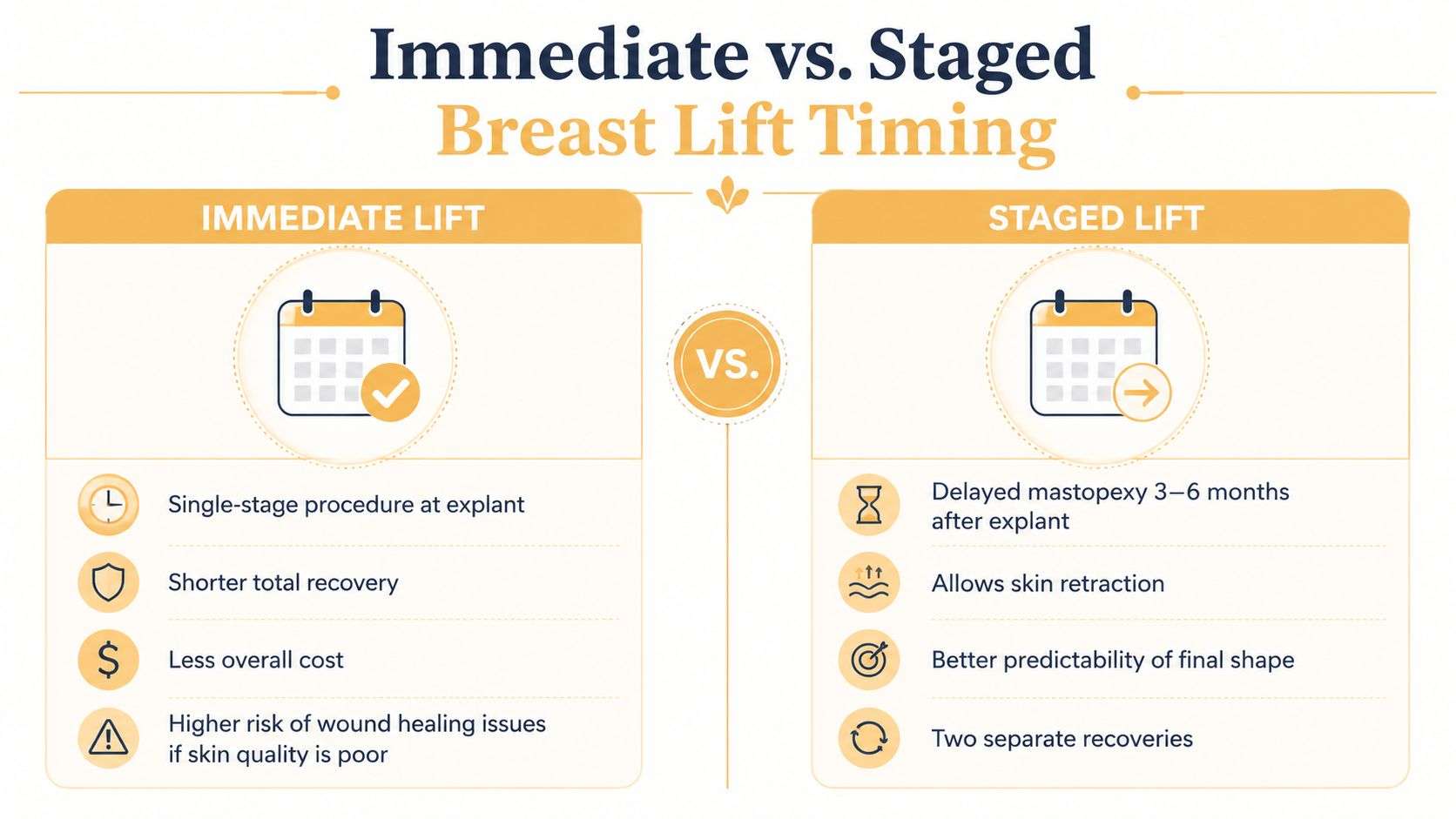
The immediate approach combines explantation and mastopexy in one operation. The surgeon removes the implant, addresses the capsule when indicated, excises excess skin, and lifts or rearranges the breast tissue during the same anesthetic. This can reduce the number of separate recoveries and lets the patient move directly toward the intended contour.
The staged approach removes the implant first and delays the lift. The breast then has time to settle, the skin may retract to some degree, and the surgeon can reassess the final amount of laxity before choosing the lift pattern. The trade-off is a second procedure, another recovery, and an interim period in which the breasts may look noticeably deflated.
When an immediate lift makes sense
An immediate lift can work well when the skin has reasonable quality, the degree of ptosis is understood, and the surgeon can preserve reliable blood supply to the skin and nipple-areola complex. It may be particularly appealing to patients who want one operative episode and who accept visible scars as part of reshaping.
Published clinical data support the approach in selected patients. In a series of 131 patients undergoing simultaneous explantation, capsulectomy, and mastopexy, surgeons treated 262 breasts, with a mean interval of 9.5 years from the last implant procedure to explantation. The reported complication rate was 3.8% per procedure, and the reoperation rate was 7.3% per procedure, or 9.2% per patient. The clinical series published in Aesthetic Surgery Journal offers useful outcome context, though individual risk can differ substantially.
When staging is the safer choice
A staged lift deserves serious consideration when the implant was large relative to the native breast, the skin is thin or heavily stretched, the nipple requires substantial elevation, or smoking and other healing risks are present. A technical review recommends considering staging when planned nipple-areola transposition exceeds 4 cm, with the lift performed 2 to 3 months after explantation, particularly for smokers or higher-risk patients. The technical review on periareolar lifting and glandular duplication explains the concern, which is increased tension and possible ischemia when the nipple must travel farther.
A staged plan isn't a failure of confidence. It's a deliberate way to learn how the tissues behave after volume removal. The disadvantage is that the patient must tolerate an incomplete appearance before the second operation, and the final lift still carries its own risks.
Practical rule: The more stretched the envelope and the farther the nipple must move, the more valuable tissue recovery and staged planning may become.
Surgical Lift Techniques Used After Explant
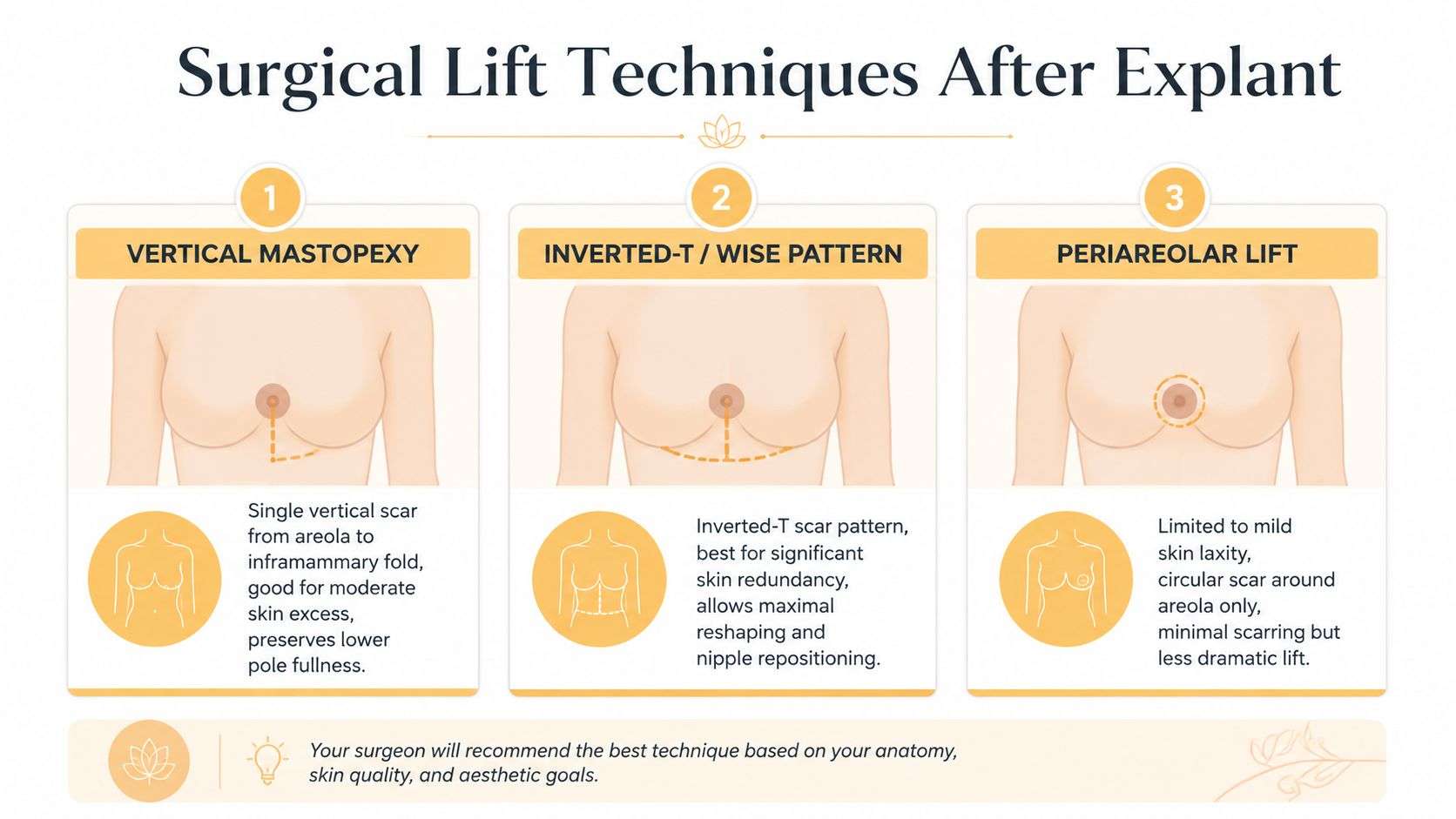
The lift pattern should follow the amount and location of excess skin, not a preferred scar pattern. A small periareolar lift won't reliably correct severe lower-pole laxity, while an extensive anchor pattern may add unnecessary scarring when the problem is limited.
Periareolar lift
A periareolar, or donut, lift places the incision around the areola. It can suit mild ptosis with limited skin excess and offers a shorter visible scar pattern. Its corrective power is limited, however. Excessive tightening around the areola can flatten projection, widen the areola, or create recurrent laxity, so it isn't a reliable solution for every deflated post-explant breast.
Vertical lift
A vertical, or lollipop, lift adds a line from the areola toward the inframammary fold. It allows more skin removal and lower-pole reshaping than a periareolar lift while avoiding the full horizontal component of an anchor scar. This pattern can preserve or concentrate lower-pole tissue and may be appropriate for moderate skin excess.
Inverted-T lift
An inverted-T, or Wise-pattern, lift uses an anchor-shaped scar. It provides the greatest control over substantial skin redundancy, nipple repositioning, breast width, and lower-pole contour. Patients with large implant-related stretching often need this flexibility, but they must accept a longer scar burden and the possibility of wound-healing issues at the junction of the incisions.
Managing the pocket and available tissue
Explant surgery may include capsulectomy when the capsule is abnormal, contracted, symptomatic, or otherwise clinically relevant. In other cases, removing too much capsule or undermining too widely can threaten blood supply. A 64-patient series using implant removal, total intact capsulectomy, and a mammary imbrication lift/fixation approach reported a mean follow-up of 6.5 months. The reported complications included minor cellulitis in 1.6%, late hematoma with infection in 1.6%, fat necrosis plus pulmonary embolism in 1.6%, and scar irregularity requiring revision or steroid injection in 6.2%. The indexed surgical series describes a technique designed to limit wide undermining and preserve blood supply while reshaping the breast.
Some surgeons use auto-augmentation, folding or rearranging the patient's own breast tissue to improve central or upper-pole contour. This can create more projection without placing a new implant, but available tissue may be thin after years of implant pressure. A detailed discussion of lift patterns and natural reshaping is available through breast lift without implants.
Safety Data and Expected Outcomes
Patients deserve outcome data that reflects explantation with a lift, not just standard primary breast lifting. In a consecutive series of 841 patients undergoing mastopexy after explantation, the patient-level complication rate was 4.76%, and the revision rate was 4.63%. The full published series supports the view that combined removal and lifting can have a relatively low revision burden in experienced surgical settings, while still requiring individualized risk assessment.
Another series reported that 88.1% of patients with implant-breast-illness symptoms described reduced pain, myalgias or arthralgias, and fatigue after explantation with capsulectomy and mastopexy. A separate 2025 study of 149 explantation-mastopexy cases reported 94% uneventful postoperative courses and strong satisfaction scores. The 2023 clinical report provides the symptom outcome data. These findings don't guarantee symptom resolution or a specific cosmetic result, but they help frame why many patients choose combined surgery rather than removal alone.
What can affect risk
Risk increases when tissue has poor perfusion, the skin is thin, the capsule is severely contracted, or prior surgery has disrupted normal blood supply. Smoking, previous infection, radiation exposure, substantial asymmetry, and large planned nipple movement also matter. A lift can improve position and contour, but it can't recreate every feature supplied by an implant.
| Outcome Metric | Reported Rate/Range | Clinical Context |
|---|---|---|
| Complications after mastopexy following explantation | 4.76% | Patient-level rate in a consecutive series of 841 patients |
| Revision after mastopexy following explantation | 4.63% | Patient-level revision rate in the same series |
| Complications in simultaneous explantation, capsulectomy, and mastopexy | 3.8% per procedure | Series involving 131 patients and 262 breasts |
| Reoperation in the simultaneous series | 7.3% per procedure, 9.2% per patient | Reflects different ways of counting reoperation |
| Symptom improvement in patients reporting implant-breast-illness symptoms | 88.1% | Reported reduction in selected symptoms after combined surgery |
| Uneventful postoperative courses in a 2025 series | 94% | Study of 149 explantation-mastopexy cases |
Implant rupture is another reason patients may need revision planning. A review of breast implant complications reported FDA premarketing approval data showing rupture or leaking of silicone or saline implants in up to 31.2% of patients, while rupture represented 12.2% to 23.4% of revision procedures in several registries. The indexed review on breast implant complications provides that context.
A good result means more than a higher nipple. It means a contour that matches your tissue limits, a scar plan you understand, and expectations that remain realistic after healing.
Recovery Timeline and Postoperative Care
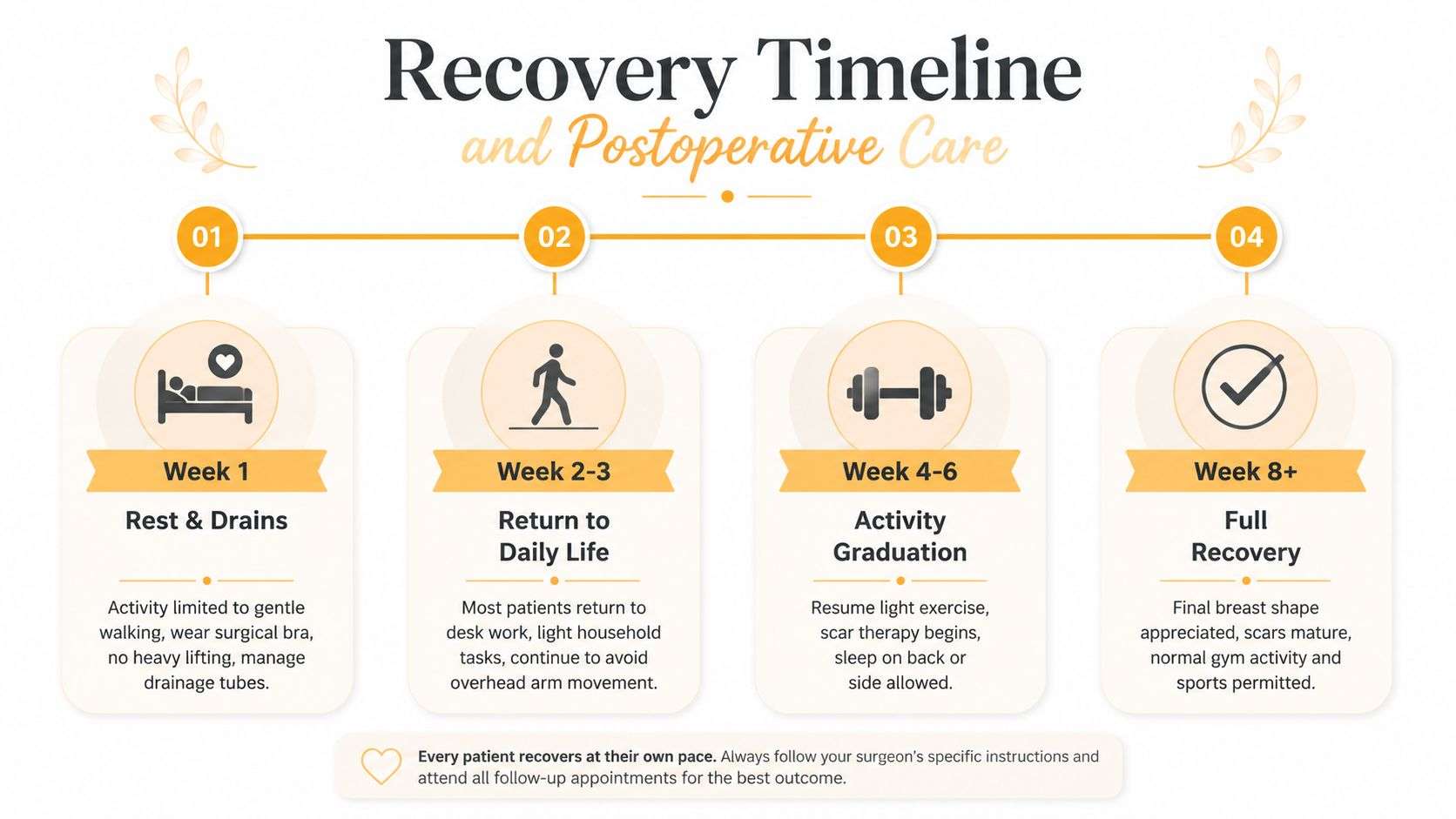
Recovery depends on whether the operation includes capsulectomy, how extensive the lift is, and how the tissues respond. Early care usually centers on protecting the incisions, limiting tension, wearing the prescribed surgical support, and monitoring drainage or swelling. Gentle walking is generally encouraged early, while lifting, pushing, and strenuous upper-body movement are restricted according to the surgeon's instructions.
Early healing
During the first phase, bruising, swelling, altered sensation, firmness, and uneven positioning can occur. Drains may be used depending on the operation, although their use varies with technique and surgeon preference. Call the practice promptly for increasing redness, worsening pain, fever, sudden swelling, drainage changes, or a nipple that appears progressively dusky or poorly perfused.
Patients should follow specific instructions about showering, dressing changes, sleeping position, medications, and return to work. General wound biology can be easier to understand through this resource on how wounds heal EkagraHealth AI, but it doesn't replace postoperative instructions from your surgical team.
Returning to activity
Light walking supports mobility without placing significant strain on the repair. Desk work and ordinary daily tasks may resume when comfort, medication use, and the surgeon's examination make that appropriate. Upper-body resistance training, overhead movement, running, and contact activity require clearance, because repetitive tension can widen scars or disrupt healing tissue.
Scar care commonly begins only after the incisions have closed and the surgeon approves it. Silicone products and gentle massage may be recommended, but patients shouldn't apply anything to an open or irritated incision. For procedure-specific guidance, review breast implant removal recovery.
Determining If You Are a Candidate
Candidacy starts with anatomy, not enthusiasm. A specialist evaluates skin elasticity, breast volume, nipple position, breast width, asymmetry, the implant pocket, capsule condition, previous scars, and the amount of tissue available for reshaping. The examination should also consider whether you want to go flat, pursue a natural lifted contour, consider Breast Implant Revision, or discuss another approved breast surgery option.
Your medical history matters. Smoking can impair blood flow and wound healing. Significant weight fluctuation can change the breast envelope after surgery, and prior radiation or repeated operations can make tissue less predictable. If the breast is very thin after explantation, a lift may improve position without fully restoring upper-pole fullness. Some patients may discuss fat grafting or autologous tissue reshaping, while others may prefer Breast Augmentation or a different plan.
Bring useful information to the consultation
- Implant history: Bring the implant type if known, placement plane, approximate size, date of implantation, and records from earlier operations.
- Reason for removal: Explain whether the concern involves pain, capsular contracture, rupture, leakage, rippling, malposition, symptoms, or a change in aesthetic preference.
- Desired endpoint: Be clear about whether you want a smaller lifted breast, maximum natural fullness, minimal scars, or an intentionally flatter result.
- Health factors: Share smoking history, medications, previous healing problems, radiation exposure, weight changes, and relevant diagnoses.
- Timing priorities: Discuss whether one recovery is more important to you than allowing the tissues to settle before a staged lift.
Dr. Mark Anton, the medical director and founder of OC Breast Surgery, is a breast surgery specialist who can evaluate these trade-offs in the context of revision anatomy. A consultation should leave you with a clear explanation of the proposed lift pattern, expected scars, possible contour limits, recovery restrictions, and circumstances that might favor immediate versus staged surgery.
OC Breast Surgery offers Breast Implant Removal and lift-based breast surgery planning for patients who want to address deflation, sagging, or asymmetry after explantation. Schedule a consultation with OC Breast Surgery in Newport Beach to learn which breast surgery option may be right for your goals, anatomy, medical history, and preferred timing.