
You've scheduled breast implant removal, arranged time away from work, and perhaps even prepared your home for the first few days. Then a practical question starts to feel urgent: when will you feel like yourself again? The answer depends on more than the day your implants come out. Your explant recovery timeline includes early soreness, a return to everyday function, and a much longer period in which breast shape, scars, sensation, and overall wellbeing continue to change.
Table of Contents
- Understanding Your Explant Recovery Journey
- The First Week After Surgery
- Week-by-Week Physical Recovery Milestones
- Symptom Resolution Beyond Wound Healing
- The Difference Between Functional and Complete Recovery
- Activity Progression and Follow-Up Care
- Why Surgical Expertise Matters for Complex Cases
Understanding Your Explant Recovery Journey
You may feel ready for a smaller, more natural contour, then wonder why recovery does not end when the implants are removed. Explant recovery has several milestones. Early soreness and tightness usually improve first. Movement and daily function return over the following weeks, while breast shape, scars, sensation, and overall wellbeing may continue changing for months.
Physical wound healing and systemic symptom resolution follow different clocks. Incisions and irritated tissues often heal over weeks. Symptoms that involve the wider body, including fatigue or other concerns linked to the period before surgery, may take months or, in some cases, years to settle. Your surgeon can help distinguish expected recovery from symptoms that need evaluation.
Two patients can have different timelines after procedures described as “implant removal.” Simple implant removal generally disturbs less tissue than removal combined with capsulectomy or a breast lift. Capsular contracture, rupture, leaking implants, previous surgery, and significant sagging can change both the surgical plan and the healing period.
A realistic expectation: returning to work marks functional progress, not the end of recovery.
Desk work may be possible after about one week, while tenderness can continue for up to six weeks. Unrestricted physical activity often waits until around four to six weeks, depending on your procedure and surgeon's instructions. The final contour may continue settling for three to six months as skin retracts and tissues remodel.
Recovery has three overlapping phases
- Immediate postoperative care: soreness, swelling, limited arm movement, medication, and incision care take priority during the first days.
- Functional recovery: walking, desk work, driving, and household activities return in stages over several weeks.
- Tissue, systemic, and emotional adjustment: scars soften, skin settles, sensation changes, broader symptoms may resolve gradually, and the new breast contour becomes more familiar over months.
The psychological adjustment can be easy to overlook. Even when explant surgery is wanted, your reflection may look unfamiliar after the volume and projection change. Relief, uncertainty, grief, or mixed feelings can all occur. Support with meals, transportation, childcare, and work can give you space to recover without treating an early appearance as the final result.
For procedure-specific planning, review breast explant surgery at OC Breast Surgery. Patients who want a broader explanation of why discomfort can outlast early mobility improvements may also consult this muscle strain recovery guide. Discuss your anatomy, implant history, symptoms, and goals with your surgical team so your expected course is individualized.
The First Week After Surgery
You may wake after surgery feeling relieved, surprised, or both. The first week protects the healing area while your body begins gentle movement. Arrange a ride home and help with meals, lifting, childcare, and reaching, especially during the earliest days. Your physical recovery is starting, but the new breast contour may also feel unfamiliar.
The first 72 hours
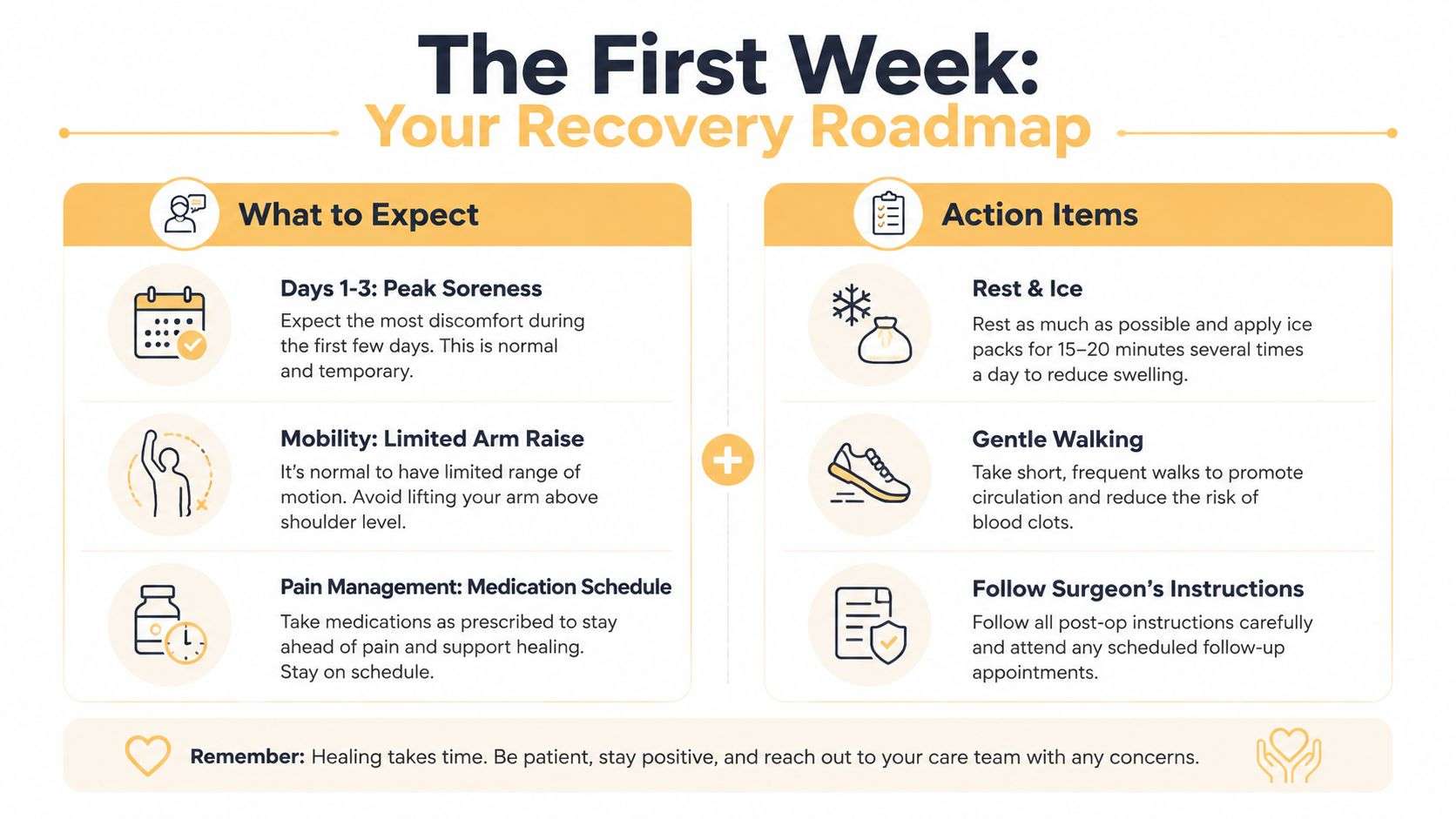
Expect soreness, pressure, swelling, fatigue, and restricted arm movement. Tightness may be stronger when the implant was beneath the chest muscle or when surgery included capsulectomy or a lift. Take medication exactly as prescribed. Following the recommended schedule can keep discomfort from becoming harder to control.
If drains were placed, your surgical team should teach you how to empty and record them. Drain management typically involves emptying and recording output for about five to seven days. Keep the tubing secure, and report a sudden change in drainage, accidental dislodgement, or a breast that enlarges quickly. The drain is a temporary fluid pathway, not a sign that healing is failing.
Walk briefly around your home when cleared. These gentle trips support circulation without placing the same demands on your incisions as chores or exercise. Avoid lifting, overhead reaching, strenuous tasks, and repeated arm movements. Sleep on your back with your upper body supported if your team recommends it, and use the prescribed compression garment or bra instead of selecting a replacement yourself.
Practical questions during week one
Showering, dressing changes, and drain care depend on the procedure and your surgeon's instructions. Follow the written guidance from OC Breast Surgery, especially when dressings or drains must stay dry. Do not drive while taking sedating pain medication. Wait until you can comfortably control the steering wheel, turn, and respond quickly.
Contact your surgical team promptly about excessive bleeding, rapidly increasing one-sided swelling, worsening redness or heat, fever, pus, foul-smelling drainage, or pain that suddenly intensifies. Seek urgent medical attention for sudden chest pain, shortness of breath, or calf pain.
By about one week, some desk workers may be cleared to return. That usually means computer-based duties with regular breaks, not lifting, an uncomfortable commute, or a full household workload. Energy can still fluctuate, and emotional adjustment may continue as swelling changes the contour from day to day. Early appearance is a progress marker, not the final result.
Week-by-Week Physical Recovery Milestones
A patient may feel ready for ordinary movement while deeper tissues are still repairing. Recovery also varies with the operation. Simple implant removal often involves less dissection and incision care than removal combined with capsulectomy or a lift, which can extend swelling, fluid management, and internal healing.
The early weeks
During week one, soreness, swelling, bruising, and fatigue commonly limit activity. Gentle walking may be allowed, but lifting and strenuous exercise remain restricted. The goal is steady movement without testing the healing tissues.
By week two, movement often feels easier. Some patients can return to desk work with their surgeon's approval, while tenderness and swelling continue, particularly after capsulectomy or a combined lift.
During weeks three and four, routine activities may become more manageable. Walking can often increase gradually, and approved low-impact movement may be introduced. Upper-body loading, chest exercises, and vigorous workouts still require clearance.
At weeks five and six, everyday function is often much closer to normal. The breasts may still feel firm or sensitive, and residual swelling or asymmetry can remain. Functional recovery and cosmetic settling follow different clocks.
| Milestone | Simple Implant Removal | Explant with Capsulectomy or Lift |
|---|---|---|
| Early healing | Often involves a more limited recovery burden | May require more incision care, tissue healing, and fluid management |
| Work return | Desk work may be possible around one week if cleared | Work timing may be longer when discomfort or drains limit mobility |
| Initial healing | Functional improvement develops over the following weeks | Initial healing commonly takes about two to six weeks |
| Strenuous activity | Clearance depends on wound healing and comfort | Strenuous activity commonly waits until around four to six weeks |
| Final contour | Shape changes continue as tissue settles | Shape and scars may continue changing for three to six months or longer |
These milestones describe common patterns, not promises. Full activity commonly resumes around four to six weeks, while cosmetic settling continues for three to six months as the new shape develops. A lift can add incision-related care and may change the pace of recovery, so the calendar should not replace an examination.
The changing contour can also require psychological adjustment. Early swelling, firmness, or unevenness may make the breasts look unlike the result you expected. Give the tissues time to settle, and discuss persistent concerns at follow-up rather than judging the final shape during the first weeks.
Symptom Resolution Beyond Wound Healing
A closed incision answers one question, not every question. Physical wound healing and systemic symptom recovery follow different clocks, especially for patients pursuing explant because of symptoms they associate with breast implant illness.
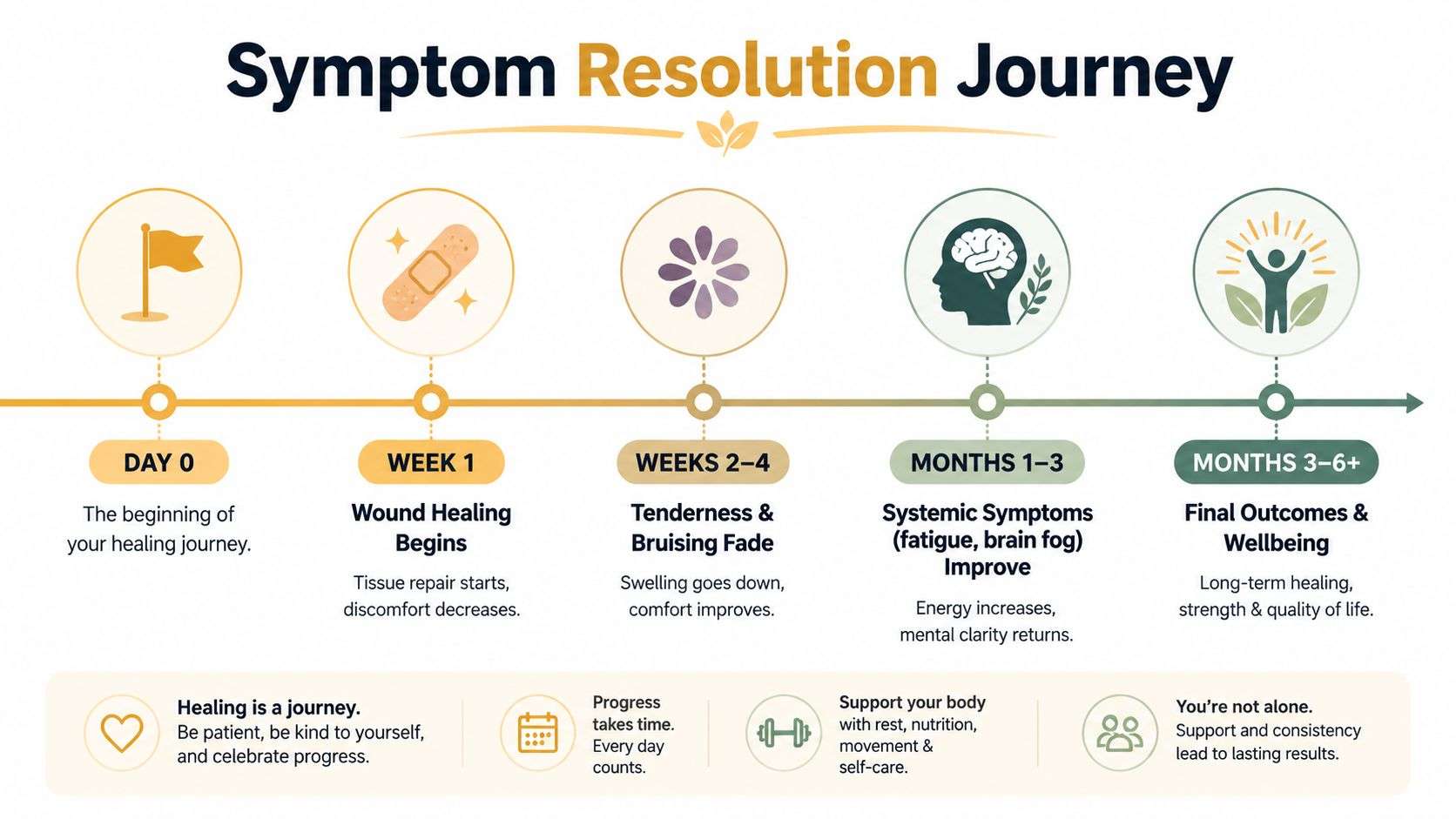
A peer-reviewed 24-month follow-up reported significant improvement across all symptom clusters studied. Musculoskeletal complaints improved most rapidly by three months, neurocognitive symptoms by six months, fatigue stabilized by 12 months, and dermatologic symptoms improved most slowly between 18 and 24 months. A separate peer-reviewed report found that improvement was demonstrable within the first 30 days and remained present beyond that period. These findings are available through the PubMed follow-up report on explant symptom outcomes.
Why early feelings can be confusing
In the first days, anesthesia, medication, poor sleep, surgical stress, and pain can make it difficult to judge broader symptoms. Improvement may begin before you feel physically comfortable, or it may emerge gradually after the incision has already healed.
That doesn't mean every symptom will resolve, and explant surgery can't promise a particular health outcome. It does mean patients should avoid using the first postoperative week as the final test of whether surgery helped. Track symptoms in a simple, consistent way and discuss persistent or worsening concerns with your medical team.
The breast implant illness and symptom guide from OC Breast Surgery can help frame the difference between patient-reported symptoms, surgical recovery, and the need for individualized medical evaluation.
A more useful way to measure progress
Instead of asking, “Am I completely better yet?” consider separate questions:
- Are my wounds progressing normally?
- Can I move more comfortably than last week?
- Has my energy changed?
- Are the symptoms that led me to consider explant changing, staying the same, or worsening?
This approach protects you from two opposite errors. You won't dismiss a concerning surgical change as part of a long recovery, and you won't assume that normal early soreness means the operation has failed to provide any broader benefit.
The Difference Between Functional and Complete Recovery
If you can return to desk work after about one week, you may still feel tired, tender, swollen, or cautious with arm movement. “Back to work” describes one practical milestone, not the end of healing. Recovery after implant removal can resemble recovery from other breast operations and may take two to six weeks or longer, depending on the procedure.

Function returns before the final shape
Functional recovery means completing basic tasks safely. Complete recovery extends beyond that point. Tenderness may continue to fade, scars may mature, sensation may change, and the breast contour may keep settling.
The skin and soft tissue need time to adjust after implant removal. Cosmetic settling commonly continues for three to six months, and contour changes may last longer when the procedure includes capsulectomy or a lift. During this period, one breast may look different from the other, the lower breast may appear loose, or the chest may feel firm before gradually softening.
A return-to-work date is a planning tool, not a finish line.
Physical healing is only one part of recovery. Symptoms that led you to consider explant may improve gradually over months, and some concerns may require evaluation rather than waiting. A healed incision does not automatically mean every systemic symptom has resolved.
The emotional adjustment is real
Some patients feel comfortable with their new appearance immediately. Others grieve lost fullness, notice skin laxity, or question whether the early contour represents the final result. These reactions do not mean the decision was wrong. They reflect the adjustment between understanding the goal and seeing a changing body in the mirror.
The adjustment can be harder after rupture, leaking implants, capsular contracture, or previous revision surgery. More extensive tissue work can also mean drains, closer postoperative management, and a longer period of internal healing. The guidance on capsulectomy after implant removal explains why the operation's extent affects recovery.
Give yourself time to assess the contour. Keep follow-up appointments, treat photographs as general reference points, and bring specific concerns to your surgeon instead of judging the outcome from one early mirror check.
Activity Progression and Follow-Up Care
Activity should increase according to healing, not impatience. Your surgeon's instructions control the schedule because the right progression after simple removal may not be the right progression after capsulectomy or a lift.
Build movement in layers
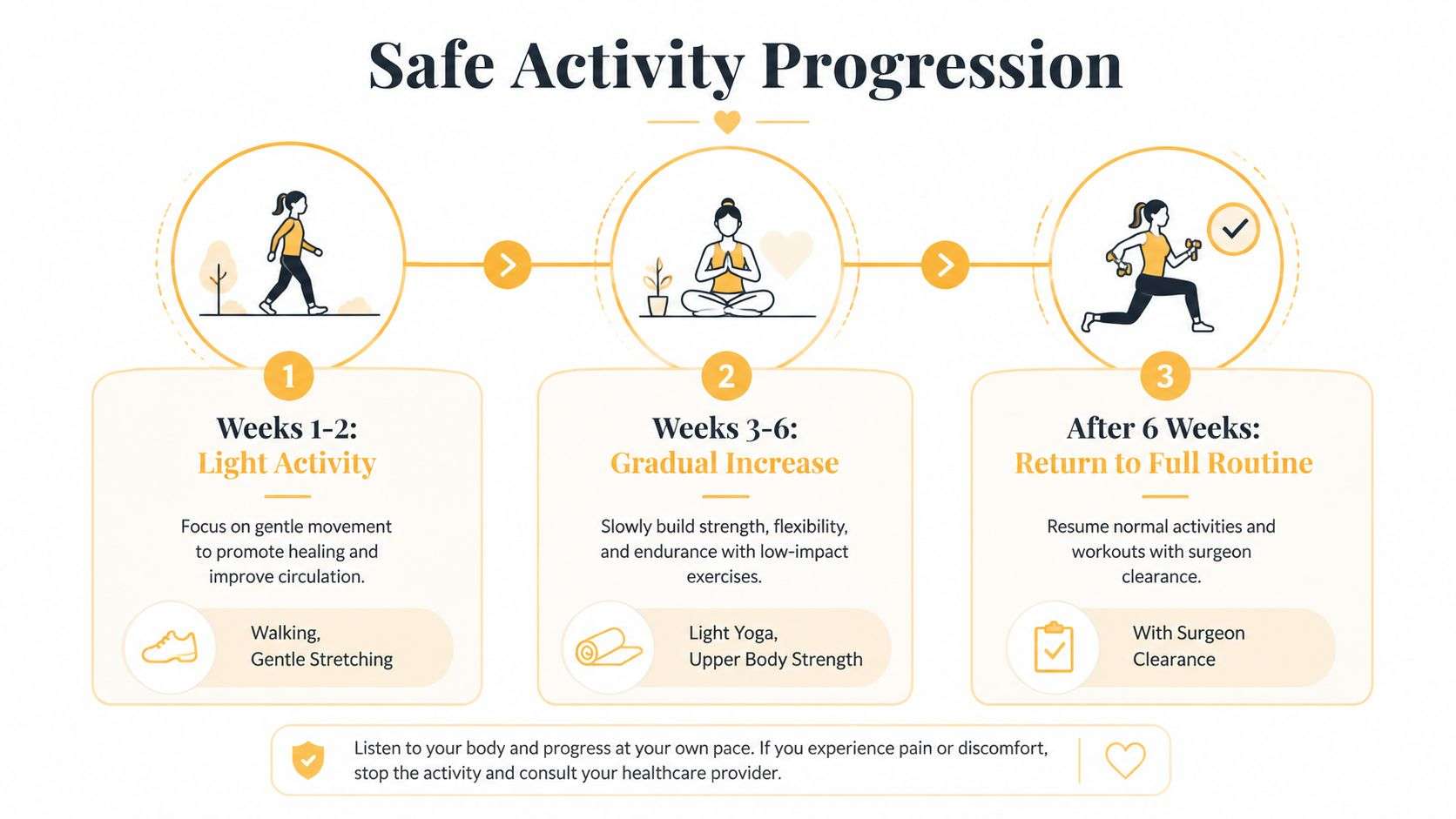
Start with short, gentle walks and ordinary movement around the home once you're cleared. Avoid stretching into pain, lifting, repeated overhead reaching, and any exercise that increases breast pressure or pulling.
As comfort and mobility improve, your surgeon may permit longer walks and carefully selected low-impact activity. Upper-body strength work, yoga positions that load the arms, running, swimming, and heavy lifting should wait until you've received procedure-specific clearance.
A simple progression looks like this:
- Early phase: walking and basic mobility, with rest between activities.
- Intermediate phase: gradually longer walks and approved low-impact movement.
- Later phase: a return toward normal exercise after the incisions, breast tissue, and internal repairs have been assessed.
Pain that escalates during activity, new swelling, increased drainage, bleeding, or a pulling sensation that persists afterward can indicate that you've progressed too quickly. Stop the triggering activity and contact OC Breast Surgery for guidance.
Care for incisions and support the breasts
Don't begin scar massage until your surgeon confirms that the incisions are adequately healed. Ask which scar products, if any, are appropriate for your skin and procedure. Keep follow-up visits even when you feel well, because examinations help identify fluid collections, delayed healing, infection, or contour concerns before they become more difficult to manage.
Wear the surgical garment or supportive bra as directed. Transitioning to regular bras, underwire styles, side sleeping, and higher-impact activity should be based on healing rather than a fixed personal deadline.
Dr. Mark Anton, the medical director of OC Breast Surgery, can assess your progress during follow-up and explain when a change in activity, garment, or scar care is appropriate. General timelines are useful for planning, but an examination provides the information needed for individualized decisions.
Why Surgical Expertise Matters for Complex Cases
A straightforward explant and a complicated revision are not interchangeable operations. Capsular contracture, rupture, leaking implants, malposition, rippling, and prior surgery can change the tissue condition, available skin, scar pattern, and need for additional procedures such as a lift or reconstruction.
Dr. Mark Anton is the founder and medical director of OC Breast Surgery, a breast surgery specialist with fellowship training in breast surgery and breast reconstruction and more than three decades in practice, as described by the practice. A consultation should focus on the details that shape your plan, including implant position, capsule condition, breast skin quality, asymmetry, nipple position, and whether your goal is removal alone or a different breast surgery option.
Planning for a realistic result
A careful consultation should clarify:
- The surgical extent: whether removal alone, capsulectomy, implant revision, or a lift is being considered.
- The recovery burden: expected restrictions, drain possibilities, work planning, and activity progression.
- The contour transition: how the breasts may look early and how they may change during settling.
- The safety plan: warning signs, follow-up timing, and who to contact with concerns.
OC Breast Surgery focuses its clinical scope on approved breast procedures, including Breast Implant Removal, Breast Implant Revision, Breast Reduction, Super Breast Lift, Breast Reconstruction, and Breast Augmentation. That focused approach can be relevant when a patient needs individualized planning after a previous operation, especially when the goal is a natural-looking result rather than just removing an implant.
A consultation can't eliminate uncertainty, but it can replace vague promises with a procedure-specific plan. It also gives you the opportunity to discuss insurance questions cautiously, since coverage varies by carrier and situation. Contact your insurance provider and the practice for guidance rather than assuming coverage or reimbursement.
Schedule a consultation with OC Breast Surgery in Newport Beach to learn which breast surgery option may be right for your goals. Dr. Mark Anton and the OC Breast Surgery team can review your explant recovery timeline, implant history, anatomy, and treatment options, including Breast Implant Removal with or without additional breast surgery.