
Many individuals start by asking, “What cup size should I choose?” That's understandable, but it's the wrong first question. A bra letter isn't a fixed measurement, and an implant isn't a number of cubic centimeters placed into an empty space. The result depends on your breast base, chest dimensions, existing tissue, skin envelope, nipple position, and the amount of projection your body can support.
A thoughtful answer to how to choose implant size starts with anatomy, then incorporates your goals. Measurements establish a safe and proportionate range. Sizers, photographs, and imaging help refine the choice, but they can't replace a physical examination by a breast surgery specialist. The most attractive result is usually not the largest implant that can fit. It's the implant that works with your tissue today and remains reasonable as that tissue changes over time.
Table of Contents
- Why Cup Size Is the Wrong Starting Point
- The Anatomical Measurements That Determine Your Size Range
- Translating Volume Into Visible Change
- Choosing Between Implant Profiles and Shapes
- Balancing Aesthetic Goals With Long-Term Revision Risk
- Preparing for Your Sizing Consultation at OC Breast Surgery
Why Cup Size Is the Wrong Starting Point
A target cup size sounds precise, but it isn't. Bra sizing varies between manufacturers, and the same letter can represent very different proportions on different band sizes. A fuller result on a narrow chest requires a different implant design from a similar-looking result on a broader chest, even if both patients describe their goal as a “C” or “D” cup.
The stronger planning principle is tissue-based sizing. In practice, that means assessing the breast base, soft-tissue thickness, chest wall, skin elasticity, and nipple position before selecting an implant volume. A 2016 systematic review rated tissue-based planning methods highest in methodological quality, with a mean score of 6.0 ± 1.4, compared with 1.4 ± 2.3 for dimensional-analysis approaches and 0.0 ± 0.0 for methods that didn't use breast measurements. Those findings support choosing an implant from the patient's anatomy rather than from subjective preference alone. (Systematic review of implant-size selection systems)
Practical rule: Treat the cup size as a description of a bra, not as a surgical prescription.
Historical practice patterns show how sizing has become more structured. In a 2009 survey, 33% of plastic surgeons used base diameter during preoperative evaluation, 16% used it as the main determinant, and 25% used trial implants placed in a bra. The survey also found that 80% commonly used implants in the 300 to 400 cc range, but that range is a population pattern, not a recommendation for any individual patient. (The review and survey data on implant selection)
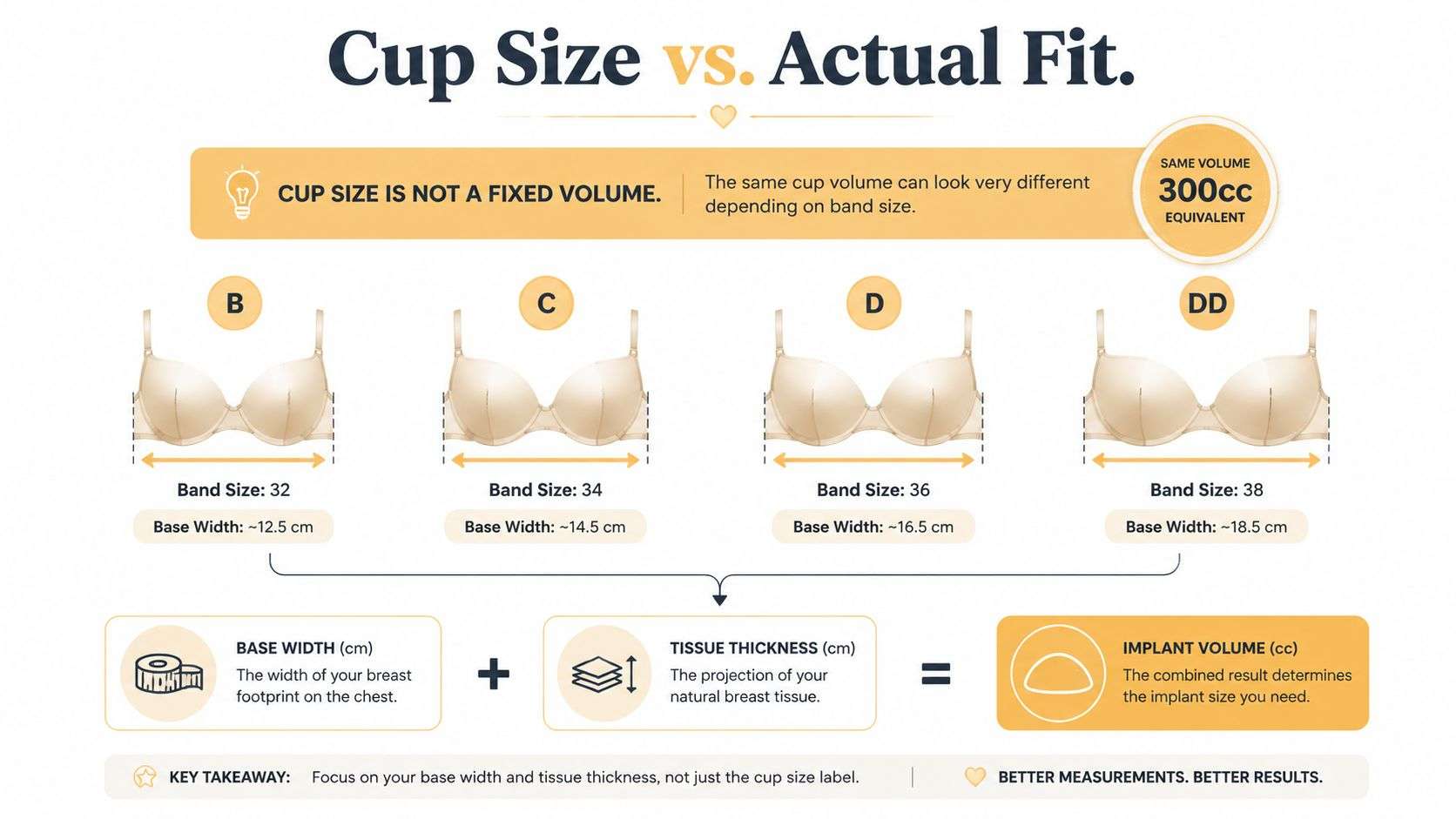
Your own tissue also affects how much implant is appropriate. A thin soft-tissue envelope may show implant edges or rippling sooner, while a thicker envelope can provide more camouflage. Existing breast volume contributes to the final appearance, too, so two patients with the same implant can look substantially different.
If you're still trying to understand how breast development, breast volume, and bra needs relate to one another, this guide to the pencil test and breast development can provide useful background. The central point remains simple: your body sets the starting range, and your aesthetic preference helps select an option within that range.
The Anatomical Measurements That Determine Your Size Range
Implant size is defined by breast base width, skin elasticity, and tissue coverage, measurements taken before any volume is selected. The surgeon also assesses the implant footprint your breast can accommodate, the lower-pole support available, and how your chest wall and existing tissue will affect the final result.
Base width establishes the implant footprint
Breast base width is the horizontal distance between the inner and outer borders of the breast. It matters because implant diameter should generally remain close to the measured breast base. Practical implant guidance recommends keeping implant diameter within about 1 cm of that width.
Base width helps determine whether a wider, lower-projection implant or a narrower, higher-projection design is more suitable. If the footprint extends beyond the breast boundaries, a wider implant can create unwanted fullness toward the armpit or sternum. A narrower implant may produce excessive projection when it does not match the patient's chest proportions.
The lower pole affects how the implant settles
The distance from the nipple to the inframammary fold describes the available lower-pole skin. A shorter distance may limit how much expansion the tissue can tolerate. A longer distance may provide more room, but the surgeon still needs to assess skin quality, nipple position, and the support of the fold.
Chest-wall shape and side-to-side differences also affect planning. Mild asymmetry is common. Each breast may have a different base width, fold position, or nipple location, so identical implant volumes do not always create matching breasts. Using different dimensions or volumes may produce better balance than forcing both sides to match.
Pinch thickness reveals coverage
A pinch test measures the tissue thickness over the planned implant area. A peer-reviewed review notes that a pinch measurement of 2 cm or more can support subfascial or subglandular placement, while less than 2 cm may require additional coverage, such as a dual-plane approach. (Review of tissue measurements and implant selection)
The measurement does not determine the operation by itself. It helps the surgeon assess the likelihood of visible edges, rippling, and an overly artificial contour. Skin stretch, prior pregnancy, weight changes, previous augmentation, and sagging can change the plan. The appropriate response may be a different placement, implant profile, implant exchange, Breast Implant Revision, or a lift-based operation such as a Super Breast Lift, rather than a larger implant.
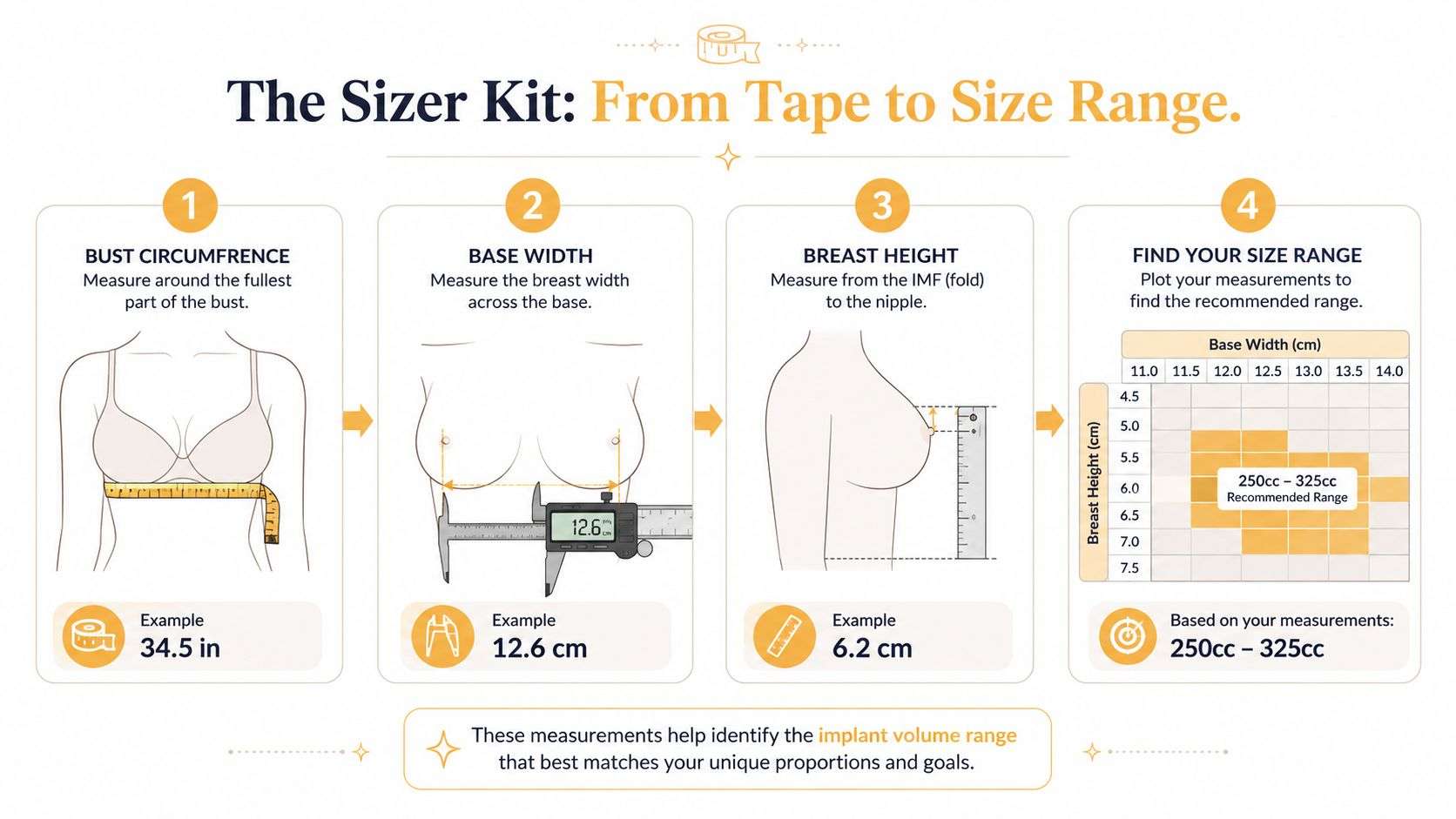
A manufacturer planning guide also places breast base width and pinch thickness before volume selection. Its materials describe measuring base width in centimeters with calipers or a tape measure, then evaluating tissue thickness before considering implant options ranging from 110 cc to 800 cc. (Implant planning guide for base width and tissue assessment)
These measurements define a credible size range, not a single correct answer. Your aesthetic goals then help select the option your anatomy can support with the lowest avoidable revision risk.
Translating Volume Into Visible Change
Cubic centimeters quantify implant volume, but they do not predict appearance on their own. Width, projection, existing breast tissue, placement, skin elasticity, and chest-wall proportions determine how that volume is distributed across the breast and chest.
A nomogram study found that each additional 100 mL of implant volume produced an approximate 2 cm increase in bust circumference. This gives the surgeon a practical way to discuss the physical scale of a planned change. It does not establish a cup size or guarantee a particular final appearance. (Nomogram study on implant volume and bust circumference)
Published implant datasets show that primary augmentation choices often cluster in the low-to-mid 300 cc range. One large follow-up study reported the most common range as 300 to 399 cc, followed by 400 to 499 cc, with individual implant sizes clustering most commonly at 350 to 374 cc. A separate 2023 analysis of 2,034 augmentations reported an average implant volume of 321.4 ± 57.5 cm³, with volumes ranging from 110 to 605 cm³. (Volume data from implant follow-up and augmentation studies)
Those figures describe selected implants. They do not establish what is appropriate for your anatomy. A 300 cc implant may look relatively full on a small breast base and more subtle across a broader chest. The same volume can also appear different beneath thicker tissue, closer to the gland, or with a lower rather than higher profile.
| Frame / Base Width | Approx. Volume per Cup-Size Change | Typical Total Volume Range | Visual Impact Notes |
|---|---|---|---|
| Narrow frame and narrower base | Varies by anatomy, not a fixed amount | Determined during examination | The same volume may create more projection and visible fullness |
| Medium frame and medium base | Varies by anatomy, not a fixed amount | Often discussed around common primary-sizing ranges | Existing tissue and profile strongly influence the silhouette |
| Broad frame and wider base | Varies by anatomy, not a fixed amount | May require a wider design for balanced proportions | The same volume can appear less projected across a broader footprint |
The table remains qualitative because no single implant volume reliably produces one cup-size change for every patient. The OC Breast Surgery breast augmentation size guide offers further discussion of volume, proportions, and implant options.
Describe the desired shape and proportion, not only a number. You may want modest restoration of upper-pole fullness, a fuller contour in clothing, or a clearly noticeable change. Those goals help the surgeon choose a width and projection that fit the breast boundaries and soft-tissue coverage, rather than forcing the tissues to accommodate a target volume. That distinction can reduce avoidable contour problems and later revision risk.
Choosing Between Implant Profiles and Shapes
Profile describes how far an implant projects forward relative to its base width. A lower profile generally spreads volume across a wider footprint, while a higher profile places more volume forward within a narrower base. Neither is automatically more natural. The correct profile depends on your chest width, breast base, soft-tissue coverage, and desired contour.
Two implants with the same volume can therefore create different silhouettes. One may look wider and flatter, while another looks narrower and more projected. This is why choosing size cannot be separated from choosing dimensions.
Profile changes the distribution of volume
A lower or moderate profile may help distribute fullness across a broader chest or create a softer slope when the patient has adequate width. A higher profile can create forward fullness when a narrow base limits implant diameter. Ultra-high projection may be useful in selected anatomies, but it concentrates more of the visual effect forward and may make edges or contour transitions more noticeable when coverage is limited.
The question isn't “Which profile looks best?” It's “Which profile places the planned volume inside my breast boundaries?”
Shape affects contour and stability
Round implants provide consistent fullness around their central axis, so rotation doesn't create the same directional shape change associated with an anatomical implant. Anatomical, or teardrop-shaped, implants can follow a more tapered contour, but rotation can alter the breast shape and must be considered during planning.
Shape also interacts with soft-tissue thickness. Thin coverage may make any implant more visible, particularly along the upper or outer edges. Adequate tissue can soften transitions and allow more flexibility in profile selection, although it doesn't remove the effects of implant weight or skin stretch.
| Profile/Shape | Projection | Base Width | Best For | Long-Term Considerations |
|---|---|---|---|---|
| Lower profile | Less forward projection | Wider footprint | Broad bases or a distributed contour | May create insufficient projection if the chest is narrow |
| Moderate profile | Balanced projection | Moderate footprint | Patients seeking proportionate fullness | Often useful when coverage and contour need balance |
| High profile | More forward projection | Narrower footprint | Narrower chests with adequate tissue support | Can make edge visibility more apparent when coverage is thin |
| Ultra-high profile | Maximum forward emphasis | Smallest footprint | Carefully selected anatomy and projection goals | Concentrated projection may increase contour concerns |
| Round shape | Even central fullness | Varies by profile | Patients who want stable rotational appearance | Appearance still depends on pocket, tissue, and skin behavior |
| Anatomical shape | Tapered contour | Varies by design | Selected contour-focused plans | Rotation can change breast shape |
The final choice may also involve implant exchange, Breast Implant Revision, or a lift when prior implants, malposition, rippling, or sagging have changed the breast envelope. A profile can't correct every structural problem. Sometimes the tissue needs to be repositioned rather than filled further.
Balancing Aesthetic Goals With Long-Term Revision Risk
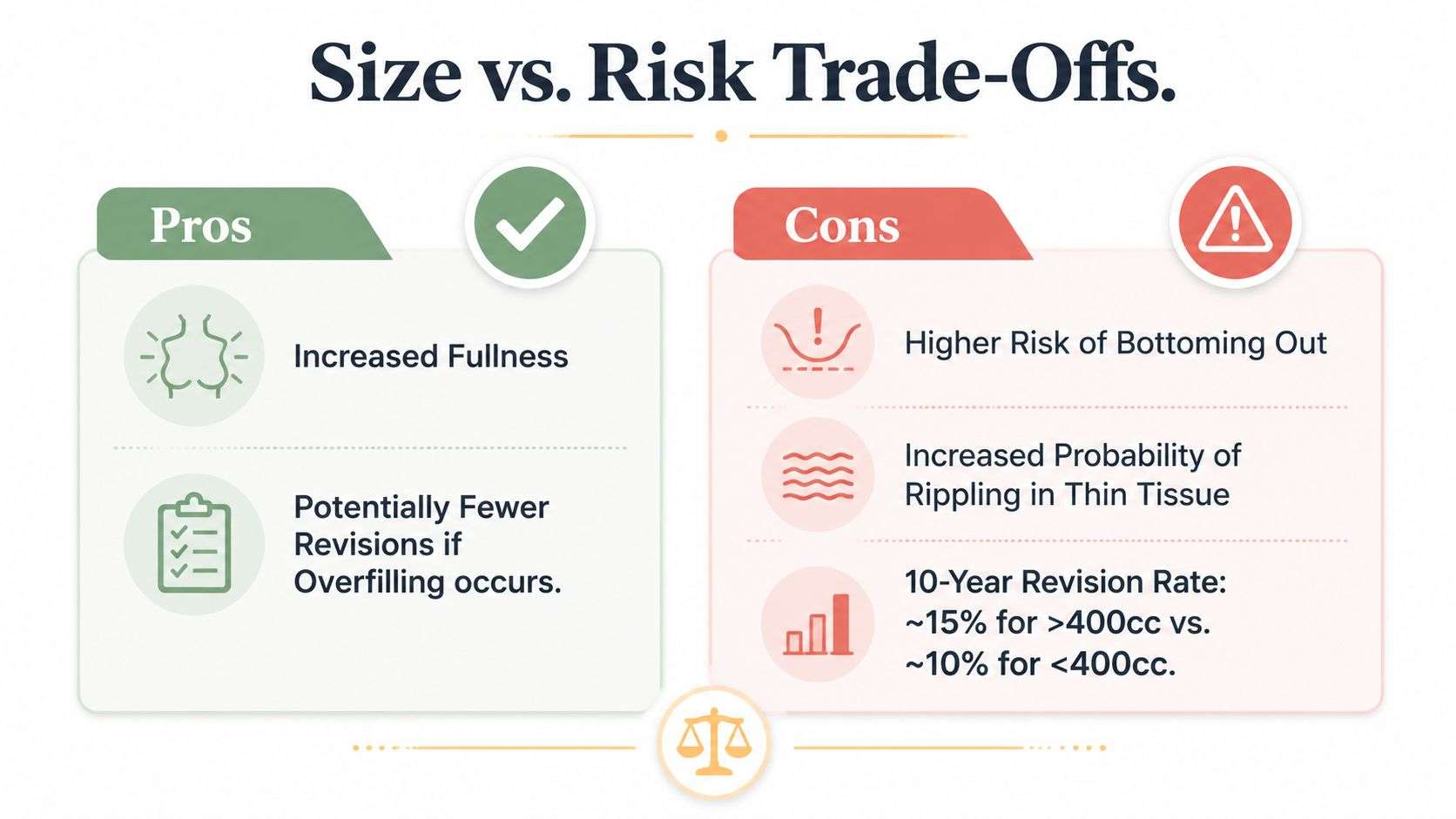
A larger implant isn't a neutral decision. It adds volume, but it also places more demand on the skin, breast tissue, implant pocket, and lower-pole support. That trade-off deserves discussion before surgery, especially if your desired look is substantially fuller than your existing frame can comfortably accommodate.
A 2023 study found that higher implant volume and a higher implant-volume-to-BMI ratio were associated with significantly higher odds of rupture and asymmetry. It didn't identify a single cutoff where complications suddenly increased, which means there's no universal “safe maximum” that applies to every patient. (Study of implant volume, rupture, and asymmetry)
FDA safety materials have described implants over 350 cc as potentially too large for many women and associated them with complications including extrusion, hematoma, infection, palpable folds, and visible skin wrinkling that may require surgical correction. That doesn't mean every implant above that volume causes a problem. It means volume should be evaluated in relation to the individual tissue envelope. (FDA safety material discussed in the evidence review)
What larger implants can change
Larger implants may create the fullness you want initially, but they can also increase tension on thin or stretched tissue. Over time, that may contribute to visible rippling, implant malposition, breast sagging, or asymmetry. If a patient later needs correction, the options may include implant exchange, implant removal, capsular-contracture treatment, pocket repair, or a lift.
Reconstruction carries its own sizing considerations. In one study of reconstruction, larger implants relative to mastectomy weight were associated with higher capsular-contracture rates, including 14.3% versus 4.1% in non-irradiated breasts. (Evidence on implant size relative to mastectomy weight)
A reasonable recommendation may be smaller
When a surgeon recommends sizing down, that isn't automatically a limitation on your goals. It may reflect concerns about tissue thickness, lower-pole support, skin elasticity, nipple position, or the probability that a larger implant will create a revision problem later.
The useful question is not whether a larger implant can be inserted. It's whether it fits the breast base, remains covered, supports the desired shape, and makes sense if your tissues stretch or your weight changes. For patients considering Breast Implant Removal or Breast Implant Revision after an earlier size choice, the same principle applies. New measurements matter because the breast envelope may no longer be the one that was present during the original operation.
For a candid discussion of maintenance and revision planning, this resource on breast implant revision costs and care can help you frame the financial and surgical implications without treating revision as an unexpected afterthought.
Preparing for Your Sizing Consultation at OC Breast Surgery
A productive consultation begins before measurements. Bring a fitted top or clothing that helps you judge proportion, plus a few inspiration photographs. Choose images that show a general shape you like, not a result assumed to be reproducible on your body. Your anatomy, tissue coverage, and healing response determine what is realistic.
Write down your priorities. Words such as “natural,” “full,” and “dramatic” can describe different outcomes. Explain where you want fullness, how visible you want the upper pole, and how you want your breasts to look in clothing and without clothing. This gives the surgeon a goal that can be tested against your measurements rather than reduced to a cup-size request.
Questions worth asking
- Sizing method: How will you determine my implant size range?
- Measurements: Which breast and chest measurements will you record?
- Coverage: How does my tissue thickness affect implant placement and profile?
- Asymmetry: Do my breasts require different dimensions or volumes?
- Future changes: What could this size mean for sagging, rippling, malposition, or revision?
- Alternatives: Would breast augmentation alone address my goals, or should I discuss a breast lift, breast implant revision, or another approved breast procedure?
Sizer systems and three-dimensional imaging can help you compare options, but they remain approximations. A sizer shows how added volume changes your proportions under clothing. Imaging can show projected contours. Neither predicts the exact postoperative appearance, because healing, implant position, tissue behavior, and later weight changes vary between patients.
Bring lifestyle details into the decision
Tell the surgeon about exercise, work demands, sleep preferences, clothing habits, and your tolerance for a visible implant edge. These factors do not determine the operation alone, but they can expose a mismatch between a desired volume and daily comfort or long-term tissue support. A size that looks appealing in a photograph may feel impractical during activity or place greater strain on stretched tissues.
Shared decision-making should be a two-way discussion. The Patients Guide decision making explains why patients and clinicians should exchange information, discuss preferences, and decide together. Ask the surgeon to connect each proposed size to your breast base, tissue thickness, implant profile, and possible revision needs.
OC Breast Surgery, located in Newport Beach, California, provides consultations for Breast Augmentation and other approved breast procedures. Planning considers anatomy, goals, medical history, and future tissue behavior. Dr. Mark Anton is the medical director and founder of OC Breast Surgery. Consultations may also address breast implant revision, Breast Implant Removal, Breast Reduction, breast lift, and Breast Reconstruction when those options better fit the patient's needs.
A good consultation should leave you understanding not only the proposed size, but also why the surrounding options were accepted or rejected.
Schedule a consultation with OC Breast Surgery in Newport Beach to discuss your measurements, implant profile, tissue coverage, and long-term revision considerations before choosing a size.