
You notice that one breast looks slightly different in the mirror. Perhaps it feels firmer, a little tender, or smaller than it used to. You may wonder whether the change is normal aging, scar tissue, or one of the signs of a leaking breast implant. That uncertainty is common, especially because saline and silicone implants can fail in very different ways.
A saline rupture often produces a visible change. A silicone rupture may produce no obvious symptom at all. The difference matters because feeling well doesn't always mean a silicone implant is intact. This guide explains what to watch for, how specialists evaluate a suspected leak, and how treatment decisions are shaped by the implant type, imaging findings, surrounding tissue, and your goals. In Newport Beach and throughout Orange County, OC Breast Surgery, led by Medical Director Dr. Mark Anton, provides breast-focused evaluation and surgical planning for concerns involving ruptured implants and breast implant revision.
Table of Contents
- Recognizing the Early Warning Signs of a Leaking Implant
- How Saline and Silicone Implant Ruptures Differ
- Physical Changes and Sensations That Signal a Problem
- Diagnostic Steps From Clinical Exam to Imaging
- Treatment Options After a Confirmed Implant Rupture
- Why Timely Evaluation Matters for Your Health and Results
- Next Steps If You Suspect a Leaking Breast Implant
Recognizing the Early Warning Signs of a Leaking Implant
A patient may first notice a small change while getting dressed. One bra cup fits differently, the breast appears less projected, or the skin seems to show a new fold. Another person may feel a firm area or tenderness that wasn't present before. These observations deserve attention, but they don't establish the diagnosis by themselves.
Implant rupture is a recognized complication, and the warning pattern depends heavily on whether the implant contains saline or silicone. Saline usually leaves a visible clue because the breast can deflate as the fluid escapes. Silicone rupture is frequently described as silent, meaning the shell may fail without an immediate change that you can see or feel. The U.S. Food and Drug Administration's information on breast implant risks explains that most silicone ruptures don't cause immediate, obvious changes.
Changes that deserve attention
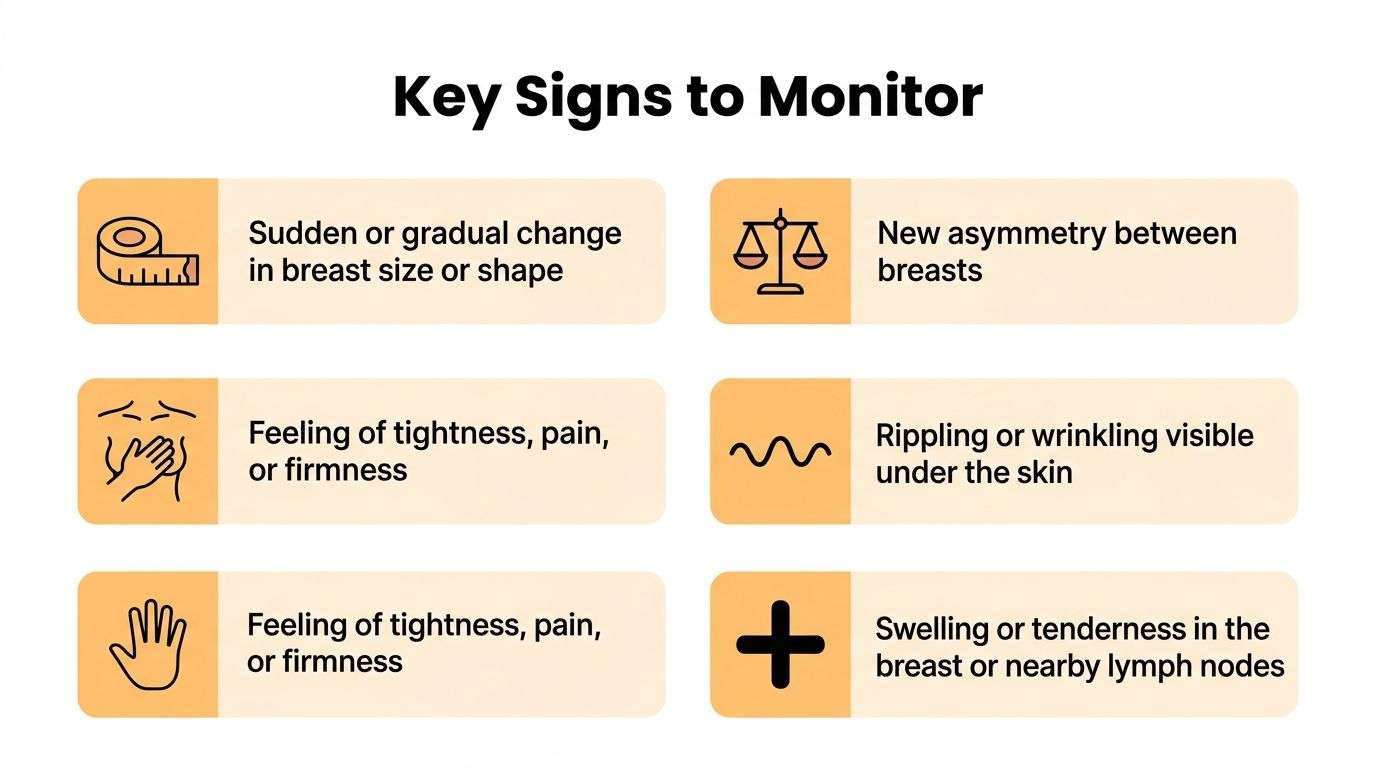
Look for a difference that is new, persistent, or progressive, rather than focusing on one isolated sensation. Relevant observations can include:
- Size: One breast becomes smaller or loses fullness.
- Shape: The contour changes, the breast looks flatter, or the implant appears displaced.
- Symmetry: The breasts no longer sit or project in the same way.
- Texture: A breast feels firmer, harder, or different from the other side.
- Sensation: Pain, tenderness, tingling, numbness, burning, or altered sensation develops.
- Surface appearance: Rippling or wrinkling becomes more visible.
Normal healing can also involve firmness, swelling, altered sensation, and unevenness, especially soon after surgery. The important question is whether the change fits your recovery stage and whether it is improving. A change that appears long after healing, or one that keeps progressing, warrants a clinical assessment rather than self-diagnosis.
Practical rule: A subtle change isn't proof of a leak, but it is a reasonable reason to contact a breast surgery specialist.
Don't wait for dramatic deflation before seeking guidance if you have silicone implants. Imaging may be appropriate even when the breast looks normal, particularly when the implant is older or symptoms are difficult to interpret.
How Saline and Silicone Implant Ruptures Differ
The simplest comparison is this: saline rupture often announces itself, while silicone rupture may remain concealed.
A saline implant contains sterile saltwater. If the shell fails, the saline generally leaks out and the body absorbs it, causing the implant to deflate. The breast may become visibly smaller, softer, or less full over days. The change can be obvious, although the speed and degree of deflation can vary.
A silicone implant contains gel. When its shell ruptures, the gel may remain within the surrounding scar-tissue capsule. That containment can preserve the breast's external appearance and leave the patient without a clear physical warning. The FDA lists possible signs of silicone rupture that include a decrease in breast size, a change in breast shape, hard lumps, an uneven appearance, pain or tenderness, tingling, swelling, numbness, burning, or altered sensation. It also emphasizes that many silicone ruptures are silent. You can learn more about the broader differences in saline and silicone implants.
A side-by-side clinical view
| Feature | Saline implant rupture | Silicone implant rupture |
|---|---|---|
| First visible clue | Deflation or loss of volume | Often no immediate visible change |
| What happens to the filling | Saline leaks and is absorbed by the body | Gel may remain inside the capsule |
| Can symptoms be absent? | Less commonly, because deflation is usually noticeable | Yes, silent rupture is common |
| Role of imaging | May help clarify an uncertain finding | Important because examination alone may miss rupture |
| Possible later findings | Shape change, softness, tenderness, or asymmetry | Firmness, lumps, pain, altered shape, or asymmetry, though none is universal |
This distinction explains why symptom-based monitoring has limits. A person with a saline implant may call after noticing a sudden change in size. Someone with a silicone implant may feel entirely normal while the shell has already failed. Both situations require an individualized evaluation, but silicone concerns particularly require attention to imaging rather than appearance alone.
The FDA's screening guidance has evolved. Earlier recommendations referenced MRI at 3 years after implantation and every 2 years thereafter, while later guidance recommends ultrasound or MRI beginning 5 to 6 years after surgery and every 2 to 3 years afterward. These milestones matter because a leaking silicone implant may not create symptoms that alert you to a problem.
Physical Changes and Sensations That Signal a Problem
Patients often ask what a ruptured implant feels like. There isn't one universal sensation. Some people notice a clear contour change, while others report only a vague difference in firmness or comfort. Some notice nothing, particularly with silicone implants.
A useful way to think about symptoms is to separate what you see, what you feel with your hand, and what you experience as a sensation.
What you may see
A decrease in breast size is especially relevant when a saline implant is involved. A new difference in shape, projection, or position can occur with either implant type, but it can also result from scar tissue, implant malposition, aging, weight change, or breast sagging. Visible rippling or wrinkling may reflect the implant's position and soft-tissue coverage rather than a rupture alone.
The key is change over time. Compare current photographs or clothing fit with your established baseline, but don't repeatedly manipulate the breast to search for a defect. Forceful pressing can increase anxiety and won't confirm whether the shell is intact.
What you may feel
New firmness, a hard lump, or an area that feels unlike the opposite breast deserves assessment. Capsular contracture, in which the scar capsule tightens around the implant, can also cause firmness, distortion, discomfort, and a raised or compressed appearance. Because contracture and rupture can coexist, a physical examination may identify a problem without distinguishing its exact cause.
The clinical review of implant rupture reports that patients can present with capsular contracture, breast lumps, pain, firmness, asymmetry, or changes in breast shape and size, but these findings aren't present in every rupture. That variability is why a symptom checklist is useful for deciding when to call, not for confirming a diagnosis.
What you may feel internally
Pain or tenderness can be localized or diffuse. Tingling, numbness, burning, swelling, or an altered sensation may involve the breast or nearby tissue. These symptoms can arise from several breast and implant-related conditions, so their meaning depends on the timing, examination, implant history, and imaging.
A combination of findings is more concerning than a fleeting sensation, but even one progressive change is enough to justify professional advice. Contact a qualified breast surgery practice if you develop sudden deflation, a persistent new lump, increasing firmness, worsening pain, or a meaningful change in breast shape.
Diagnostic Steps From Clinical Exam to Imaging
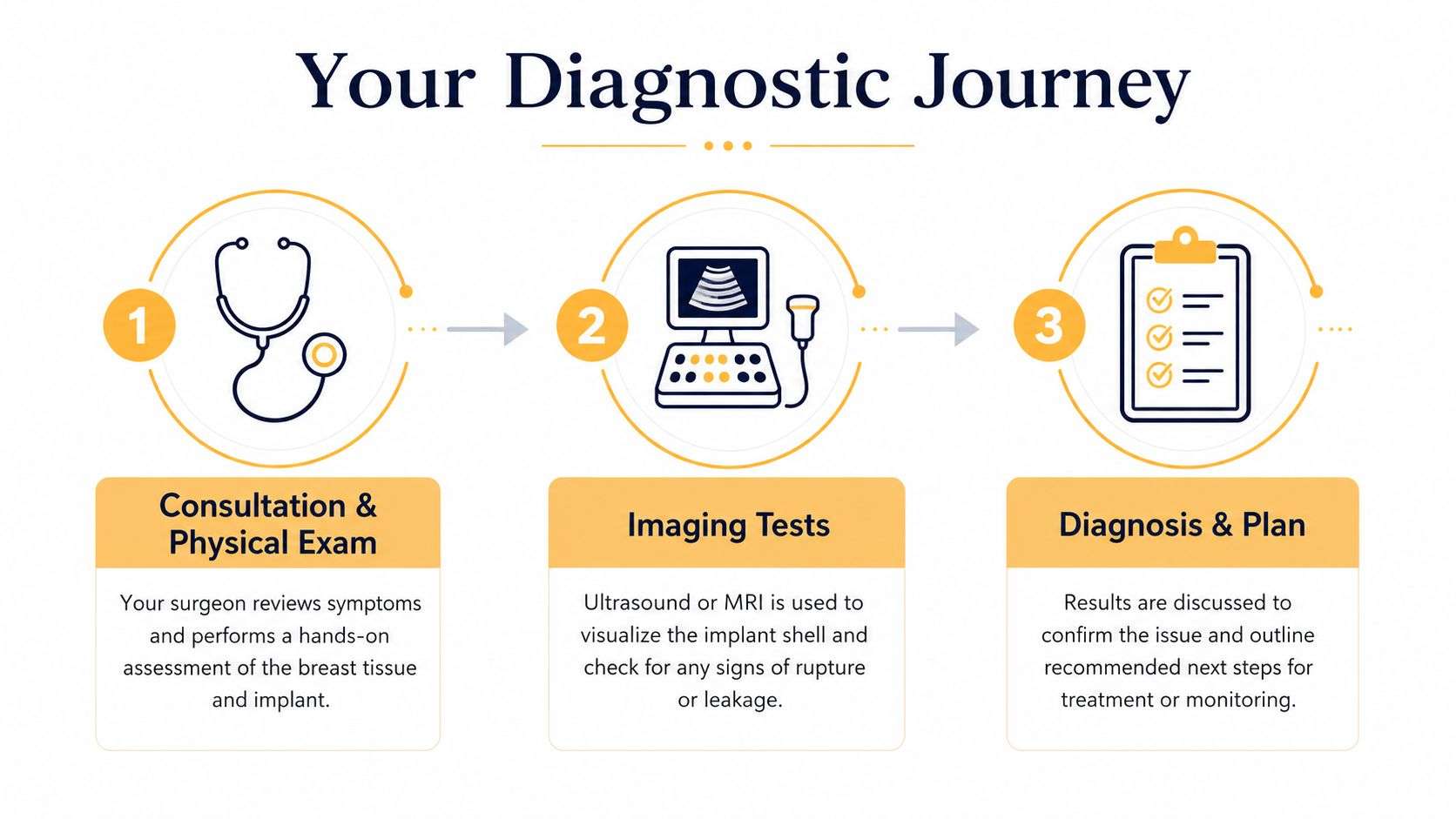
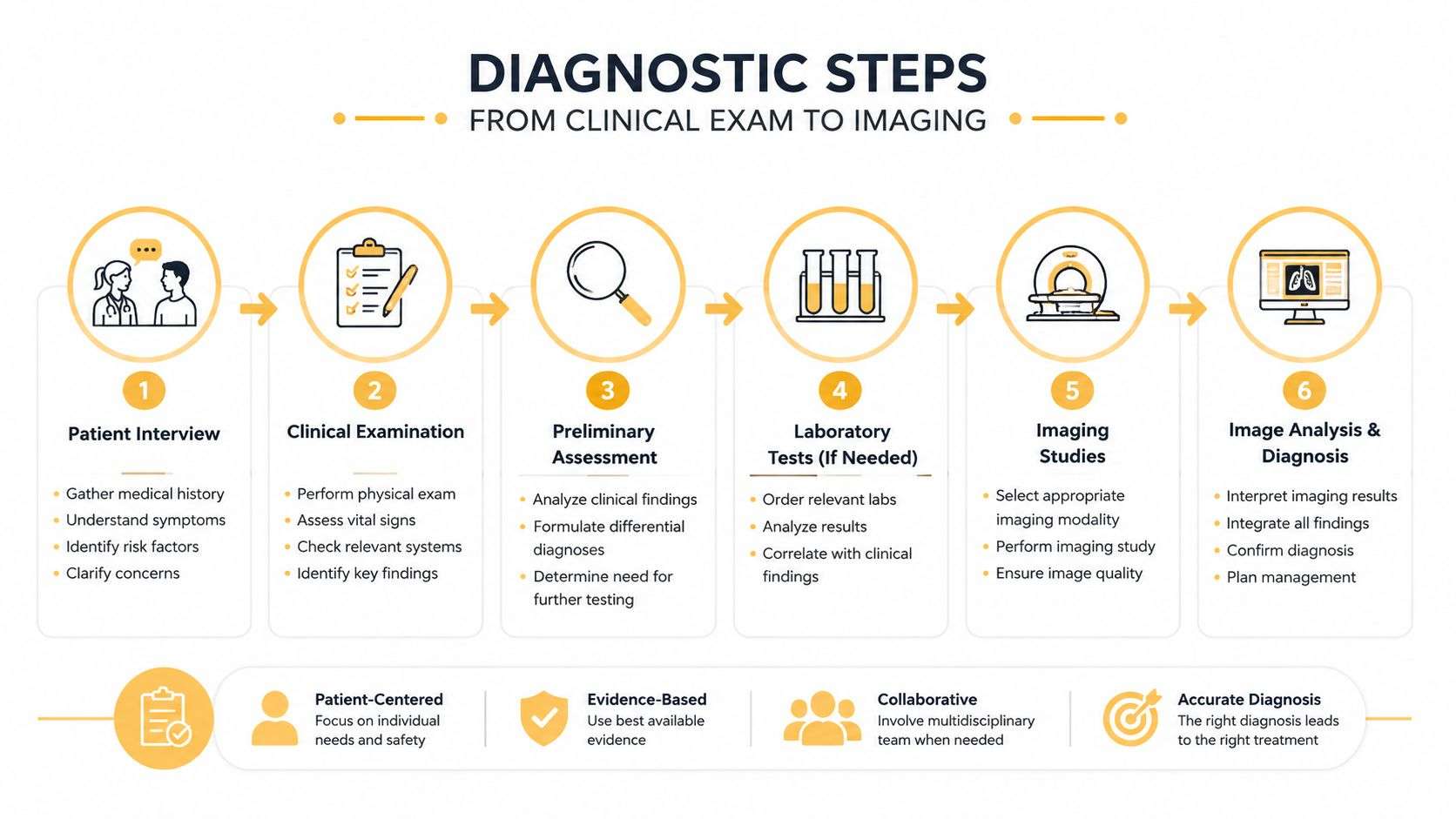
A consultation begins with your story. The specialist will ask when you first noticed the change, whether it has progressed, and whether you have had pain, trauma, surgery, infection, or prior implant-related treatment. Bring any available implant documentation, operative reports, previous imaging, and information about the implant's manufacturer, model, size, and filling type.
The physical examination adds information that a photograph can't provide. The clinician assesses breast size and symmetry, skin and nipple position, implant location, firmness, tenderness, palpable lumps, and the condition of the surrounding tissue. The examination may suggest deflation or contracture, but it can't reliably exclude a silent silicone rupture.
Why imaging changes the answer
Ultrasound and MRI are the principal imaging tools used to evaluate implant integrity. Ultrasound can help assess the implant and surrounding tissue, while MRI may provide a more detailed view when silicone rupture is suspected or an ultrasound result is uncertain. The appropriate study depends on your implant type, symptoms, prior imaging, availability, and the clinical question.
A radiology review reports MRI sensitivity ranging from 64% to 100% and specificity ranging from 63% to 97% for implant rupture. The same review cites one study in which MRI accuracy was 94%, compared with 72% for ultrasound, when rupture was confirmed at surgery. These results support imaging as an important part of evaluation, while also showing why the final interpretation must be connected to the examination and your history. Review the practical considerations in this MRI guide for breast implant rupture.
What to expect: Imaging is an information-gathering step. It doesn't automatically mean you'll need surgery, and a consultation doesn't commit you to a particular treatment.
Screening for silent rupture
The FDA-referenced screening timeline matters most for silicone implants because a normal appearance doesn't reliably prove implant integrity. Earlier recommendations called for MRI at 3 years and every 2 years afterward. Later guidance shifted toward ultrasound or MRI starting 5 to 6 years after surgery and every 2 to 3 years after that, as described in the FDA source above.
Imaging has practical considerations. MRI can require more time and may be less accessible, while ultrasound is widely available and can be useful for an initial or routine assessment. Your breast specialist can help coordinate the appropriate study and explain what the findings mean in relation to your anatomy and goals.
Treatment Options After a Confirmed Implant Rupture
A confirmed rupture doesn't dictate one universal operation. The right plan depends on the implant filling, whether silicone remains contained within the capsule or has moved beyond it, the condition of the breast tissue, the presence of capsular contracture, and whether you want to maintain, reduce, or remove implant volume.
Removal without replacement
Breast implant removal, also called explant surgery, may fit patients who no longer want implants or who prefer a smaller, more natural breast profile. Removing an implant can change breast volume and skin drape, particularly when the breast has stretched over time. Some patients may also consider removal with a lift when sagging or nipple position is part of the concern.
The surgical plan may include treatment of the surrounding scar capsule when clinically appropriate. That decision is individualized because the capsule's condition, implant type, and location of any leaked material all affect the safest approach. A silicone rupture may require careful management of gel and surrounding tissue, while saline deflation often presents a different operative problem.
Exchange for a new implant
An implant exchange removes the ruptured device and places a replacement. The replacement may use the same filling type or a different one, depending on your preferences, anatomy, tissue coverage, and the specialist's recommendation. Revision surgery can also address asymmetry, malposition, visible rippling, or a size that no longer suits your goals.
A new implant doesn't eliminate the need for future monitoring or acknowledge that implants aren't lifetime devices. It does, however, allow the surgeon to address the immediate rupture while reassessing the pocket and breast shape.
Removal with a lift
When rupture is accompanied by breast sagging or stretched skin, removal alone may leave more loose tissue than the patient expects. A lift can reposition the breast tissue and nipple area after implant removal, although it involves its own scars, healing process, and risks. The decision should follow an examination rather than a photograph-based assumption.
Dr. Mark Anton, a breast surgery specialist and the founder of OC Breast Surgery, evaluates these factors during individualized revision planning. Patients considering explant surgery can also review this guide to breast implant removal before a consultation.
Why Timely Evaluation Matters for Your Health and Results
Most implant ruptures aren't medical emergencies, but that doesn't make evaluation unimportant. A timely assessment clarifies whether the change represents rupture, capsular contracture, malposition, or another issue. It also gives you time to consider your choices instead of making decisions while symptoms are worsening or an operation is already urgent for another reason.
Implant age is one reason not to dismiss a new change. A radiology review describes rupture incidence at about 2 implant ruptures per 100 implant-years, with estimated implant integrity of 98% at 5 years and 83% to 85% at 10 years. Another review notes that about 50% of implants have ruptured by 10 years and that many ruptures occur 10 to 15 years after implantation. These figures describe historical review data, not a personal prediction. Individual risk depends on the device, surgical history, tissue, and other factors.
Planning before the problem expands
A delayed evaluation can allow firmness, distortion, asymmetry, or tissue changes to become more established. In silicone cases, the surgeon also needs to understand whether gel is contained by the capsule or has moved into nearby tissue. That distinction can affect the scope of revision surgery and the discussion of recovery.
Early evaluation expands your information and planning options. It doesn't force you to choose surgery that day.
Patients often worry that a rupture automatically signals a dangerous health crisis. The appropriate response is balanced: don't panic, but don't ignore persistent or progressive changes. Seek urgent medical attention for severe symptoms or signs of an acute medical problem, and contact a breast surgery specialist promptly for suspected implant failure.
A practice focused on breast surgery, such as OC Breast Surgery in Newport Beach, can evaluate rupture alongside related concerns such as capsular contracture, asymmetry, rippling, and breast sagging. The purpose of specialist care is not to promise a particular outcome. It's to match the surgical plan to the actual implant findings, breast anatomy, medical history, and personal goals.

Next Steps If You Suspect a Leaking Breast Implant
Start by arranging a consultation rather than trying to confirm the diagnosis at home. Contact a breast surgery practice and describe the change clearly, including when it started, whether it is getting worse, and whether you have pain, swelling, firmness, or altered sensation.
Prepare useful information
Gather anything that can help the specialist reconstruct your implant history:
- Implant details: Bring the implant card or records if you have them, including the filling type, size, and model.
- Surgical history: Write down the date and reason for the original augmentation, reconstruction, or revision.
- Imaging records: Include prior ultrasound or MRI reports and, when possible, the actual images.
- Symptom timeline: Note when you first observed a size, shape, texture, or sensation change.
- Personal priorities: Decide whether preserving volume, changing size, removing the implant, or improving sagging is most important to you.
During the visit, ask whether your findings are more consistent with rupture, capsular contracture, malposition, or another condition. Ask which imaging study is appropriate, whether the implant should be exchanged or removed, whether a lift might be relevant, and what recovery and risks would apply to your situation.
A consultation is an educational conversation, not a commitment to surgery. Your options may include Breast Implant Revision, Breast Implant Removal, or removal with a lift, depending on the examination and imaging. Coverage varies by insurance carrier and situation, so contact your insurance provider and the practice for guidance rather than assuming reimbursement.
Schedule a consultation with OC Breast Surgery in Newport Beach to learn which breast surgery option may be right for your goals. The practice can help evaluate suspected leakage and discuss Breast Implant Revision, Breast Implant Removal, or another approved breast surgery approach based on your anatomy, imaging, medical history, and expectations. Visit OC Breast Surgery to begin the conversation.