
You may be years out from breast augmentation and noticing that your priorities have changed. Perhaps the implants feel uncomfortable, one breast has become firm, the skin has stretched, or you want a smaller, more natural contour. The question often becomes more complicated than “Should I remove the implants?” It becomes, “What will my breasts look like after they're gone?”
Implant removal with lift addresses both parts of that decision. The implants are removed, while the remaining breast tissue and skin are reshaped to improve position, projection, and proportion. The right plan depends on your anatomy, implant history, skin quality, nipple position, and goals. This guide explains how surgeons think through the choice between removal alone, removal with a lift, and a staged approach.
Table of Contents
- Why Patients Choose Implant Removal With Lift
- How Implant Removal With Lift Actually Works
- Explant Alone or Explant With Lift Compared
- Scar Patterns and Incision Choices for Explant With Lift
- Recovery Week by Week After Implant Removal With Lift
- Planning an Individualized Operative Strategy
- Realistic Expectations and Common Misconceptions
Why Patients Choose Implant Removal With Lift
A patient may arrive for consultation after years of feeling that her augmentation no longer fits her life. Pregnancy, weight fluctuations, aging, changes in exercise habits, or a simple preference for a smaller silhouette can alter the way implants look and feel. Other patients seek Breast Implant Removal because of rupture, leakage, visible rippling, implant malposition, discomfort, or capsular contracture.
Capsular contracture occurs when the tissue surrounding an implant hardens and tightens. The FDA classifies grades III and IV as severe, and these cases may require another operation. Surgical correction commonly involves removing the implant, with or without removing the capsule, as described in the FDA's overview of breast implant risks and complications.
Why removal alone can change the silhouette
An implant provides internal volume and projection. Over time, the skin and supporting tissues accommodate that volume, while natural aging and gravity reduce elasticity. Pregnancy and weight changes can stretch the lower breast further. When the implant comes out, the outer envelope may remain larger than the native tissue inside it.
That mismatch creates the familiar deflated appearance. The breast may look flatter, the lower pole may hang, and the nipple may sit lower on the breast. Thin tissue can also make rippling or contour irregularity more visible, a concern discussed in this guide to breast implant rippling.
The central question: Removal takes away volume. A lift changes the position and shape of the tissue that remains.
Thinking in terms of shape engineering
The decision isn't based only on implant size. A breast specialist evaluates:
- Native tissue volume: How much breast tissue will remain after the device is removed?
- Skin elasticity: Can the skin contract and redrape, or is there excess tissue?
- Nipple position: Has the nipple descended toward or below the breast fold?
- Lower-pole support: Is the lower breast stretched and thin?
- Desired silhouette: Do you want a flatter, smaller breast, or restored projection and upper-pole fullness?
A 2024 U.S. practice report recorded 41,271 breast implant removals and 153,616 breast lifts, showing that both operations are established procedures in major surgical practice. The same report listed 36,367 augmentation-patient implant removals and 87,051 breast lifts in 2020, offering context for how commonly these operations are performed over time. American Society of Plastic Surgeons procedure data
The rest of the plan follows from that assessment. Incision design, capsule management, nipple preservation, recovery, and the choice between one operation or staged surgery all serve the same purpose: creating a breast shape that fits your anatomy after the implant is no longer part of it.
How Implant Removal With Lift Actually Works
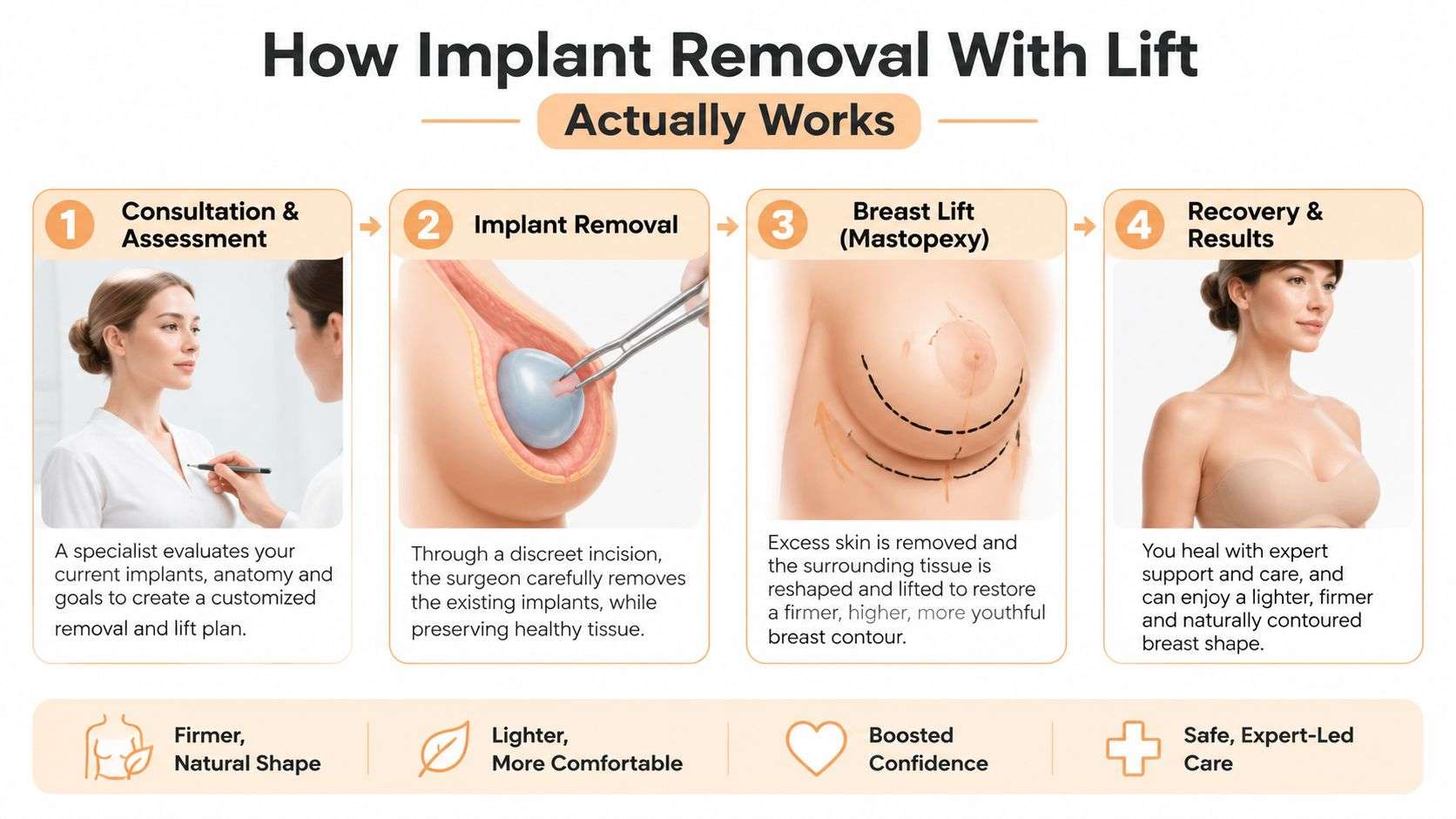
Think of the breast as a custom garment. The implant is the structured lining that supplies volume. The capsule is the fabric sleeve your body forms around that lining. The breast tissue and skin are the outer shell. When the lining comes out, the surgeon must decide whether the sleeve should also be removed and how the outer shell should be refitted.
Explant means removing the breast implant. Capsulectomy means removing some or all of the capsule. A partial capsulectomy removes only the portion that requires treatment. A total capsulectomy removes the entire capsule, sometimes in sections. An en bloc capsulectomy removes the implant and capsule together as one intact specimen when that approach is appropriate and technically safe. These terms describe different surgical goals, not interchangeable procedures.
The operative sequence
- The implant is removed. The surgeon accesses the device through an existing or planned incision and examines the implant pocket and capsule.
- The capsule is assessed. Its condition, thickness, adherence, and relationship to surrounding tissue help determine whether partial, total, or another form of capsulectomy is appropriate.
- The breast tissue is reshaped. A lift, also called a mastopexy, reduces excess skin and repositions the remaining tissue into a more supported breast mound.
- The nipple and areola are repositioned. The nipple generally remains attached to a segment of breast tissue called a pedicle, which carries blood supply and may help preserve sensation.
- The skin is redraped. The surgeon removes carefully planned excess skin rather than pulling the breast tight.
A mastopexy isn't just skin tightening. The goal is to place the breast mound higher on the chest wall, improve the relationship between the nipple and lower pole, and create a shape that has a reasonable chance of remaining stable as swelling resolves.
Same-stage surgery combines removal, capsule management when needed, reshaping, nipple repositioning, and skin closure during one anesthesia event. The exact operation varies with implant size, pocket location, tissue quality, prior scars, and whether the implant has ruptured. FDA-reviewed information notes that implant rupture risk increases as implants age, and the FDA states that ruptured implants should be removed whether the rupture is intracapsular or extracapsular. FDA-reviewed rupture information and clinical guidance summarized in the implant coverage policy provide the relevant background.
Explant Alone or Explant With Lift Compared
Removal alone can be a reasonable choice when the breast has enough natural volume and the skin can contract after the implant comes out. A patient with a smaller implant, high-riding nipples, limited sagging, and good elasticity may prefer to avoid the additional incisions of a lift.
A lift becomes more useful when the nipple has descended, the lower pole is stretched, or the implant has been large relative to the patient's native tissue. The operation adds scars and more tissue reshaping, but it can address the position and envelope that removal alone cannot correct.
Explant alone versus explant with lift at a glance
| Factor | Explant Alone | Explant With Lift |
|---|---|---|
| Typical anatomy | Good elasticity, adequate native volume, limited ptosis | Stretched skin, lower nipple position, thin coverage, or marked deflation |
| Main benefit | Removes implant without adding lift incisions | Removes implant while reshaping tissue and repositioning the nipple |
| Scarring | Usually limited to the access incision | Requires a lift pattern chosen according to the amount of reshaping needed |
| Projection | May become flatter after volume removal | Can improve projection through tissue reorientation |
| Risk profile | Avoids risks specific to mastopexy | Adds lift-related risks, including wound-healing concerns and possible sensory changes |
| Long-term concern | Residual skin and ptosis may remain | Shape may be improved, but aging, weight change, and tissue quality still affect durability |
| Best fit | Patients comfortable accepting a less lifted contour | Patients who want to address position and excess skin during explant |
The degree of ptosis matters. Patients with grade II or III ptosis, a nipple at or below the inframammary fold, or substantial lower-pole skin often need more than implant removal to create the desired silhouette. Conversely, a patient with a relatively compact breast envelope may decide that a natural, flatter result is preferable to additional scars.
When staging can be sensible
A staged plan separates explantation from the lift. That may help when the surgeon wants to observe how the breast redrapes, when tissue is extremely thin, or when extensive previous surgery creates concern about blood supply. Patients after major weight loss may also have an envelope that requires careful planning before committing to a single-stage shape.
The trade-off is practical. Staging means another operation, another recovery, and additional planning. The evidence base directly comparing immediate and delayed lift remains limited. A large modern series of combined implant removal and mastopexy reported 841 consecutive cases, with an overall complication rate of 4.76% and a revision rate of 4.63%. Patients with two or more prior mastopexies had a significantly higher revision risk, with an odds ratio of 7.72 and a 95% confidence interval of 2.65 to 22.50. The open-access clinical study supports careful selection, particularly in patients with repeated prior lifts.
Scar Patterns and Incision Choices for Explant With Lift
The existing augmentation incision often provides access to the implant. If it sits in the breast fold, it may be useful for implant removal and capsule work. If it surrounds the areola, it may also be incorporated into the lift. But an old access incision rarely supplies enough control to lift a breast with significant excess skin or a low nipple.
The incision pattern depends on how far the tissue must move and how much skin must be removed.
Three common lift patterns
- Circumareolar: The incision circles the areola. It may suit mild lifting, but it offers less control for substantial skin excess.
- Lollipop: The incision circles the areola and extends vertically toward the fold. It addresses more droop while avoiding a horizontal fold incision.
- Anchor, or Wise-pattern: The incision includes the areolar circle, vertical line, and horizontal line in the fold. It allows the most extensive skin removal and reshaping for significant ptosis.
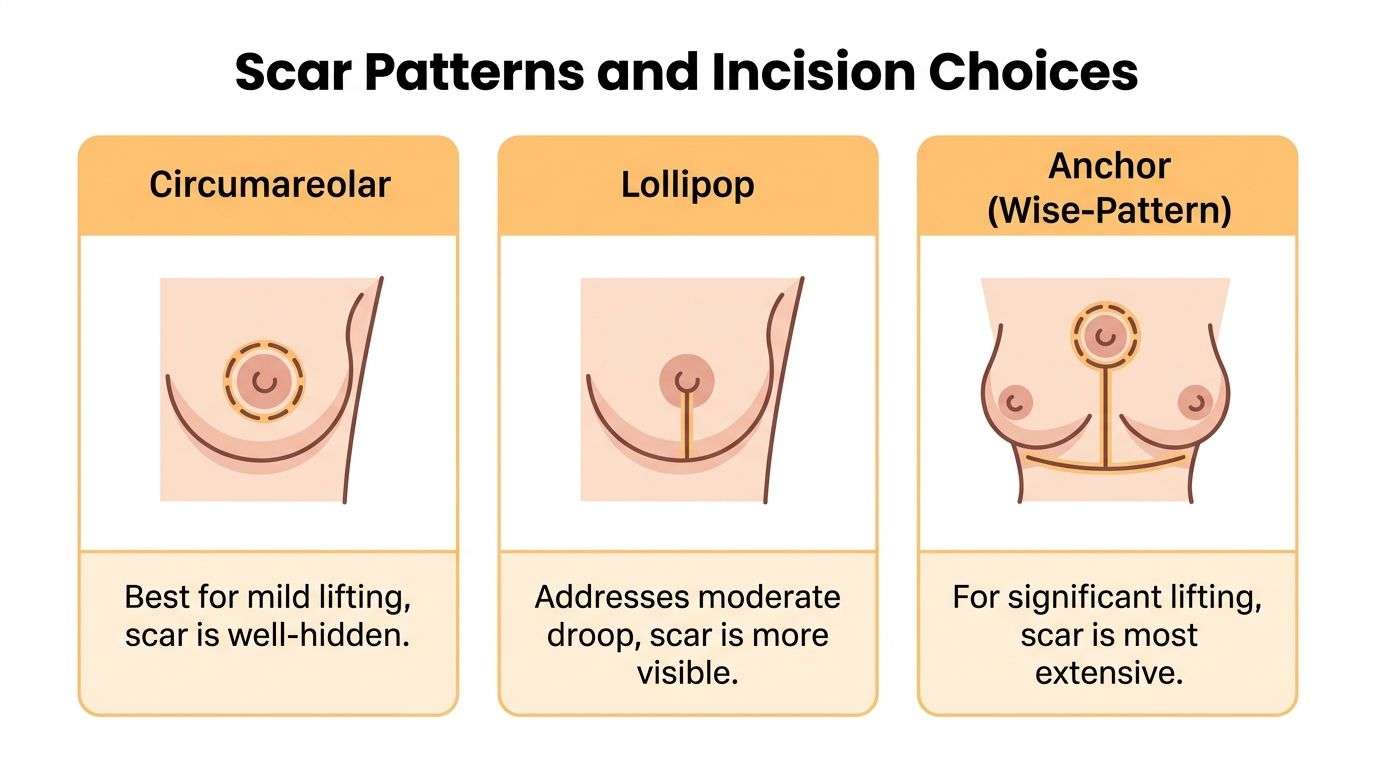
Before surgery, the surgeon examines the breasts while you're standing and maps landmarks such as the breast fold, breast meridian, nipple position, and planned new nipple level. Measurements help determine how much tissue must travel upward and whether a shorter pattern would leave excess skin or compromise contour.
Why a longer scar can sometimes create a better shape
A shorter scar isn't automatically a better operation. Circumareolar surgery may limit how much the breast can be lifted. An anchor pattern creates more scar, but it can provide greater control over the lower pole and breast envelope. The appropriate choice balances reshaping power, tissue safety, scar tolerance, and your desired contour.
Scar maturation is gradual. Redness generally fades, raised areas often flatten, and color may blend with surrounding skin as healing progresses. The scar can continue changing through 12 to 18 months, so early appearance shouldn't be treated as the final result. Your surgeon will also discuss incision care and individual factors that influence scar behavior.
Recovery Week by Week After Implant Removal With Lift
Recovery depends on the amount of tissue reshaping, capsule management, implant condition, and your general health. Your written instructions take priority over any general timeline, especially if drains, special dressings, or additional procedures are involved.
The first days
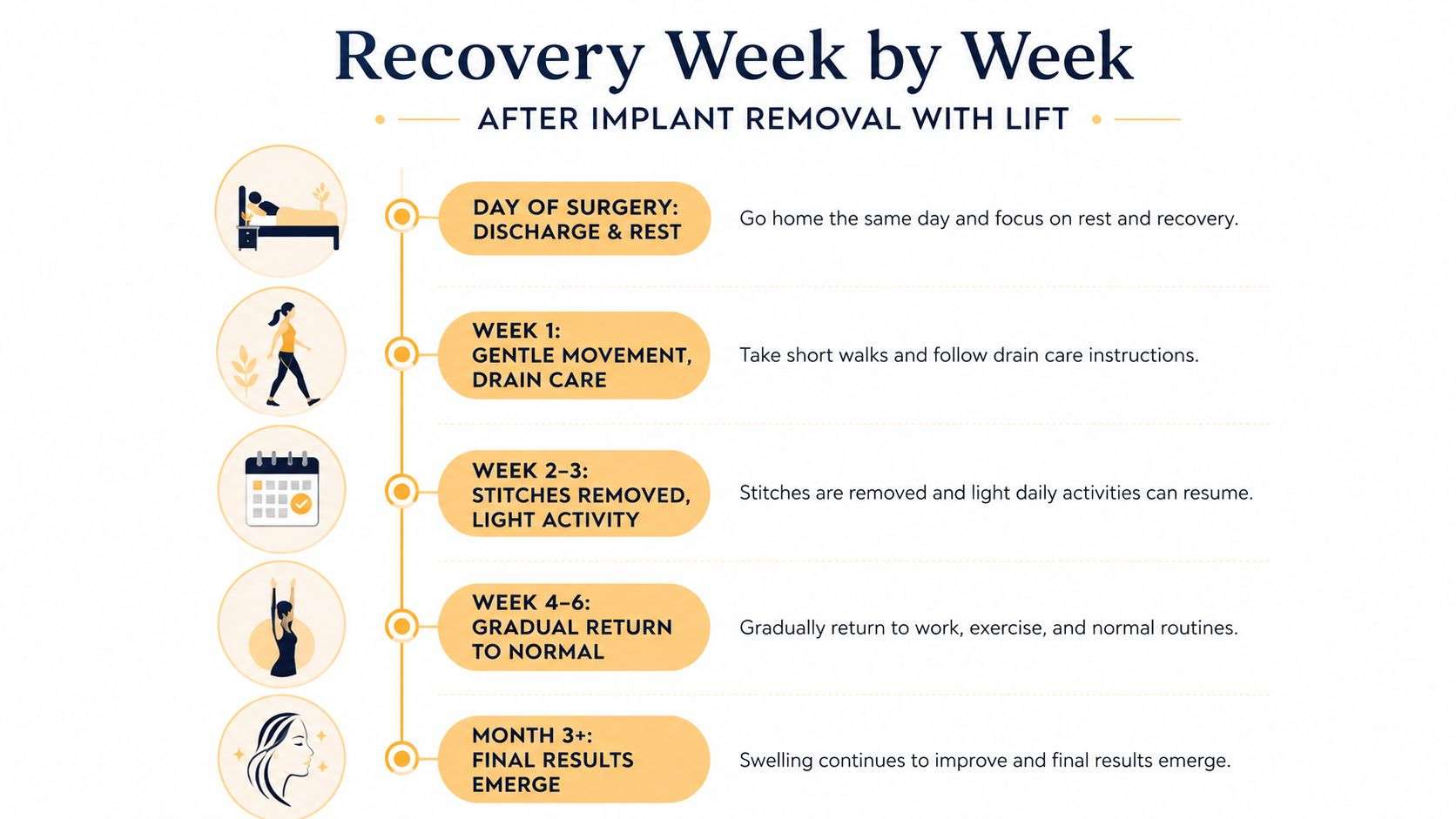
On the day of surgery, many patients receive instructions for medication, dressings, bathing, sleep position, and activity. If a drain is used, you'll be taught how to record output and keep the site clean. The first 72 hours usually focus on rest, short walks around the home, hydration, and keeping the upper body in a raised position to reduce swelling.
During the first week, avoid lifting, pushing, pulling, and strenuous arm movement. You may need help with household tasks. Suture or staple care varies, and removal timing depends on the closure and the surgeon's protocol. Driving and desk work should wait until you're alert, off sedating medication, able to control the vehicle safely, and comfortable enough to react without guarding the chest.
Weeks two through six
As discomfort and swelling improve, light daily movement usually increases. Lower-body exercise may return before upper-body work, followed by gentle upper-body activity when cleared. Chest isolation exercises should wait until the surgical team confirms that the tissues and incisions can tolerate them.
A typical progression looks like this:
- Week one: Gentle walking, wound observation, and drain care if applicable.
- Weeks two and three: Gradual daily activity, with incision checks and follow-up care.
- Weeks four through six: A cautious return toward normal activity, based on healing rather than the calendar.
- Months two through six: Continued settling of the breast shape and maturation of scars.
A University of Utah patient guide notes that adding a lift can add about one hour to surgery and may slightly increase risks such as reduced nipple or areola sensation, breastfeeding difficulty, and delayed wound healing. The patient guide to implant removal explains these trade-offs in accessible terms.
Red flags that need prompt attention
Contact your surgical team urgently for expanding breast swelling that may indicate a hematoma, fever with increasing or asymmetric swelling, sudden opening of an incision, or drainage that seems concerning. Calf pain or shortness of breath requires urgent medical evaluation, because these symptoms can signal a serious blood clot or lung complication.
Planning an Individualized Operative Strategy
A sound plan starts with measurements, not a procedure name. During consultation, the surgeon evaluates the current implant size and position, skin elasticity, native breast volume, nipple-to-fold distance, breast asymmetry, prior scars, and the condition of the capsule. Imaging may be considered when rupture or other implant concerns need clarification.
The goal is to translate those findings into a shape strategy. Some patients need only removal. Others need a lift to reduce excess skin and reposition the breast mound. Some may benefit from combining explantation and mastopexy, while others may be safer or more predictable with staged surgery.
Factors that guide the operation
| Factor | How It Shapes the Plan |
|---|---|
| Implant size and position | Larger or lower implants may leave more stretched skin and require stronger reshaping |
| Native tissue volume | Determines how much breast mound can be rebuilt from existing tissue |
| Skin quality | Influences how well the envelope redrapes and how durable the contour may be |
| Nipple-to-fold distance | Helps determine the lift required and the incision pattern |
| Capsule integrity | Guides whether capsule removal is partial, total, or another individualized approach |
| Prior operations | Affects scar placement, blood supply, sensation, and revision risk |
| Shape goals | Clarifies whether the priority is a smaller contour, projection, symmetry, or upper-pole fullness |
Pedicle selection is another important decision. A superomedial pedicle keeps the nipple attached to tissue from the upper and inner breast, while an inferior pedicle uses tissue from below. The choice depends on the existing blood supply, prior incisions, tissue distribution, and the amount of movement required. Preservation of vascularity and sensation is especially important in repeat surgery.
Fat grafting may complement the result when a patient wants additional soft-tissue volume without replacing the implant. It isn't appropriate for everyone, and it doesn't substitute for removing excess skin or correcting a significantly low nipple. The plan should remain focused on the anatomy that needs correction.
At OC Breast Surgery in Newport Beach, California, Dr. Mark Anton, the medical director and founder, focuses on breast surgery planning that may include Breast Implant Removal, Breast Implant Revision, and lift procedures. A consultation should feel like collaborative engineering, not a menu selection. You can review the considerations involved in breast lift after implant removal while preparing questions for an in-person assessment.
Realistic Expectations and Common Misconceptions
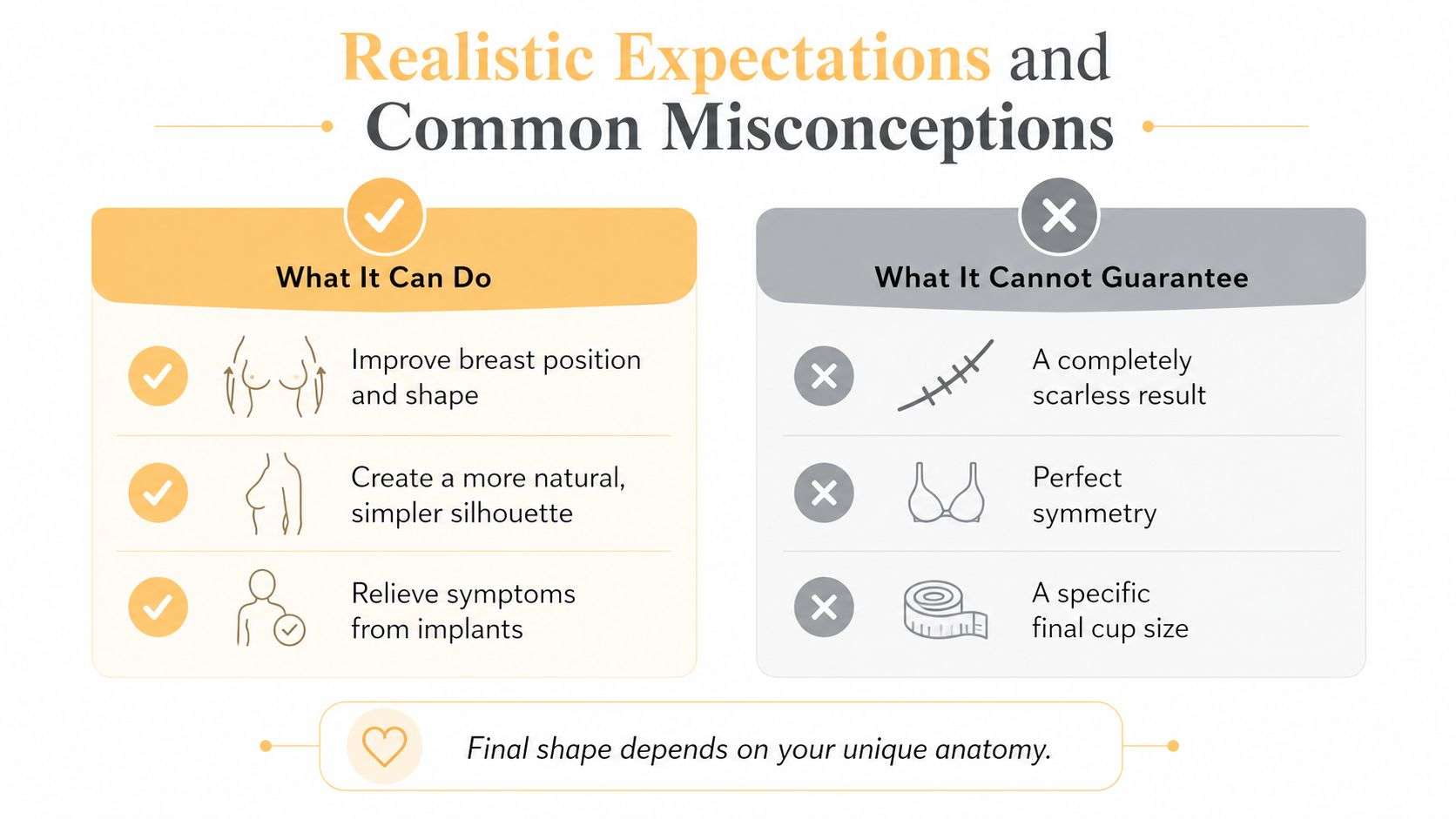
Implant removal with lift can improve breast position, reduce excess skin, and create a simpler, more natural-looking silhouette. It can't guarantee a scarless result, perfect symmetry, a specific cup size, or a permanent shape. The final contour reflects the tissue you bring to surgery, including skin elasticity, breast volume, implant size, prior scars, and nipple position.
Misconception one, scarless explant means no scars
“Scarless explant” often refers to removing an implant through an existing augmentation incision. That doesn't mean the breast has no visible scar. A lift generally requires additional incisions, even when the surgeon incorporates part of the original scar into the new design.
Misconception two, every patient heals on the same schedule
Recovery differs according to tissue quality, implant characteristics, capsule management, and the extent of reshaping. Swelling and bruising can make the breasts look higher or tighter at first. The shape then settles gradually, while scars continue to mature.
Misconception three, capsulectomy is always better
Capsulectomy may be important when the capsule is abnormal, contracted, ruptured, or clinically concerning. But removing capsule tissue can add operative complexity, bleeding risk, and recovery compared with implant removal alone. The appropriate extent depends on the findings and the reason for surgery.
Modern technique-focused data reinforce the importance of tissue preservation. An earlier series involving 86 consecutive patients reported no partial or total nipple-areola necrosis, supporting careful pedicle selection and maintenance of blood supply during simultaneous reshaping. The technique-focused study provides that surgical context. A separate clinical series reported that dual-pedicle mastopexy after implant removal retained about 65% of the removed implant volume on average, with generally none-to-mild postoperative pain in previously symptomatic patients and high satisfaction scores. The published clinical series illustrates how tissue reorientation may restore some projection, though it can't reproduce every implant's volume.
A staged approach can make the result easier to judge in uncertain anatomy, but it requires a second operation, additional cost, and another recovery. The most useful expectation is an individualized improvement, not an identical template result. Schedule a consultation with OC Breast Surgery in Newport Beach to discuss Breast Implant Removal with or without a lift, your anatomy, and your long-term shape goals. Dr. Mark Anton and the OC Breast Surgery team can help you compare the surgical paths and prepare a plan based on your medical history and priorities.