
Fat Transfer Recovery: The Ultimate 6-Month Guide
Understanding Fat Transfer and the Path to Healing
Fat transfer recovery is a managed healing process spanning 2-6 months. Most patients return to work in 1-2 weeks, with final results appearing by the sixth month.
Key Fat Transfer Recovery Timeline:
- First 48-72 hours: Rest, pain management, and initial healing
- Week 1-2: Swelling peaks then reduces; return to light activities
- Week 3-6: Significant improvement; resume moderate exercise
- Month 2-6: Final results emerge as fat grafts develop a new blood supply
- Fat survival rate: 60-80% of transferred fat typically survives long-term
Fat transfer, or fat grafting, is a natural improvement procedure using your own body fat. It involves three steps: harvesting fat via gentle liposuction from areas like the abdomen or thighs, purifying the fat, and injecting it into the treatment area.
This dual-benefit procedure improves the recipient area while contouring the donor site. The recovery process is crucial for establishing blood supply to the new fat cells, and proper post-operative care is key to your final results.
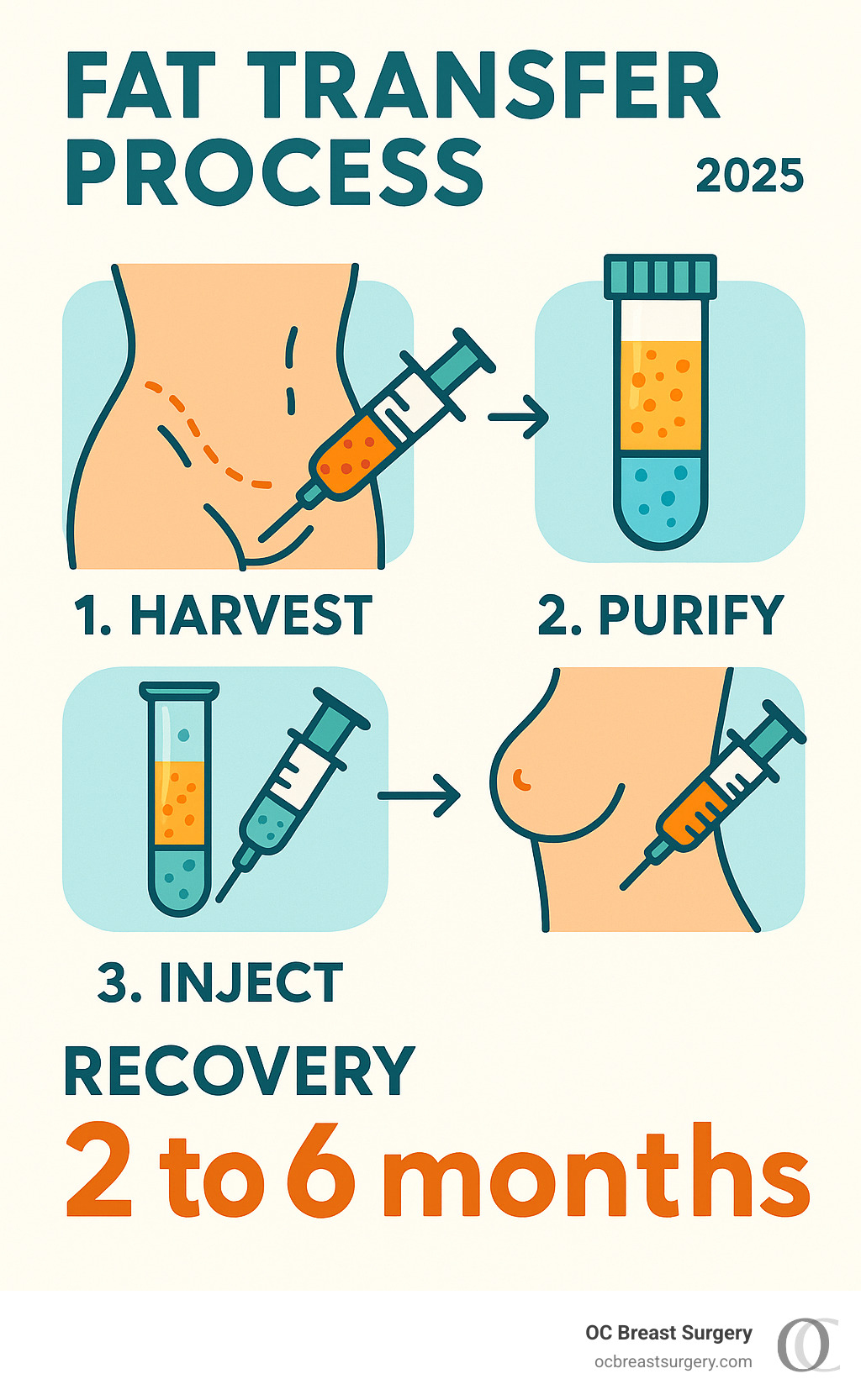
Recovery varies based on the treatment area. Facial fat transfer may take 4-6 weeks, while breast or body contouring can need up to six months for complete healing.
I’m Dr. Mark Anton. With over 33 years of surgical experience, I have guided countless patients through their fat transfer recovery journey. My background in breast and reconstructive surgery provides deep insight into optimizing recovery for the best possible outcomes.
Your Week-by-Week Fat Transfer Recovery Timeline
Think of your fat transfer recovery as a journey with distinct chapters. Understanding what happens during each phase helps you feel prepared as your body heals. Everyone’s timeline is unique; these are guideposts, not rigid rules.

The First 48-72 Hours: Rest and Initial Healing
During these first few days, your body begins the healing process. Feeling tired and sore is normal as your body focuses its energy on recovery.
Pain management is a top priority. We provide prescribed medications for your comfort; take them with food to avoid stomach upset. Some patients may also receive a nerve medication like Gabapentin for about a week.
Rest is best right now. Plan to relax, getting up only with assistance for the restroom. Your body is working to help the newly transferred fat cells settle.
If you’ve had facial fat transfer, keeping your head liftd while resting helps reduce swelling. For other areas, sleeping with an extra pillow can increase comfort.
Caring for your donor and recipient sites means keeping them clean and dry for the first 48 hours. Avoid touching or massaging the treated areas, as the delicate fat grafts are establishing their new blood supply. Limited mobility is key, but short 2-5 minute walks around your home every couple of hours help prevent blood clots.
Week 1-2: Turning a Corner
You’ll start feeling more like yourself as the initial swelling and bruising begin to fade, marking real progress in your fat transfer recovery.
Your first follow-up appointment is around 7-10 days post-surgery. We’ll check your healing, remove any stitches, and answer your questions.
Swelling and bruising reduction becomes noticeable. Many patients feel comfortable in public by days 11-14, sometimes using makeup to cover any remaining discoloration.
Most people can return to work after about two weeks. If you have a desk job and can work from home, you might feel ready sooner. Listen to your body and rest when tired.
Light activities, like gentle walks, become possible and help with circulation. You can do most daily tasks that don’t cause discomfort, but avoid anything strenuous.
For those considering breast improvement, you can learn more about fat transfer breast augmentation scars to understand the complete healing picture.
Week 3-6: Resuming Normalcy
In this phase, you’ll feel a return to normalcy. Major discomfort subsides, and you can resume more activities as significant swelling goes down, revealing your emerging results.
While some subtle puffiness may linger, the most dramatic swelling is gone. You’ll start seeing glimpses of your final look.
Resuming moderate exercise typically happens around three weeks post-op. This includes brisk walking, swimming, or light yoga. Wait at least 4-6 weeks for intense workouts.
Compression garments remain important. Whether it’s for liposuction or a supportive sports bra for breast procedures, wearing these 24/7 for the first month helps manage swelling and supports healing.
Fat graft stabilization occurs during these weeks. The transferred cells are still establishing their blood supply, so continue avoiding pressure on treated areas for the best final results.
Month 2-6: Seeing the Final Contour
Your patience is rewarded as your final results emerge over these months.
The remaining swelling gradually disappears, and the fat cells that successfully developed a new blood supply integrate completely. You will see your true, long-term results around six months post-procedure.
Understanding the fat survival rate helps set realistic expectations. About 60-80% of transferred fat typically survives. We account for this by calculating the right amount to transfer during your procedure.
The new blood supply is crucial for permanent results, a process that takes about six months. Once established, your results are considered permanent, and the fat behaves like other fat cells in your body.
Your long-term shape stabilizes during this period. The fat will respond to significant weight changes, so maintaining a stable weight helps preserve your results.
Final results typically take about six months to fully develop, and you can explore what to expect by reading about breast fat transfer 1 year later.
Essential Post-Operative Care: The Dos and Don’ts for Optimal Results
Your fat transfer recovery requires careful nurturing. Post-operative care after you leave our Newport Beach, CA office is as crucial as the surgery itself, giving you significant control over your final results.

We provide detailed, personalized instructions for your recovery. Your body is primed to heal; our goal is to create the right environment for its success.
Key “Dos” for a Smooth Recovery
These actions help ensure exceptional results. Your newly transferred fat cells need the right conditions to thrive permanently.
Wear your compression garments religiously. They may feel snug, but they are essential. For breast fat transfer, a supportive sports bra is worn day and night for about a month, then during the day for up to three months. Body contouring requires compression for up to six weeks. These garments reduce swelling and help your new contours settle.
Stay hydrated. Aim for 64-100 ounces of water daily. Proper hydration reduces swelling, supports blood flow to the new fat grafts, and aids the healing process.
Eat healing foods. Focus on protein-rich options to help your body rebuild. Women should aim for 1.2g of protein per kg of body weight, and men 1.5g per kg. Good sources include lean meats, fish, eggs, and beans. Pair them with fruits and vegetables for essential vitamins. For specific guidance, see our guide on what to eat after fat transfer to breast.
Keep moving, but gently. Short walks of 2-5 minutes every couple of hours maintain healthy circulation without stressing healing tissues.
Sleep smart by following position recommendations. After buttock fat transfer, sleep on your side or stomach. Facial fat transfer patients should sleep liftd at a 45-degree angle on their back. These positions protect your investment by avoiding pressure.
Critical “Don’ts” to Protect Your Results
Following these rules is essential for protecting your results and ensuring your fat transfer recovery stays on track.
Avoid direct pressure on treated areas. This is the golden rule. Sustained pressure can cut off blood supply and compromise fat cell survival. For breast patients, this means no sleeping on your stomach initially. For buttock procedures, sitting is carefully managed for several weeks.
Absolutely no smoking. Smoking restricts blood flow and oxygen, dramatically decreasing fat cell survival. We require patients to quit at least three weeks before surgery and abstain throughout recovery to protect your results.
Skip the alcohol for at least the first week, especially while taking pain medication. Alcohol interferes with healing, increases swelling, and can have dangerous interactions with medications.
Pause high-intensity exercise. Strenuous exercise, heavy lifting, or high-impact activities must wait at least 3-6 weeks. Your body needs its energy to heal.
Stay out of hot tubs, baths, and pools until incisions are fully healed (typically 4-6 weeks) to prevent infection. Stick to gentle showers.
Watch your salt intake. Excessive sodium contributes to fluid retention and prolonged swelling. Limiting salt will help swelling resolve faster.
Recovery Variations: Face vs. Breast vs. Body Contouring
Fat transfer recovery varies significantly by treatment area. Understanding these differences helps you prepare for your unique healing journey, whether it’s for the face, breasts, or body.
| Key Metric | Facial Fat Transfer | Breast Fat Transfer | Body Contouring (e.g., Buttocks, Hips) |
|---|---|---|---|
| Pain Level | Mild to moderate | Moderate | Moderate to significant |
| Swelling Duration | 4-6 weeks (initial) | 6-8 weeks (initial) | 4-6 weeks (initial) |
| Compression Garment Use | Less common; light support band/tape | Surgical bra (up to 8 weeks) | 24/7 for 6 weeks+ (often longer) |
| Activity Restrictions | Quicker return to social activities | Avoid heavy lifting for 4-6 weeks | Most restrictive (e.g., no sitting) |
| Time to Final Results | 6 months | 6 months | 6 months |
Facial procedures often have the quickest recovery. Breast procedures are moderately intensive. Body contouring involves the most intense recovery but yields dramatic results.
Essential Tips for Your Facial Fat Transfer Recovery
Facial fat transfer is often the gentlest option due to smaller volume requirements and less extensive liposuction. Your face heals well, but proper care is essential for confidence.
The key to facial fat transfer recovery is head elevation. Keep your head raised about 45 degrees while sleeping to reduce swelling and help your new contours emerge.
Cold compresses are helpful during the first week. Apply for 20 minutes at a time to ease discomfort, but be gentle and do not press on the area.
An advantage of facial procedures is the quicker return to social activities. Many patients feel comfortable going out within 1-2 weeks. The minimal pressure requirement is easier to manage—simply sleep on your back and avoid resting your face on your hands.
Navigating Your Breast Fat Transfer Recovery
Breast fat transfer recovery focuses on supporting the newly grafted fat as your body integrates it.
Your surgical bra is a recovery partner. You will be fitted with a specialized bra to wear for up to eight weeks. It helps reduce swelling and guides your new shape.
Avoiding pressure on your breasts requires sleeping on your back initially. Underwire bras must be avoided until you are cleared, as they can create uneven pressure that interferes with healing.
The moderate swelling in your breasts and donor sites subsides over 6-8 weeks. Avoiding heavy lifting or strenuous arm movements for at least 4-6 weeks protects the healing tissue.
For detailed guidance, our guide on whether you should wear a bra after fat transfer provides valuable insights.
What to Expect with Body Contouring Recovery (Hips/Other Areas)
Body contouring, such as buttock augmentation, involves the most comprehensive fat transfer recovery. These procedures use extensive liposuction and larger fat volumes, leading to a more involved but rewarding healing process.
Special pillows and supports are essential. For buttock procedures, you must avoid sitting directly on your behind for at least three weeks. You will learn to sit on your thighs or use specialized pillows, and sleeping on your stomach or sides becomes the norm.
The extensive liposuction means you are healing from fat removal and transfer simultaneously. This dual process contributes to the intensity of early recovery but also delivers dramatic results.
Compression garment use is critical for body contouring. These garments are worn 24/7 for at least six weeks to manage swelling and encourage proper skin retraction.
This is the most involved recovery, requiring patience and lifestyle adjustments, but the stunning, natural-looking results are a worthwhile investment.
Long-Term Results, Risks, and When to Call Your Surgeon
Beyond the initial fat transfer recovery, the focus shifts to maintaining your results. Understanding the long-term outlook and knowing when to call your surgeon is key to a smooth journey.

Maintaining Your Results for Years to Come
A key benefit of fat transfer is its permanence. Once the new blood supply is established around the six-month mark, the transferred fat cells are a living part of your body.
Maintaining a stable weight is the golden rule for preserving your results. The transferred fat cells will expand or shrink with significant weight changes. Staying within 10-15 pounds of your surgery weight keeps results looking their best.
A healthy lifestyle supports long-term success. Regular exercise and a balanced diet keep your fat grafts thriving.
Sometimes, multiple sessions are needed to achieve ideal results, especially for larger volume improvements. Subsequent procedures can build upon the first, often with improved fat survival rates.
For insights into longevity, explore our guide on how long fat transfer lasts.
Understanding Potential Risks and Complications
No surgical procedure is 100% risk-free. However, fat transfer complications are rare, with some studies showing a complication rate as low as 2% for facial procedures, making it a very safe option.
Common concerns include minor asymmetries (which may require touch-ups), temporary firmness (fat necrosis), and minimal scarring. Occasionally, patients experience seromas (fluid collections) that typically resolve with simple drainage.
Infection is possible with any surgery, but our meticulous technique and aftercare instructions keep this risk extremely low. Incisions are placed in inconspicuous areas to make any minimal scarring barely noticeable.
A 60-80% fat survival rate is excellent, but sometimes the body absorbs more fat than expected. This is not a complication, but a biological variable. A touch-up procedure can restore the desired volume if this occurs.
While rare, complications can occur, and our experienced team knows how to handle them if they arise.
Warning Signs: When to Seek Medical Attention
Your safety is our top priority. While serious complications are rare, knowing the warning signs provides peace of mind during your fat transfer recovery.
Call us immediately for:
- A fever over 100.4°F
- Excessive pain not managed by medication
- Sudden, sharp pain
- Increasing redness, warmth, or unusual discharge from incisions
- Asymmetrical or rapidly increasing swelling
- Incisions that appear to be opening
- Signs of an allergic reaction (hives, rash, difficulty breathing)
Shortness of breath or chest pain are emergency symptoms requiring immediate medical care.
We would rather you call with a concern that turns out to be normal than miss something important. Your peace of mind is worth the call.
Conclusion: Embracing Your New Contours with Confidence
Your fat transfer recovery is a rewarding journey. Each phase, from the initial days of rest to seeing your final results months later, brings you closer to the natural look you desire.
Recovery is an investment in yourself. Your patience, dedication to wearing compression garments, and commitment to a healthy diet will lead to results that last for years.
The beauty of fat transfer lies in its permanence. Once the transferred fat cells establish their new blood supply around the six-month mark, they are part of you for life, responding to your body’s natural changes.
At OC Breast Surgery in Newport Beach, CA, we understand recovery is both a physical and emotional journey. We have supported thousands of patients through the ups and downs, from initial swelling to the final boost in confidence.
Dr. Mark Anton and our team are your partners throughout the entire process. We provide comprehensive guidance, answer all your questions, and celebrate your milestones with you.
Your body is doing something remarkable during recovery. It’s creating new blood vessels and integrating tissue. Be patient with the process, trust your body’s healing abilities, and reach out to us with any concerns.
Ready to take the next step toward achieving your ideal look with natural, lasting results? Learn more about our boob job fat transfer procedures and find how we can help you accept your most confident self.
Your journey to beautiful, natural-looking results starts with a consultation, but the confidence you’ll gain lasts a lifetime.